




Details
Description
A quartet of Chinese porcelain Bai Zi Tu plaques, with finely painted, polychrome garden scenes on the theme of "One …
Read more
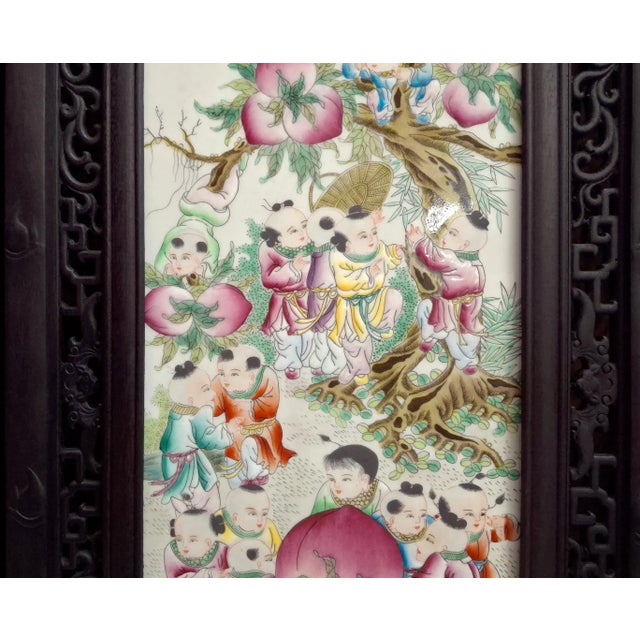
A quartet of Chinese porcelain Bai Zi Tu plaques, with finely painted, polychrome garden scenes on the theme of "One Hundred Kids" mounted in finely carved, reticulated hongmu frames. Each plaque is signed, "Made by Wang Qi at Zhushan, Year of Ding-Mao", with an inscription in caoshu script and three red seal marks. The reticulated frames have a finely carved cartouche of a Fu Bat over a lucky coin and peaches amid stylized vines at their top and bottom and a smaller reticulated frame with another four Fu Bats centered on the top and sides amid stylized vines. The finely painted and detailed, garden scenes have seventeen to eighteen Chinese boys playing with Buddha's hand citrons, peaches, and pomegranates (San Duo), the two outside plaques featuring walled gardens while the two in the center feature the garden, proper. The wood bars comprising the exterior of the frames are slightly rounded on top and are decorated with lightly carved peppers. The backs of the frames are removable in the typical Chinese fashion using removable wood tongues. Circa Republic of China era, no later than mid century.
each plaque: 47" high x 14.5" wide x 1" deep
site size: 28.5" high x 8" wide.
Wang Qi: After the fall of the Qing dynasty, imperial orders for porcelain dwindled at Jingdezhen, the main porcelain production center of China. Porcelain artists, released from Imperial restraints, and eager to develop new markets, developed new styles. In 1928 eight of the leading artists formed a group, calling it Yueman hui (Full Moon Society) because they met to exchange ideas about art during the full moon. Wang Qi, (1884-1937), was the founding member of this group, which because it had eight members later came to be known as Zhushan Bayou (Eight Friends of Zhushan)
five Fu bats: The five Fu Bats carved into the reticulated frames symbolize "The Wu Fu Lin Men", The Five Blessings. Referring the episode of Hong Fan in the Book of Documents, the meaning of five blessings are "health" (康寧)), "wealth" (富)), "long life" (壽)), "love of virtue" (yu hao te (攸好德)) and "peaceful death" (考終命)).
Hundred Kids: The Chinese "hundred kids" symbol, known as Bai Zi Tu (百子图), is a powerful and popular motif that represents wishes for prosperity, a happy and abundant family, and a long lineage of successful sons. It is frequently depicted as a joyful scene of children playing together in a garden.
Key meanings of the hundred kids symbol include:
Abundant progeny and a happy family: The symbol is a strong blessing for fertility and for having a large, healthy family with many children and grandchildren. The number 100 is not meant to be literal but signifies "many" or "complete".
Success and auspiciousness: The scenes often show children engaged in scholarly, military, or creative activities like playing instruments, painting, or archery. These depictions represent the hope that the offspring will grow up to be successful, pass the imperial exams, and achieve high social standing.
Longevity and stability: In addition to children, the artwork often includes other symbols of longevity, such as pine trees and cranes, reinforcing the wish for a long and stable family line.
A historical reference: The motif is sometimes linked to a legend about King Wen of the Zhou dynasty, who was said to have 99 sons and adopted a hundredth. This legend reinforced the importance of carrying on the family name and line.
San Duo: The Chinese symbol of the "Three Fruits," or San Duo (Three Abundances/Plenties), represents the wish for good fortune, longevity, and many children. The combination typically consists of the Buddha's hand citron (for blessings/happiness), the peach (for longevity), and the pomegranate (for many children/fertility). This auspicious motif is a traditional theme in Chinese art and culture, utilizing puns and symbolic meanings of the fruits to convey these wishes for a fulfilling life.
See less
- Dimensions
- 14.5ʺW × 1ʺD × 47ʺH
- Period
- 1910s
- Country of Origin
- China
- Item Type
- Vintage, Antique or Pre-owned
- Materials
- Bronze
- Porcelain
- Wood
- Condition
- Good Condition, Original Condition Unaltered, Some Imperfections
- Color
- Coffee
- Condition Notes
- Signs of wear and use commensurate with age: a few small, dents and scratches are seen on the frames which … moreSigns of wear and use commensurate with age: a few small, dents and scratches are seen on the frames which are refinished with cleaning and restoring oils, the plaques are in excellent vintage condition. less
Questions about the item?
Returns & Cancellations
Return Policy - All sales are final 48 hours after delivery, unless otherwise specified in the description of the product.
Cancellation Policy - Prior to shipping or local pickup, buyers may cancel an order for up to 48 hours, unless otherwise specified.
Related Collections
- Helmut Friedrich Schäffenacker Sculptural Wall Objects
- Antique Copper Finish Sculptural Wall Objects
- Medium-Density Fibreboard Sculptural Wall Objects
- Dada Sculptural Wall Objects
- Maison Jansen Sculptural Wall Objects
- Ralph Lauren Sculptural Wall Objects
- Asian Sculptural Wall Objects
- Greg Copeland Sculptural Wall Objects
- Mid-Century Modern Sculptural Wall Objects
- Curtis Jere Sculptural Wall Objects
- Plaster Sculptural Wall Objects
- Brutalist Sculptural Wall Objects
- Japanese Sculptural Wall Objects
- Sarreid Ltd. Sculptural Wall Objects
- Wenge Sculptural Wall Objects
- Arteriors Home Sculptural Wall Objects
- Silverplate Sculptural Wall Objects
- Stainless Steel Sculptural Wall Objects
- Platinum Sculptural Wall Objects
- The American School Sculptural Wall Objects