



Details
Description
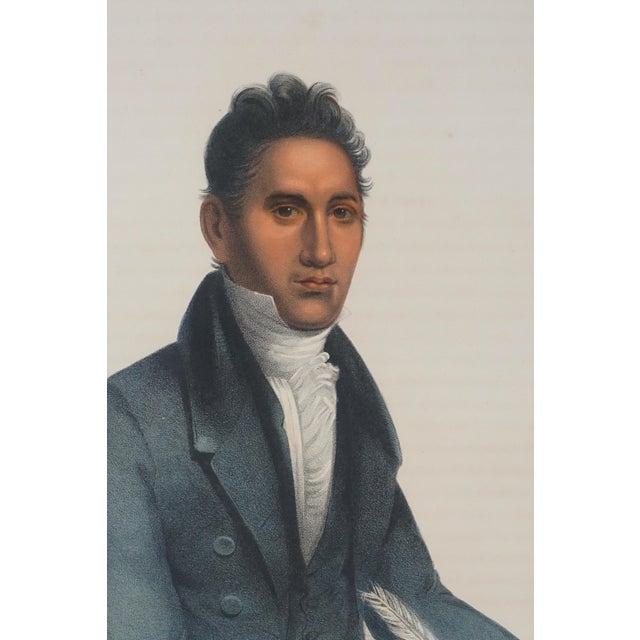
1838 John Ridge A Cherokee Indian and Interpreter Lithograph with Applied Watercolor
The lithograph depicts John Ridge, a Cherokee interpreter, …
Read more
1838 John Ridge A Cherokee Indian and Interpreter Lithograph with Applied Watercolor
The lithograph depicts John Ridge, a Cherokee interpreter, by Charles Bird King (American, 1785 - 1862), published 1838. Compared to other indian portraits in tribal regalia, King's rendering of John Ridge appears to be different. King portrayed John Ridge in Anglo-American clothing, sitting at a desk with a document and pen in hand—hinting at Ridge’s education and career as tribal leader and politician. King was known for his realistic and sensitive renderings of his sitters, and his ability to capture their physical features and attire with dignity and attention to detail.
Condition: Good; tonal aging due to age; previous mat tonal aging marks
Presented in new conservation mat
Paper size: 19.75"H X 14"W
Image size: 15"H x 10"W
Mat size:24"H x 16"W
John Ridge received his education at Foreign Mission School in Cornwall, Connecticut and served as clerk of the Cherokee National Council. When King painted his portrait in Washington, Ridge was an advisor to a Creek delegation who hoped to nullify an unlawful removal treaty signed by a few tribal members. Ironically, he would find himself in a position similar to that of these Creek treaty signers only a few years later. Originally opposed to the relocation of his own tribe, Ridge revised his opinion when he concluded that resettlement was unavoidable due to the discovery of gold in Georgia in 1829 and President Jackson’s Indian removal policy. He convinced a few other Cherokee members to sign the Treaty of New Echota in 1835 because he believed this was the only way to preserve and protect the rights of the Cherokee Nation. However, they signed the document without the knowledge and endorsement of Principal Chief John Ross and the National Party, who represented the majority of the tribe and opposed the removal. Although Ross petitioned Congress to void the treaty as invalid, it was ratified in 183
Thomas McKenney, United States Superintendent of Indian Trade, conceived the idea for a series of portraits of prominent Native Americans who visited Washington D.C. in the early 19th century. An established portraitist by the early 1820s, King was commissioned by McKenney to execute the series, resulting in rich character studies of his sitters. Members of the Indian delegation of 1825, such as this sitter, often received copies of their portraits.
Published by F. W. Greenough, Philad
"Drawn, Printed and Coloured at the I.T. Bowen's Lithographic & Print Colouring Establish. 94 Walnut St."
"Entered according to act of Congress in the Year 1838 by F. W. Greenough, in the Clerks Office of the District Court of the Eastern District of Penn."
Born in Newport, Rhode Island, Charles Bird King became famous for his portraits of distinguished Native Americans. He studied with Samuel King, colonial painter, and then at age 15, ran away to New York City where he worked in the studio of Edward Savage. From 1805 to 1812, he lived in London, studying with Benjamin West and sharing a studio with Thomas Sully.
In 1816, he settled in Washington D.C., becoming the city's first significant resident artist. He did portraits of politicians and then spent 16 years on a commission to paint members of a five-tribe Indian delegation, which came to the city in 1821. The results became the basis of the National Indian Portrait Gallery. The originals burned, but lithography copies remain.
Thomas McKenney was the Superintendent of Indian Affairs under three Presidents -- Madison, Monroe & Adams and was instrumental in having lithographs published of King's work. McKenney's persistence was a blessing to the following generations because it happened that most of the original Charles Bird King paintings were destroyed in a fire at the then new Smithsonian Institution in 1865. So the only record we have today of most of these early Indians are in fact the lithographs made by McKenney. They stand as some of the finest and most important prints ever made in America.
A visitor to his office in the War Department near the White House would have seen a carefully collected ‘museum’ of Indian artifacts. There were buffalo hides, ceremonial pipes, clothing and even a full size canoe over the doorway. Importantly, there were also portrait paintings of many of the tribal Chiefs and Sub-Chiefs that had come to Washington to meet the Great White Father, accept gifts and peace medals and sign peace treaties. Most of these portraits were done by the well known artist Charles Bird King.
The ritual of inviting the Indian Chiefs to Washington was one of the original stated missions of the Lewis & Clark Expedition brilliantly initiated by Thomas Jefferson. The underlying strategy presented to a hesitant Congress by Jefferson was to not only explore the vast continent West of the Mississippi for future settlement but more immediately to control the rivers and fur trade that had been previously dominated by French and English interests.
However, McKenney’s ideas of treating the Indians fairly and with respect were ideologically not in line with the policies of the Andrew Jackson administration and therefore he was forced to resign his post in 1830. By this time, however, he had already had the idea of making a series of lithographs after the collection of Indian portraits. It was a project that took him the next fourteen years to complete -- through years of near bankruptcy, numerous printers and emotional distress.
His persistence was a blessing to the following generations because it happened that most of the original Charles Bird King paintings were destroyed in a fire at the then new Smithsonian Institution in 1865. So the only record we have today of these early Indians are in fact the lithographs made by McKenney. They stand as some of the finest and most important prints ever made in America.
See less
- Dimensions
- 16ʺW × 0.2ʺD × 24ʺH
- Styles
- The Hudson River School
- Art Subjects
- Portrait
- Frame Type
- Unframed
- Period
- Mid 19th Century
- Country of Origin
- United States
- Item Type
- Vintage, Antique or Pre-owned
- Materials
- Watercolor
- Condition
- Good Condition, Original Condition Unaltered, Some Imperfections
- Color
- Blue
- Condition Notes
- Good; tonal aging to paper; previous mat tonal aging marks Good; tonal aging to paper; previous mat tonal aging marks less
Questions about the item?
Returns & Cancellations
Return Policy - All sales are final 48 hours after delivery, unless otherwise specified in the description of the product.
Cancellation Policy - Prior to shipping or local pickup, buyers may cancel an order for up to 48 hours, unless otherwise specified.
Related Collections
- Ralph Lauren Paintings
- Photorealism Canvas Paintings
- Ed Ruscha Paintings
- Photorealism Paintings in New York
- Joseph Solman Paintings
- Karen Offutt Paintings
- Laddie John Dill Paintings
- Richard Serra Paintings
- FM Mobler Paintings
- Lowell Nesbitt Paintings
- Mark Lewis Art Paintings
- Mark Lewis Paintings
- Jo Baskerville Paintings
- Louis Wolchonok Paintings
- Jean Calogero Paintings
- Francine Tint Paintings
- Jeff Slemmons Paintings
- Vienna Secession Paintings
- René Magritte Paintings
- BandB Italia Paintings
- Photorealism Paintings in Los Angeles
- BDDW Paintings
- Keith Haring Paintings
- Black Photorealism Paintings
- Lee Reynolds Paintings