





Details
Description
WWII, how are you? Private Theater: Gay American Soldier in Reflection, Original WWII-Era Gouache, Signed CSG
A highly nuanced, emotionally …
Read more
WWII, how are you? Private Theater: Gay American Soldier in Reflection, Original WWII-Era Gouache, Signed CSG
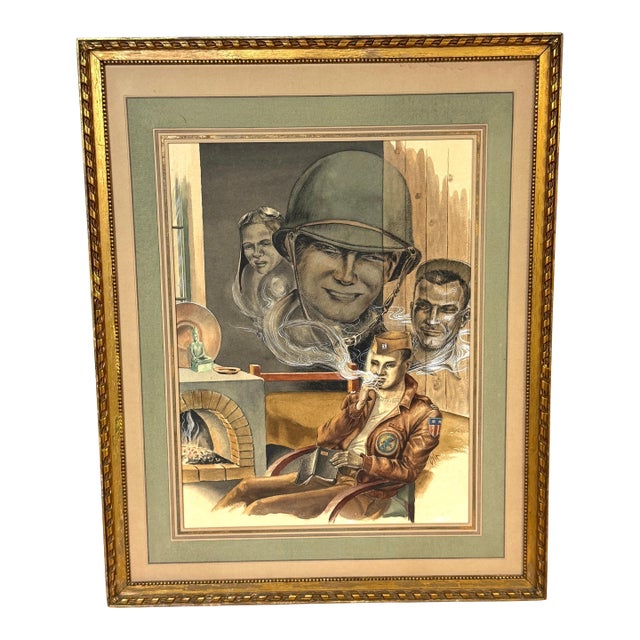
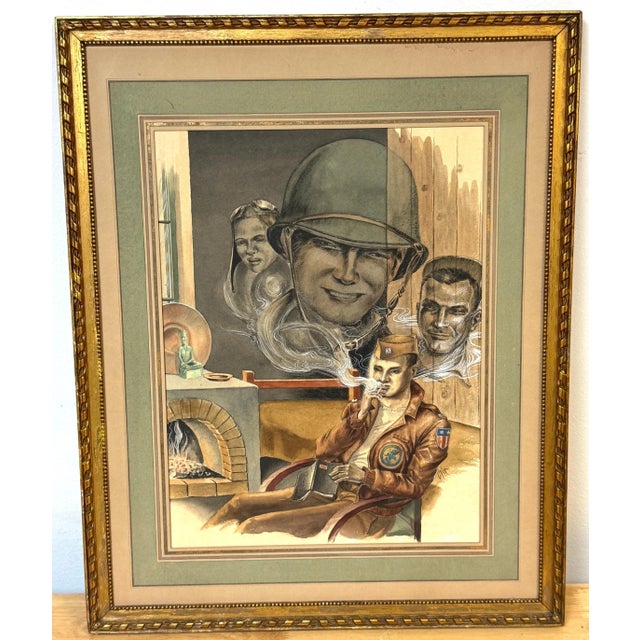
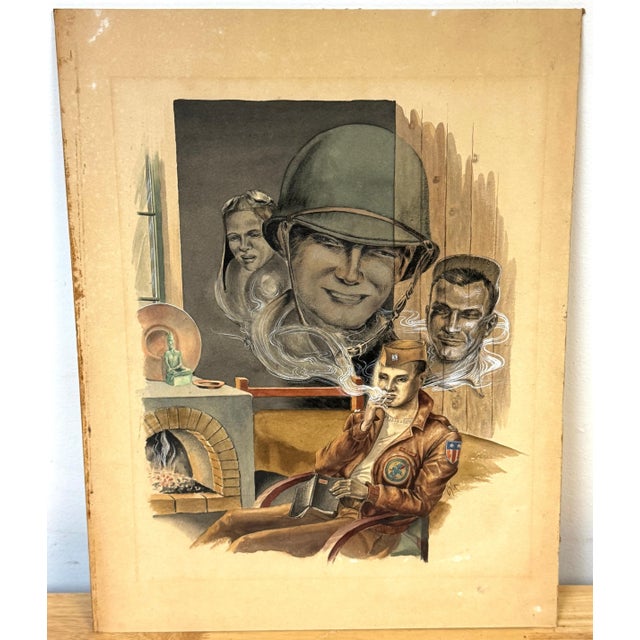
A highly nuanced, emotionally layered, and visually accomplished original painting in gouache and watercolor on Whatman drawing board, signed CSG lower right. This rare mid-20th-century work portrays a seated U.S. Army Air Forces officer—smiling faintly, cigarette in hand, and with a small black-bound diary resting on his lap—lost in reverie as smoke from his cigarette rises and transforms into the visages of three idealized male figures. Rendered in an illustrative realist style with tonal sensitivity and surreal suggestion, the composition invites interpretation as an interior portrait of desire, intimacy, and memory—quietly coded, emotionally sincere, and possibly autobiographical.
The figure wears a regulation-issue A-2 leather flight jacket, iconic of U.S. Army Air Forces personnel during WWII. The jacket is detailed with a personalized, hand-painted circular patch depicting a lion rampant in a blue roundel—a heraldic symbol of power, pride, and possibly self-invention. An American flag patch is affixed to the left shoulder. The jacket, traditionally worn by bomber crews, officers, and pilots, functions here not only as a marker of military identity but as a gendered and cultural signifier—suggesting the complex intersection of duty, masculinity, and private identity. The slightly open collar, relaxed posture, and cigarette suggest the officer is off-duty—physically grounded but mentally elsewhere.
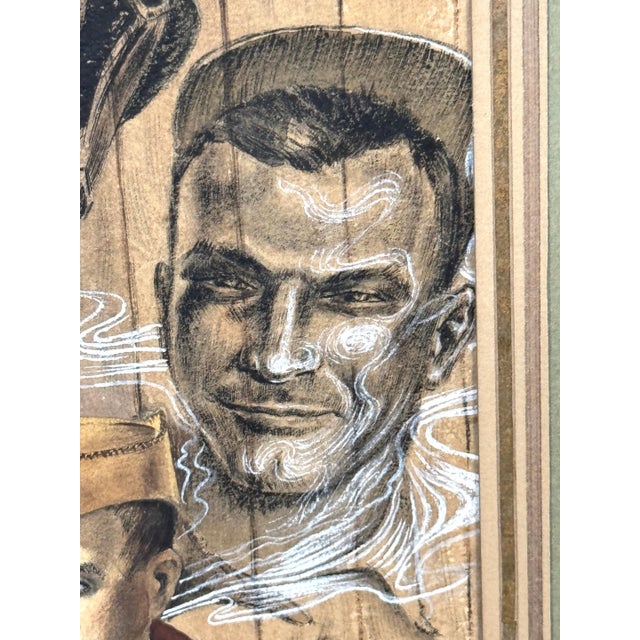
The seated figure’s companions—summoned in smoke—appear above and behind him in a dreamlike procession: a helmeted infantryman, a pilot in goggles, and a hat-wearing civilian (?) man posed in pin-up style. Each face is rendered with tenderness and idealization, not as ghosts or casualties, but as romantic or erotic conquests: remembered lovers, fleeting encounters, or imagined partners. Their expressions, softly lit and emotionally present, reflect a form of desire neither tormented nor tragic. This is not a meditation on loss but on intimacy remembered, perhaps treasured.
On the table beside him rests a small bronze Buddha figurine, alongside a glowing hearth. These elements anchor the setting in a warm, personal interior and strongly suggest the figure’s posting in the Pacific theater, where American officers often encountered Buddhist statuary and Southeast Asian material culture. The presence of the Buddha introduces another symbolic register—serenity, inward focus, and detachment—as the soldier communes privately with the imagined or remembered men above him. The open diary on his lap reinforces the introspective quality of the composition: it is both literal and metaphorical, a record of experience and a stand-in for interior life.
The work is executed on a Whatman Drawing Board, an English-made, extra hard-sized artist’s board manufactured by W. & R. Balston Ltd., a papermaker dating back to the 18th century and associated with high-quality drawing and watercolor supports used by professional illustrators, engineers, and artists. The board was distributed by E.H. & A. Cowan, New York, whose label appears on the back. The artist likely acquired these materials while stationed in England in the immediate postwar period, when American servicemen—especially those with artistic training or inclination—had access to British supplies through military PXs or civilian shops. The use of Whatman board further underscores the skill level and professional orientation of the artist.
The painting retains its original hand-cut double mat in celadon and taupe, as well as its giltwood frame with a classic bevel profile. Together, they reinforce the object’s period authenticity and suggest that the work was valued and preserved by its maker or a recipient. The subtle coloring of the mat complements the palette of smoke, uniform, and skin tones, while the frame provides a finished, domestic context.
Stylistic Context and Interpretation:
This work belongs to the wider tradition of coded gay representation in mid-20th-century American art, particularly within the subculture of servicemen, illustrators, and artists who navigated their identities in private or through metaphor. Its psychological depth and visual restraint echo the figural compositions of Paul Cadmus, while the interior theatricality and emotional focus are reminiscent of George Tooker or Jared French, members of the PaJaMa collective. The painting also aligns with traditions of wartime eroticism, visual diary-making, and private homoerotic expression found in soldier-made sketchbooks and personal effects—most of which were never intended for public exhibition.
Yet, unlike works mired in secrecy or tension, this painting is notable for its tone of quiet confidence. The central figure smiles. He is neither anguished nor conflicted. Instead, he appears to dwell in affectionate recall, fully at ease with the three men rising from memory like incense. That poise and serenity distinguish this work from both standard military art and more overt mid-century coded erotica.
Dimensions:
• Framed: 20.5” H x 16.5” W
• Mat opening (sight): 13.5” H x 10.25” W
• Board: 16.25” H x 13.5” W
Condition:
Very good vintage condition. Minor toning to the board and light edge wear. The original mat shows scattered foxing and toning consistent with age. The giltwood frame retains its original surface and shows only minor nicks and rubs appropriate to its age.
Signed
Signed CSG at lower right. While the artist remains unidentified, the quality of execution, use of professional materials, and specificity of subject strongly support attribution to a U.S. soldier-artist working in England in the late 1940s—possibly with a background in illustration or technical drawing.
See less
- Dimensions
- 16.5ʺW × 0.5ʺD × 20.5ʺH
- Styles
- Modern
- Frame Type
- Framed
- Art Subjects
- Figure
- Period
- Mid 20th Century
- Country of Origin
- United States
- Item Type
- Vintage, Antique or Pre-owned
- Materials
- Giltwood
- Paper
- Condition
- Good Condition, Original Condition Unaltered, Some Imperfections
- Color
- Brown
- Condition Notes
- Good Wear consistent with age and use. Minor losses. Minor fading. Good Wear consistent with age and use. Minor losses. Minor fading. less
Questions about the item?
Returns & Cancellations
Return Policy - All sales are final 48 hours after delivery, unless otherwise specified in the description of the product.
Cancellation Policy - Prior to shipping or local pickup, buyers may cancel an order for up to 48 hours, unless otherwise specified.
Related Collections
- Ralph Lauren Paintings
- Ed Ruscha Paintings
- Photorealism Canvas Paintings
- Photorealism Paintings in New York
- Silk Velvet Paintings
- Louise Nevelson Paintings
- Herman Miller Paintings
- Richard Serra Paintings
- Jaanika Peerna Paintings
- Jo Baskerville Paintings
- Jean-Paul Barray Paintings
- Hans Andersen Paintings
- Johannes Andersen Paintings
- Peter Behrens Paintings
- Raphael Paintings
- Photorealism Paintings in Los Angeles
- Carl-Axel Acking Paintings
- Joseph Stella Paintings
- Karl-Erik Ekselius Paintings
- Pedro Friedeberg Paintings
- Piet Hein Eek Paintings
- Cassina Paintings
- Black Photorealism Paintings
- BDDW Paintings
- Lee Reynolds Paintings