


Details
Description
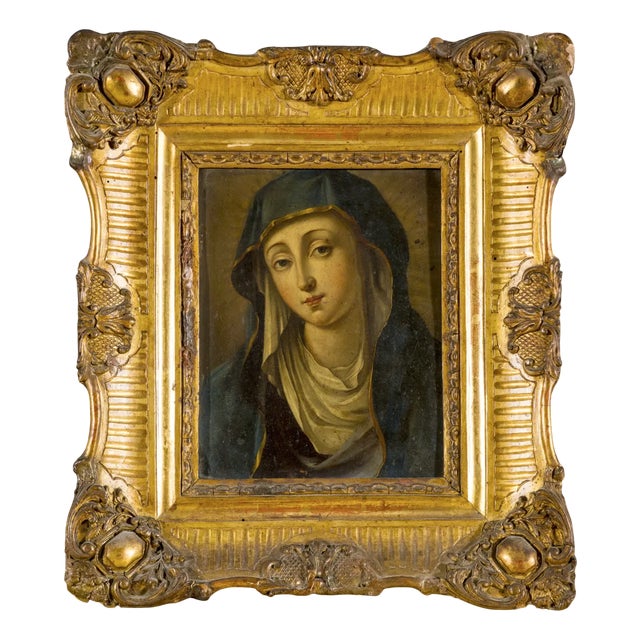
17th Century Italian Religious Painting Credited to Giovanni Battista Salvi
Virgin Mary
Period: second half of the 17th century
Technique: …
Read more
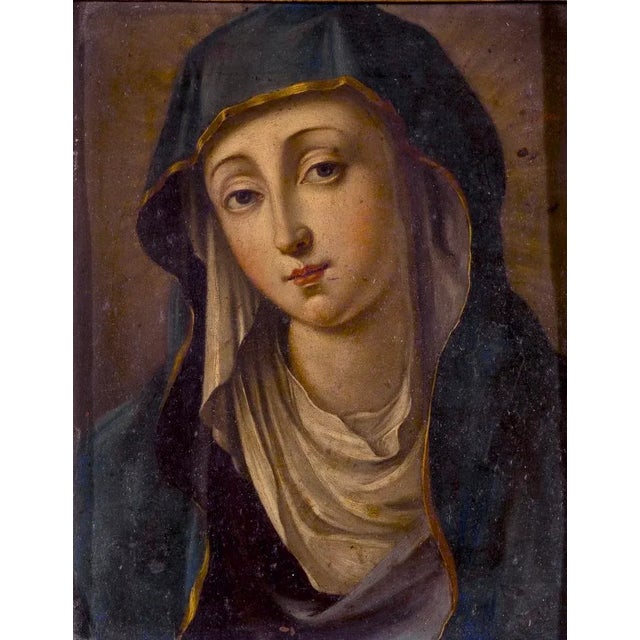
17th Century Italian Religious Painting Credited to Giovanni Battista Salvi
Virgin Mary
Period: second half of the 17th century
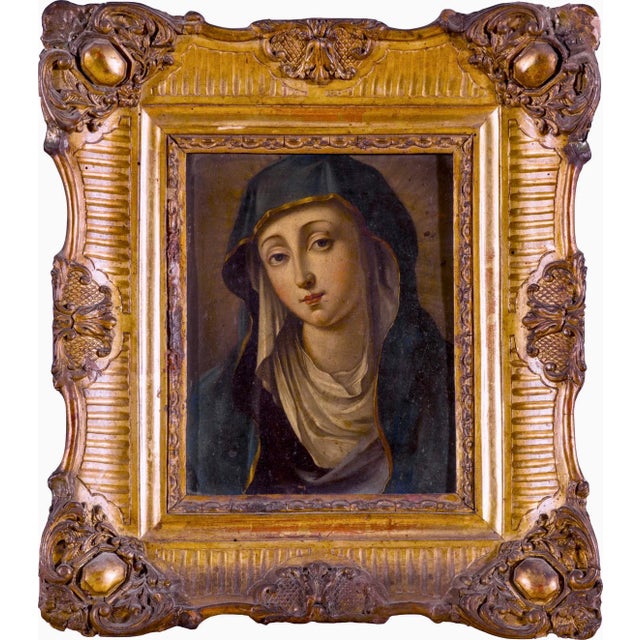
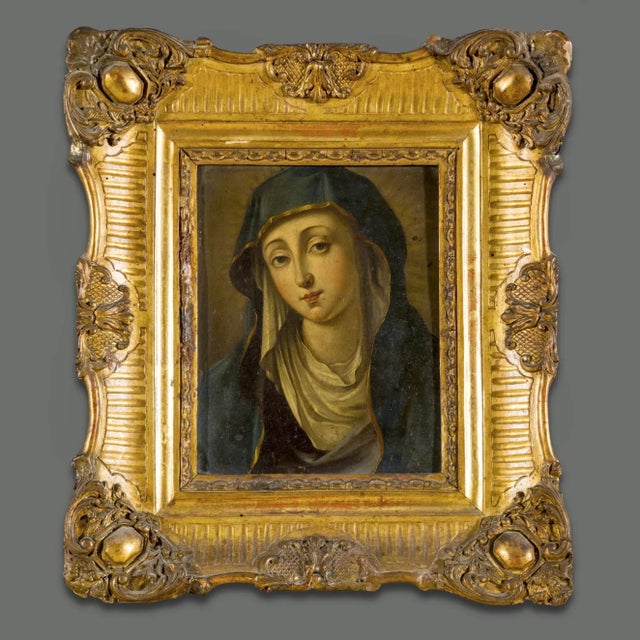
Technique: oil on copper
A beautiful, important painting which, although unsigned, can be attributed to the great Italian Baroque artist Giovanni Battista Salvi, known as ‘Il Sassoferrato’.
He specialised in depicting the Virgin Mary in close-up with her hands clasped in devotion.
The quality of the brushwork is extremely high, as is the colour rendering, which creates a very deep and intense atmosphere of bliss.
The use of the extremely rare and prestigious oil on copper technique also denotes a very high level of craftsmanship.
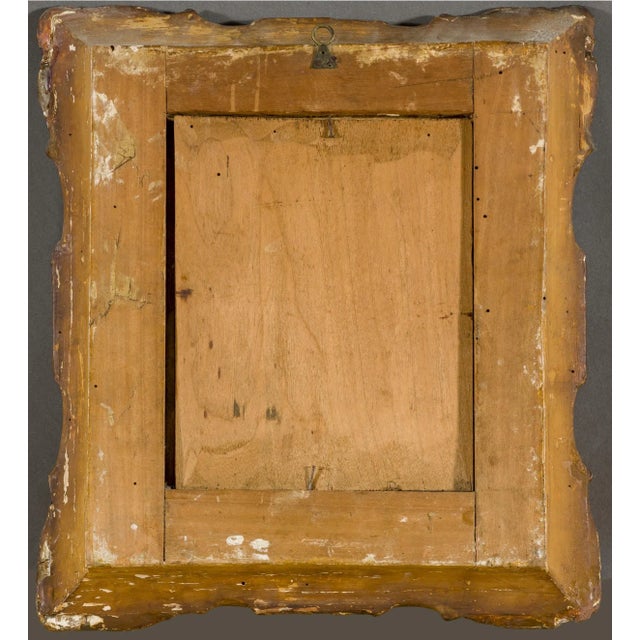
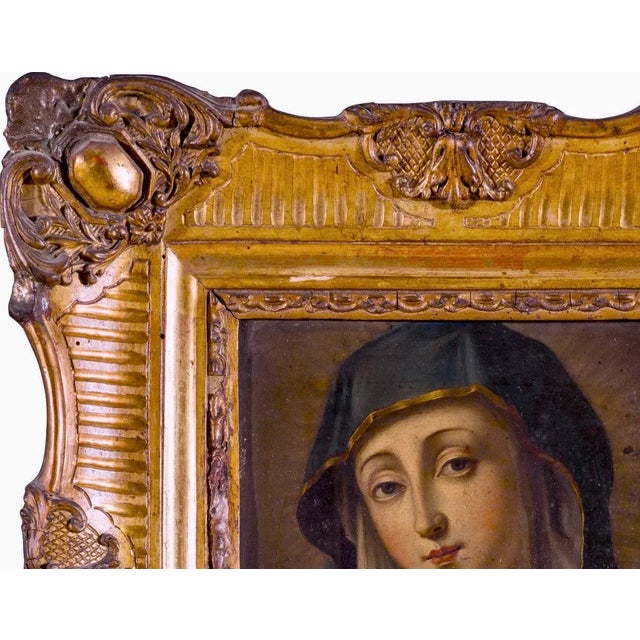
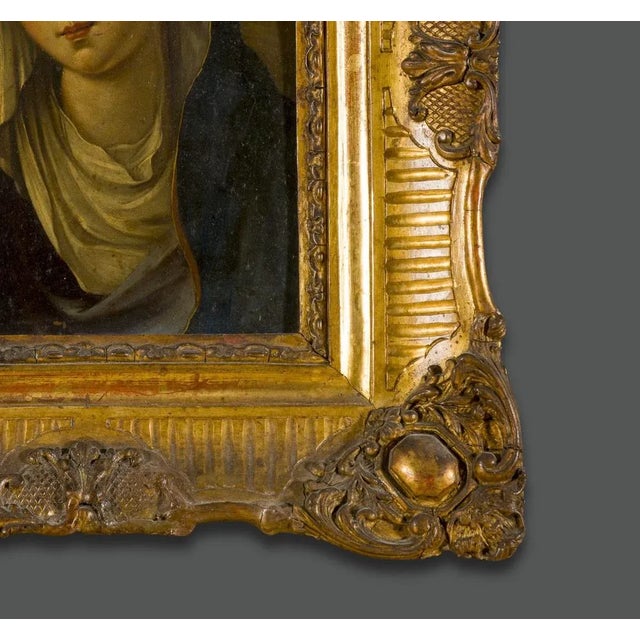
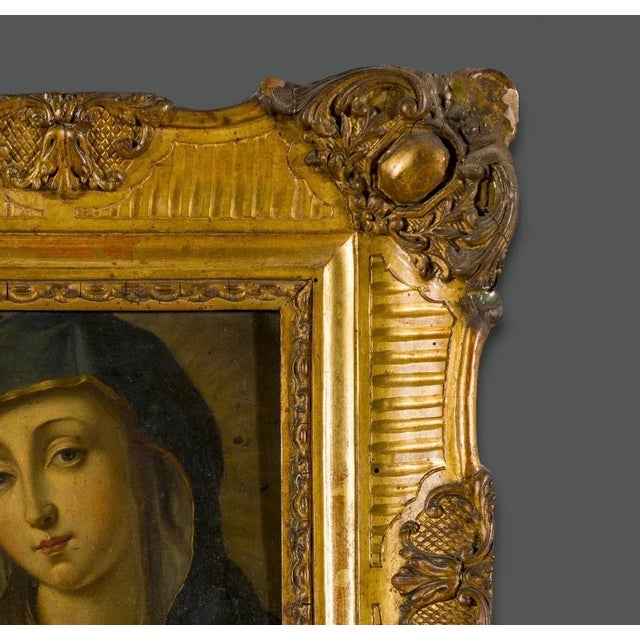
This artwork, never before on the market, comes from an important Italian private collection and is beautified by an impressive antique frame in gilded wood, in almost perfect condition.
Giovanni Battista Salvi da Sassoferrato (August 25, 1609 – August 8, 1685), also known as Giovanni Battista Salvi, was an Italian Baroque painter, known for his archaizing commitment to Raphael's style.
He is often referred to only by the name of his birthplace, Sassoferrato.
The details of Giovanni Battista Salvi's biography are very sparse.
He was born in the small town of Sassoferrato in the Marche region of central Italy, half-way between Rome and Florence, east of the Apennines.
Sassoferrato was apprenticed under his father, the painter Tarquinio Salvi; fragments of Tarquinio's work are still visible in the church of San Francesco in Sassoferrato.
The rest of Giovanni's training is undocumented but it is thought that he worked under the Bolognese painter Domenichino, a main apprentice of Annibale Carracci (c. 1580). Two other pupils of Carracci, Francesco Albani and Guido Reni, also influenced Sassoferrato. In Francis Russell's view, Reni was as much Sassoferrato's mentor as Domenichino was his master.
His paintings also show the influence of Albrecht Dürer, Guercino, and above all Raphael. He appears to also have been influenced by Pierre Mignard, whom he may have met in Rome in the 1630s.
Few public commissions by Sassoferrato exist, and, like Carlo Dolci, he seems to have concentrated on producing multiple copies of various styles of devotional image for private patrons, a demand fuelled by the Counter-Reformation of the Catholic Church. On 15 April 1642 Olimpia Aldobrandini, Princess of Rossano, who became the wife of Prince Camillo Francesco Maria Pamphili, engaged him to paint a portrait to be sent to Naples.
In the 1640s and 1650s portrait painting formed a large part of his work in Rome. In this period he executed portraits of Cardinal Francesco Angelo Rapaccioli (1643–4; Sarasota, John and Mable Ringling Museum of Art), Monsignor Ottaviano Prati (c. 1650; Rome, Palazzo Barberini) and Cardinal Ottoboni (c. 1652; Padua, Musei Civici di Padova).
His talent for portrait painting was evidently appreciated, especially by ecclesiastical clients (Blunt and Cooke).
Until the early 20th century Sassoferrato’s portrait painting was thought to be limited to his Self-portrait (1664–70; Florence, Uffizi), a work of great emotional intensity.
In 1643 Olimpia Aldobrandini engaged Sassoferrato to paint a canvas for the chapel of Santa Caterina in Santa Sabina, Rome, to replace a work by Raphael that had been lost.
This, the Virgin of the Rosary, is perhaps Salvi’s best-known and most celebrated work. The composition is rigorously constructed in the form of an isosceles triangle, and the work demonstrates his painstaking craftsmanship and skilful use of brilliant colour.
He produced few other altarpieces or large compositions, preferring to work on a smaller scale, mostly on sacred subjects, although he did occasionally paint mythological scenes.
Sassoferrato's work was held in high regard through to the mid-19th century.
His paintings were sometimes believed to be contemporary with the school of Raphael. However, by the late 19th century, reaction against sweet devotional artwork was reinforced in England by the critical commentary of John Ruskin.
The late 20th century saw a revival of interest in archaizing Italian Baroque painting, with Guido Reni leading the way in generating a surge of auction interest also in Sassoferrato.
There are over three hundred works by Sassoferrato in public collections in 2006 throughout the world, including almost all of his extant drawings in the British Royal Collection at Windsor Castle.
This piece is attributed to the mentioned designer/maker. It has no attribution mark and no
official proof of authenticity,
however it is well documented in design history. I take full responsibility for any authenticity
issues arising from misattribution
See less
- Dimensions
- 13.39ʺW × 1.97ʺD × 14.96ʺH
- Art Subjects
- Portrait
- Period
- 17th Century
- Country of Origin
- Italy
- Item Type
- Vintage, Antique or Pre-owned
- Condition
- Good Condition, Unknown, Some Imperfections
- Color
- Condition Notes
- Heavy Signs of Use,Patina Consistent with Age and Use Heavy Signs of Use,Patina Consistent with Age and Use less
Returns & Cancellations
Return Policy - All sales are final 48 hours after delivery, unless otherwise specified in the description of the product.
Cancellation Policy - Prior to shipping or local pickup, buyers may cancel an order for up to 48 hours, unless otherwise specified.
Related Collections
- Ed Ruscha Paintings
- Ralph Lauren Paintings
- Photorealism Canvas Paintings
- Photorealism Paintings in New York
- Karen Offutt Paintings
- Richard Serra Paintings
- Mark Lewis Art Paintings
- Mark Lewis Paintings
- FM Mobler Paintings
- Jo Baskerville Paintings
- Vienna Secession Paintings
- Silk Velvet Paintings
- Louise Nevelson Paintings
- Jeff Slemmons Paintings
- Photorealism Paintings in Los Angeles
- Michelle Arnold Paine Paintings
- BDDW Paintings
- Black Photorealism Paintings
- Lee Reynolds Paintings
- Mid-Century Modern Paintings
- Abstract Paintings
- Nautical Paintings
- Velvet Paintings
- Landscape Paintings
- 19th Century Oil Paintings