



Details
Description
1960s Italian Signed Dated and Authenticated Painting
Mino Maccari work
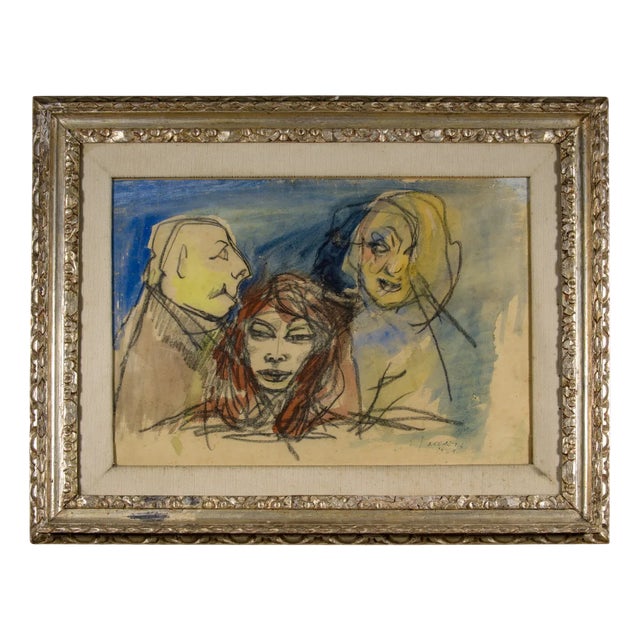
Three stylized figures
Work by the Sienese artist Mino Maccari, …
Read more
1960s Italian Signed Dated and Authenticated Painting
Mino Maccari work
Three stylized figures
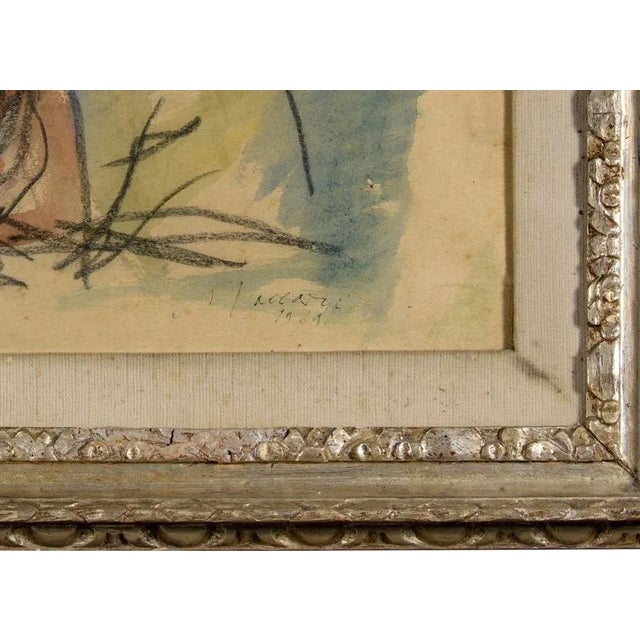
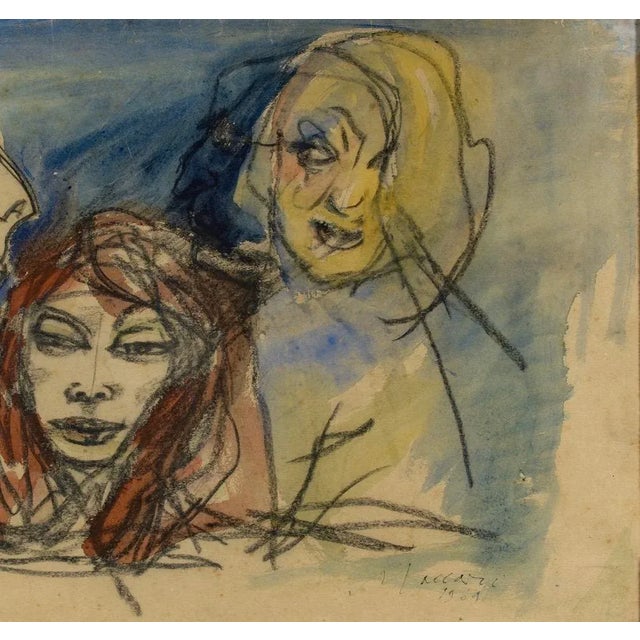
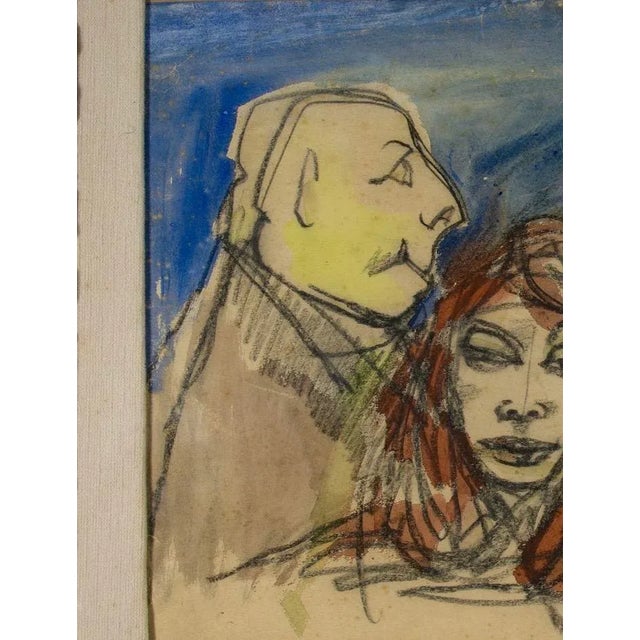
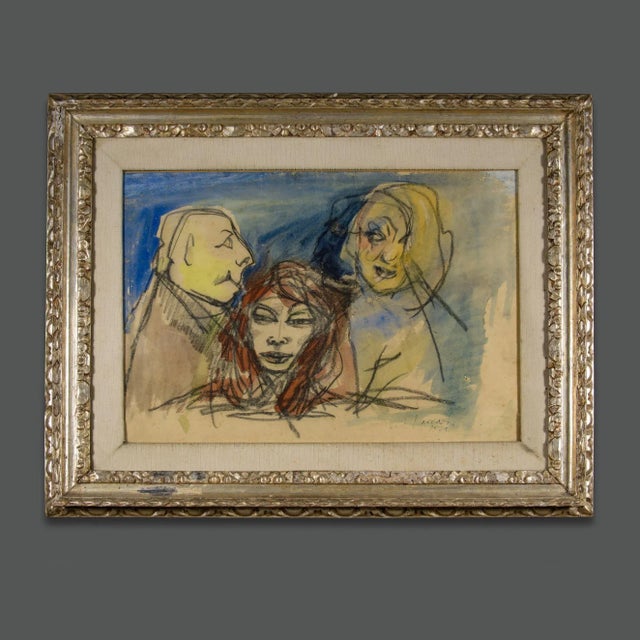
Work by the Sienese artist Mino Maccari, signed at the bottom right Maccari 1969. Mixed media drawing, watercolor and charcoal on canvas paper.
It depicts three stylized figures in an expressionist style, with a fourth figure faintly outlined.
The background is an abstract blue gradient, creating an ethereal and mysterious atmosphere.
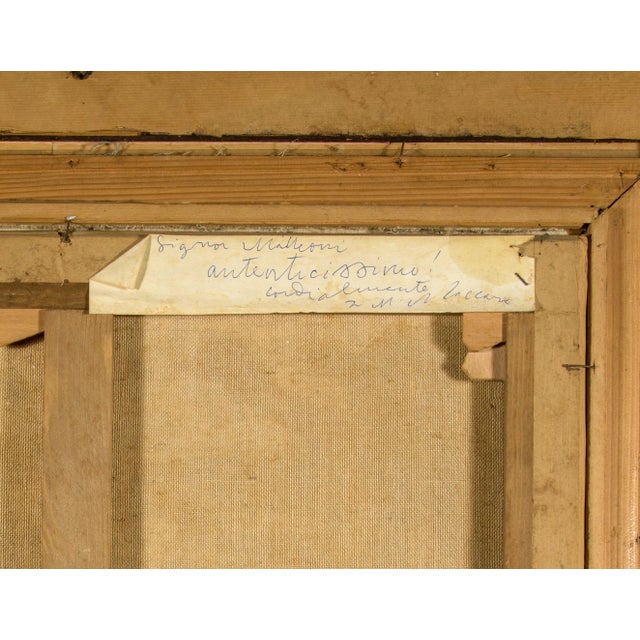
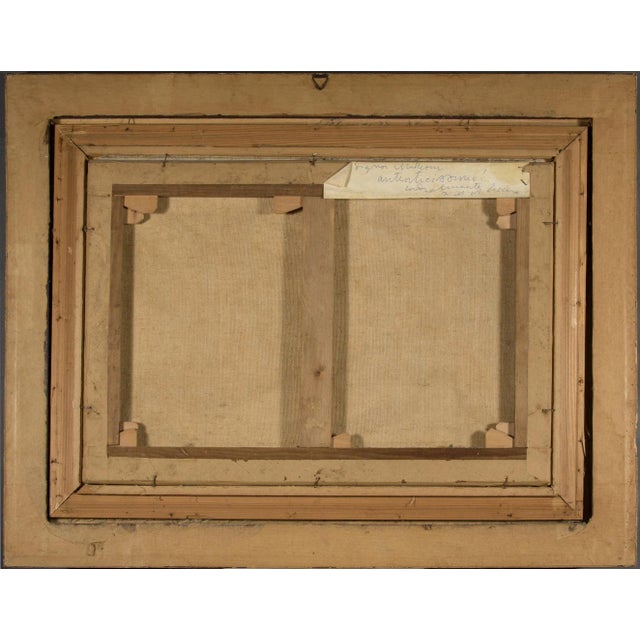
On the back, it bears a handwritten authentication signed by the artist.
This artwork, never before on the market, comes from an important European private collection and is beautified by an impressive antique frame in silvered wood, in almost perfect condition.Dimensions are frame included
The painting is also protected by glass
Mino Maccari (Siena, 24 November 1898 – Rome, 16 June 1989) was an Italian writer, painter, engraver and journalist, winner of the Feltrinelli Prize for Painting in 1963 and first winner of the Forte dei Marmi Satire Prize in 1973.
Maccari was born on 24 November 1898 into a lower middle-class family in Siena, the son of Latino Maccari and Bruna Bartalini.
from an early age, he was outgoing and gifted with a lively visual intelligence, and was drawn to freehand drawing with charcoal, but his father, a professor of literature, tried in every way to steer him towards humanities studies.
After completing his secondary education, he enrolled at university. Like many young people of his time, he was interventionist and, at the age of only nineteen, he took part in the Great War as a field artillery officer.
At the end of the war, he resumed his university studies in Siena and graduated with a law degree in 1920.
He began working at the law firm of Dini in Colle di Val d'Elsa, where his family was from and where he had spent his childhood with relatives. In his free time, he devoted himself to his true passion: painting.
It was during these moments, outside of any pre-established patterns, in his early attempts at painting and engraving, that he felt the greatest need to give meaning to his life.
This very troubled period after the First World War proved to be fertile ground for Maccari's lively, mocking and controversial character, leading him to participate in social unrest in the country and to play a significant role in the March on Rome in 1922. In 1924, he was called upon by Angiolo Bencini to oversee the printing of the magazine Il Selvaggio, which was openly fascist, revolutionary and anti-bourgeois, where his first engravings were published.
After several years of juggling work at the magazine with his law practice, in early 1926 he left the legal profession to take over the management of Il Selvaggio, a position he held until 1942.
In 1928, he wrote a small book published by Vallecchi (Florence), Il Trastullo di Strapaese (songs and wood engravings), which collected fascist songs (the same book was seized several times from Antonio Gramsci during his imprisonment).
For Maccari, as for Malaparte, the squadristi must not demobilise before completely destroying the old bourgeois state.
They must carry out a palingenetic revolution and build a new type of Italian, completely antithetical to that of liberal Italy.
But when Maccari realised that the political terrain was now impassable for uncompromising fascism, due to Mussolini's controversial normalisation policy, Il Selvaggio changed course to focus on culture.
To inaugurate this new direction, he wrote an editorial entitled “Addio al passato” (Farewell to the Past), which described the new focus of Il Selvaggio, a magazine dedicated to art, satire and political humour, following a tradition that was seemingly rustic and mocking but was in fact subtly cultured.
with the transfer of Il Selvaggio's editorial office from Colle di Val d'Elsa to Florence in 1925, Maccari collaborated with Ardengo Soffici, Ottone Rosai and Achille Lega. Meanwhile, between 1927 and 1930, he made a name for himself as a painter by participating in various national exhibitions.
Also in 1930, Maccari worked in Turin at La Stampa as editor-in-chief, with the writer Curzio Malaparte as his director.
He was very active in the cultural and publishing world of the Fascist regime, writing and contributing to various magazines: Quadrivio, L'Italia Letteraria, L'Italiano and Omnibus by Leo Longanesi; then, during the war, in Il Primato di Bottai and, later still, in Il Mondo di Pannunzio (from the first issue in 1949) and Documento di Federigo Valli. His graphic production was also extensive, ranging from L'Album di Vallecchi (1925) and Il trastullo di Strapaese (1928) to Linoleum (1931). In 1934, Maccari illustrated La vecchia del Bal Bullier by Antonio Baldini and in 1942 he published the portfolio Album, followed by Come quando fuori piove and Il superfluo illustrato.
For his pictorial work, rich in evident chromatic accents and quick brushstrokes, his violent drawing combined with the lively strokes of his engravings, he was recognised by critics as a complete artist.
After the Second World War, he continued to gain recognition, thanks to his prolific creative work, and to present solo exhibitions.
In 1962, he was also appointed president of the Accademia di San Luca in Rome and managed to secure a solo exhibition at Gallery 63 in New York.
His output of drawings, watercolours, tempera paintings, etc. was immense, sometimes in collaboration with prestigious publishing houses.
Worth mentioning, just as an excellent example, are the 32 black and white and colour drawings with which he illustrated Il gusto di vivere, a volume of writings by Giancarlo Fusco, edited by Natalia Aspesi and published by Laterza in 1985 (Maccari gave two of these drawings to Enrico Mistretta, editorial director of Laterza). Maccari, a native of Siena and a great supporter of the Torre district, painted the banner for the Palio on 16 August 1970, which was won by Selva. In 1973, he was awarded the Forte dei Marmi Political Satire Prize, an award created that same year. This piece has an attribution mark,
I am sure that it is completely authentic and take full responsibility for any authenticity
issues arising from misattribution
See less
- Dimensions
- 38.19ʺW × 3.94ʺD × 29.13ʺH
- Art Subjects
- Nude
- Period
- 1960s
- Country of Origin
- Italy
- Item Type
- Vintage, Antique or Pre-owned
- Materials
- Paper
- Condition
- Good Condition, Unknown, Some Imperfections
- Color
- Condition Notes
- Heavy Signs of Use,Patina Consistent with Age and Use Heavy Signs of Use,Patina Consistent with Age and Use less
Returns & Cancellations
Return Policy - All sales are final 48 hours after delivery, unless otherwise specified in the description of the product.
Cancellation Policy - Prior to shipping or local pickup, buyers may cancel an order for up to 48 hours, unless otherwise specified.
Related Collections
- Photorealism Canvas Paintings
- Ed Ruscha Paintings
- Photorealism Paintings in New York
- Richard Serra Paintings
- Jo Baskerville Paintings
- Louise Nevelson Paintings
- Karen Offutt Paintings
- Nicola Simbari Paintings
- Herman Miller Paintings
- BDDW Paintings
- James McCray Paintings
- Jaanika Peerna Paintings
- Leroy Neiman Paintings
- Jeff Slemmons Paintings
- Milton Avery Paintings
- Vienna Secession Paintings
- Johannes Andersen Paintings
- Pedro Friedeberg Paintings
- Peter Behrens Paintings
- Piet Hein Eek Paintings
- Raphael Paintings
- Photorealism Paintings in Los Angeles
- Carl-Axel Acking Paintings
- Karl-Erik Ekselius Paintings
- Hans Andersen Paintings