






Details
Description
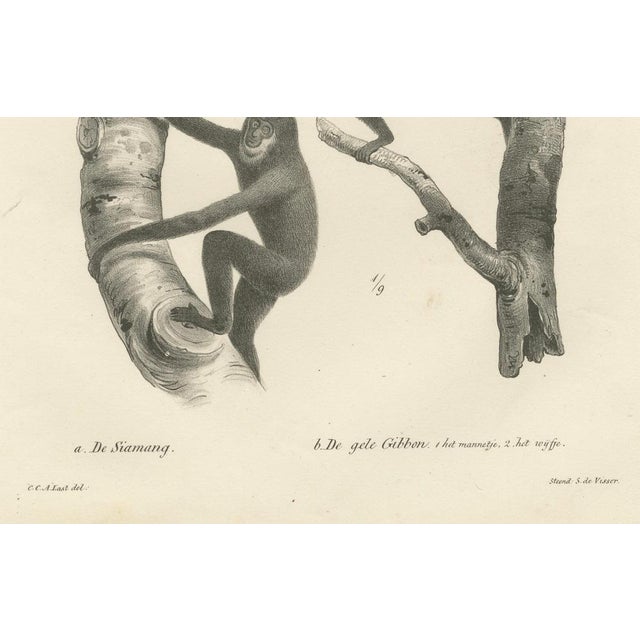
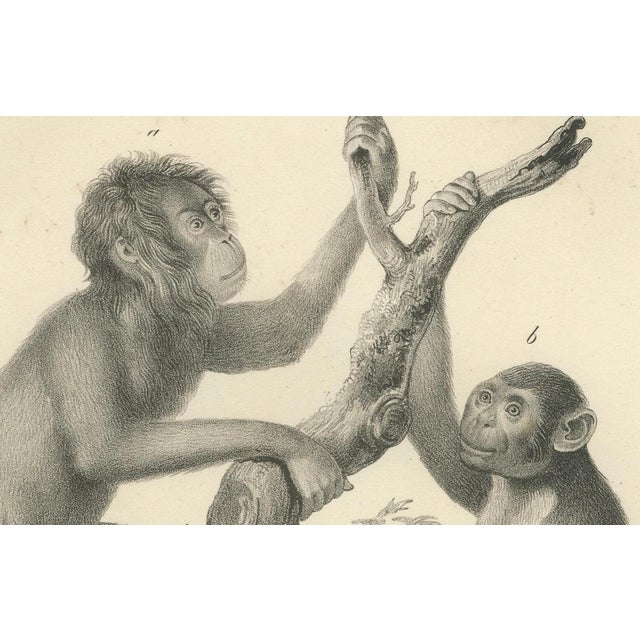
These two lithographs present primates in naturalistic settings, with careful attention to their anatomy and behavior. They are part of … Read more These two lithographs present primates in naturalistic settings, with careful attention to their anatomy and behavior. They are part of a series drawn by Carel Christiaan Antony Last and published in Heinrich Rudolf Schinz's *Volledige Natuurlijke Historie der Zoogdieren* in 1836. Printed by S. de Visser en Zoon in The Hague, these illustrations depict various species of primates that were of great interest to European naturalists during the early 19th century. The first lithograph (Pl. 25) depicts two primates: an orangutan (De Orang-Oetang) and a chimpanzee (De Chimpanse). The orangutan is shown climbing a tree, gazing upward, with detailed attention given to its long limbs and fur. The chimpanzee, also perched on a tree, exhibits a more contemplative posture, looking outward. These species were relatively new to European audiences at the time, and their inclusion in natural history works like Schinz’s was intended to highlight their biological and behavioral traits. The second lithograph (Pl. 26) features a siamang (*De Siamang*) and a group of gibbons (De gele Gibbon), a mother with a young one and another individual, shown swinging between trees. The lithograph captures the gibbons’ agile movement, with their long arms stretched as they move between branches. Gibbons and siamangs are closely related and known for their brachiation—a form of arboreal locomotion, which is beautifully depicted in the illustration. These prints, like the others in Schinz's volume, were created as part of the larger scientific and artistic effort of the 19th century to catalog and document the world’s fauna. The combination of the scientific and artistic processes in these prints reflects the era's emphasis on natural observation and classification. The attention to detail in the musculature, facial expressions, and interactions with their environment reflects a European curiosity in understanding these exotic creatures. Both prints were designed to be educational for a European audience, with the aim of expanding knowledge about the diversity of the animal kingdom, particularly primates, who at the time were subjects of fascination due to their close resemblance to humans. The inclusion of species such as the orangutan and gibbon in these works emphasized the perceived evolutionary links between humans and other animals, a concept that was beginning to take root in scientific thought at the time. See less
- Dimensions
- 10.24ʺW × 12.6ʺH
- Art Subjects
- Animals
- Period
- Mid 19th Century
- Item Type
- Vintage, Antique or Pre-owned
- Materials
- Paper
- Condition
- Good Condition, Unknown, Some Imperfections
- Color
- Condition Notes
- Very Good — This vintage item has no defects, but it may show slight traces of use\. Condition: good, given … moreVery Good — This vintage item has no defects, but it may show slight traces of use\. Condition: good, given age. Light foxing / soiling. General age-related toning and/or occasional minor defects from handling. Please study scan carefully. less
Returns & Cancellations
Return Policy - All sales are final 48 hours after delivery, unless otherwise specified in the description of the product.
Cancellation Policy - Prior to shipping or local pickup, buyers may cancel an order for up to 48 hours, unless otherwise specified.
Related Collections
- Soicher Marin Original Prints
- Rattan Original Prints
- Medium-Density Fibreboard Original Prints
- Silver Finish Original Prints
- Robert Kipniss Original Prints
- Dye Transfer Original Prints
- Original Prints in Salt Lake City
- Original Prints in Lexington, KY
- Original Prints in Panama City, FL
- Ralph Lauren Original Prints
- Damien Hirst Original Prints
- Sam Francis Original Prints
- Johannes Kip Original Prints
- Botanical Prints
- Framed Prints
- Bird Prints
- Woodblock Prints
- Screen Prints
- Japanese Woodblock Prints
- Thomas McKnight Original Prints
- George Barbier Original Prints
- Frank Stella Original Prints
- Gustave Baumann Original Prints
- Teak Original Prints
- Chaim Gross Original Prints