



Details
Description
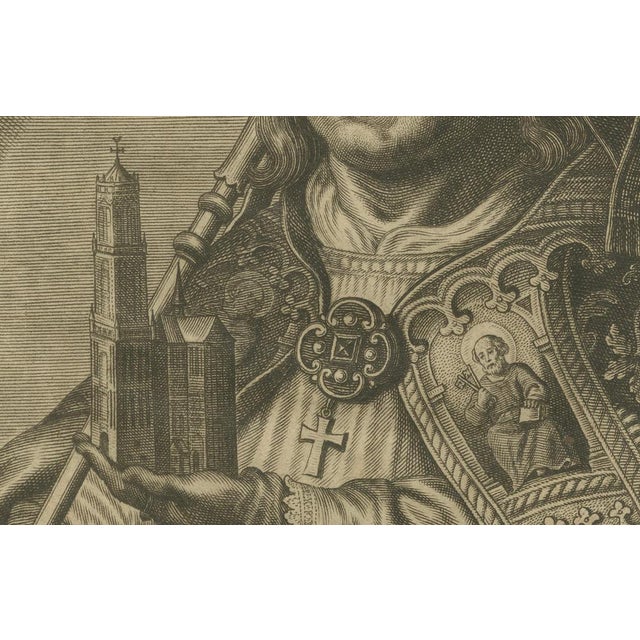
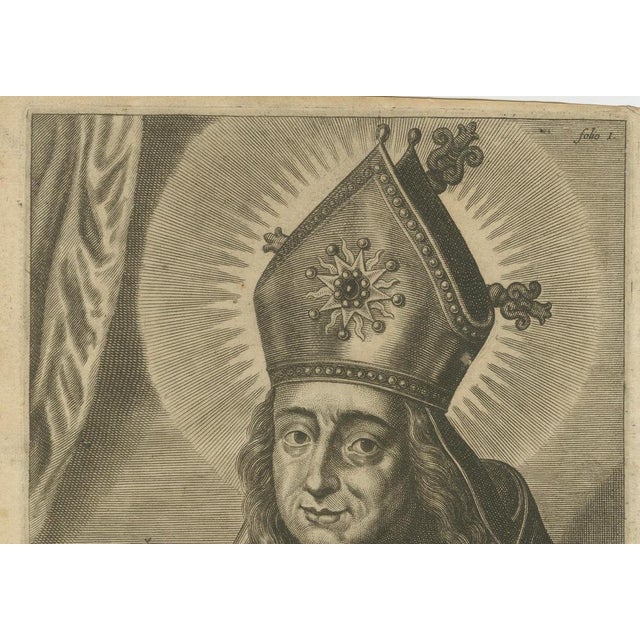
This engraving depicts saint willibrord (ca. 658–739), a prominent missionary and the first archbishop of utrecht, often regarded as the … Read more This engraving depicts saint willibrord (ca. 658–739), a prominent missionary and the first archbishop of utrecht, often regarded as the "apostle to the frisians." he played a key role in the christianization of the netherlands and parts of northern europe. The figure in the print is identified as "den h. Willebrordvs" (saint willibrord) in the text below, noting his mission to the netherlands under the guidance of pope gregory ii around the year 719. The engraving is attributed to 'lommelin sculpsit', which indicates that it was engraved by robert lommelin, a flemish engraver active during the mid-17th century. Lommelin was known for his detailed and high-quality engravings, often used in books and religious works. The print is from 'kerckelijke historie van de geheele werelt\.' (religious history of the whole world), written by cornelius hazart, a jesuit historian and writer. This publication, printed in amsterdam in 1667, is a comprehensive account of the christian church's history and included many engravings to illustrate key figures and events. Key features of the engraving include: - saint willibrord holding a model of a church, symbolizing his role in establishing christianity in the netherlands. - his episcopal attire, richly decorated with intricate religious imagery, emphasizing his position as a bishop. - a serene yet determined expression, underscoring his dedication to his missionary work. This print serves as both a work of religious art and a historical artifact, celebrating the legacy of one of the most influential figures in early christian missionary efforts in northern europe. Its inclusion in hazart’s book highlights the significance of willibrord's contributions to the church and its expansion. More about willbrordus: saint willibrord (ca. 658–739) was a missionary bishop from northumbria, england, who played a pivotal role in the christianization of the frisians in what is now the netherlands and parts of northern germany. His life and work were marked by dedication to spreading christianity, and he is regarded as the "apostle to the frisians." here's a brief summary of his life and what happened to him: 1. Early life and education: willibrord was born in northumbria, england, around 658, into a devout christian family. After the death of his father, he was entrusted to a monastery at ripon, where he received a solid religious education. He later studied in ireland, which was a center for missionary training at the time. 2. Missionary work: around 690, willibrord was sent to the frisian kingdom (modern-day netherlands) by the frankish ruler pepin of herstal. His mission was to convert the frisian people, who were still largely pagan, to christianity. He faced significant resistance, particularly from king radbod, the pagan ruler of the frisians. 3. Support from the papacy: willibrord traveled to rome in 695, where pope sergius i consecrated him as the archbishop of the frisians and gave him the name "clement." this official endorsement strengthened his position and mission. 4. Challenges and achievements: despite setbacks, including radbod's hostility and the destruction of his mission after pepin's death, willibrord continued his efforts. He founded churches and monasteries, the most notable being the abbey at echternach (in present-day luxembourg), which became a center of learning and missionary activity. 5. Later life: after radbod's death in 719, the frisians became more receptive to christianity under frankish rule. Willibrord spent the rest of his life establishing and strengthening the christian church in the region. He retired to the monastery at echternach, where he lived a devout and peaceful life. 6. Death and legacy: willibrord died on november 7, 739, at echternach. He was buried there, and his tomb became a place of pilgrimage. He was canonized as a saint, and his feast day is celebrated on november 7. Echternach continues to host the famous annual dancing procession in his honor, a tradition dating back to the middle ages. Willibrord's work laid the foundation for the christian church in the netherlands and surrounding regions. He is remembered as a tireless missionary and an influential figure in the spread of christianity in northern europe. See less
- Dimensions
- 7.48ʺW × 11.42ʺH
- Art Subjects
- Nude
- Period
- 17th Century
- Item Type
- Vintage, Antique or Pre-owned
- Materials
- Paper
- Condition
- Good Condition, Unknown, Some Imperfections
- Color
- Condition Notes
- Very Good — This vintage item has no defects, but it may show slight traces of use\. Condition: Good, considering … moreVery Good — This vintage item has no defects, but it may show slight traces of use\. Condition: Good, considering age. General age-related toning and/or occasional minor defects from handling. The margins are cut short to the plate-mark. Please study scan carefully. less
Returns & Cancellations
Return Policy - All sales are final 48 hours after delivery, unless otherwise specified in the description of the product.
Cancellation Policy - Prior to shipping or local pickup, buyers may cancel an order for up to 48 hours, unless otherwise specified.
Related Collections
- Soicher Marin Original Prints
- Medium-Density Fibreboard Original Prints
- Rattan Original Prints
- Original Prints in Panama City, FL
- Ralph Lauren Original Prints
- Original Prints in Salt Lake City
- Damien Hirst Original Prints
- Original Prints in Lexington, KY
- Johannes Kip Original Prints
- Silver Finish Original Prints
- Sam Francis Original Prints
- Dye Transfer Original Prints
- Botanical Prints
- Framed Prints
- Bird Prints
- Woodblock Prints
- Screen Prints
- Japanese Woodblock Prints
- Thomas McKnight Original Prints
- George Barbier Original Prints
- Frank Stella Original Prints
- Gustave Baumann Original Prints
- Teak Original Prints
- Clay Original Prints
- Louis XIII Original Prints