


Details
Description
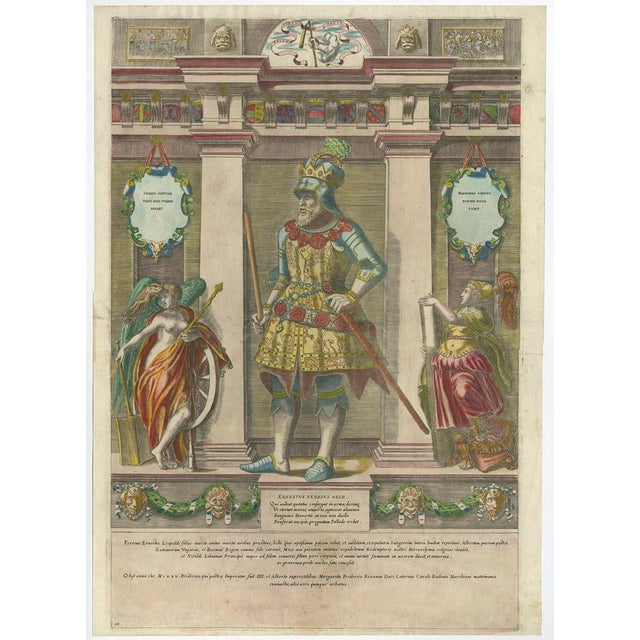
Antique print titled ''Ernestus Ferreus Arch'. **Ernest the Iron (1377-1424)** Background: Ernest the Iron, also known as Ernst der Eiserne, … Read more Antique print titled ''Ernestus Ferreus Arch'. **Ernest the Iron (1377-1424)** Background: Ernest the Iron, also known as Ernst der Eiserne, was a member of the House of Habsburg. He ruled over the duchies of Styria, Carinthia, and Carniola, which are regions in present-day Austria and Slovenia. Reign: Ernest became the head of the Leopoldian line of the Habsburgs in 1411. His rule was marked by efforts to consolidate Habsburg power in the region. Significance: His nickname, "the Iron," likely refers to his steadfastness and strong leadership during turbulent times. His reign laid the groundwork for the future prominence of the Habsburg dynasty in European politics. Artistic Techniques Engraving - **Medium**: The print is a copperplate engraving, a common technique during the Renaissance for producing detailed and precise images. Engravers would incise lines into a metal plate, ink the plate, and then press it onto paper to create the print. - **Detail**: This print shows meticulous attention to detail, especially in the depiction of Ernest’s armor and the surrounding architectural elements. The textures and patterns on the armor are carefully rendered to give a sense of depth and realism. - **Coloring**: The print is hand-colored, which was a common practice to enhance the visual appeal of black-and-white engravings. The colors are likely added with watercolor paints, giving a vibrant and dynamic look to the image. **Symbolism and Composition** - **Architectural Elements**: The background features classical architectural elements such as columns, arches, and a frieze. These elements frame the central figure of Ernest and lend a sense of grandeur and importance to the subject. - **Allegorical Figures**: The print includes allegorical figures, likely representing virtues or aspects of Ernest’s reign. For example, the figure on the left with wings and a wheel might represent Fortuna (Fortune), indicating Ernest's successful and fortunate rule. - **Latin Inscriptions**: The inscriptions provide context and celebrate Ernest’s achievements. These were typical in Renaissance portraiture to convey the subject's virtues and historical significance. Significance within the Collection **Austriacae Gentis Imagines** - **Collection**: This print is part of "Austriacae Gentis Imagines," a collection of portraits of notable figures from the Habsburg dynasty and Austrian nobility, compiled by Francesco Terzi. - **Purpose**: The collection aimed to celebrate and document the lineage and achievements of the Habsburg family. Such collections were important for reinforcing dynastic legitimacy and prestige. - **Engraver’s Role**: Gaspar Oselli, the engraver, played a crucial role in visually interpreting and preserving these historical figures. His works contributed to the dissemination of Habsburg imagery and propaganda. **Gaspar Oselli (1536-1577)** - **Style and Influence**: Oselli was known for his detailed and precise engraving style. Although many of his works were copies of other engravers, his ability to reproduce intricate details ensured the high quality of the prints in Terzi's collection. - **Legacy**: Oselli’s engravings remain valuable historical documents, providing insight into the artistic and cultural practices of the Renaissance period. Conclusion This antique print of Ernestus Ferreus by Gaspar Oselli is not only a fine example of Renaissance engraving but also a significant historical artifact. It offers a glimpse into the art and politics of the time, highlighting the importance of visual culture in shaping and preserving the legacy of powerful dynasties like the Habsburgs. The combination of detailed artistry, rich symbolism, and historical context makes this print a valuable piece for both art historians and those interested in European history. Artists and Engravers: Gaspare Oselli, Gaspare ab Avibus, Gaspar Patavinus (1536 - 1577). Engraver; half-brother of Niccolo Nelli. Many of his works are unacknowledged copies of plates by other engravers. Made plates for Francesco Terzi's 'Austriacae Gentis Imagines', published over a number of years. Condition: Good, given age. Minor discolouration of the lowest text part and a small restored worm hole. A few light crinkles and creases. Horizontal crease in the middle. A few small spots. General age-related toning and/or occasional minor defects from handling. Please study image carefully. See less
- Dimensions
- 14.96ʺW × 20.87ʺH
- Art Subjects
- Figure
- Period
- 2000 - 2009
- Item Type
- Vintage, Antique or Pre-owned
- Materials
- Paper
- Condition
- Good Condition, Unknown, Some Imperfections
- Color
- Black
- Condition Notes
- Very Good — This vintage item has no defects, but it may show slight traces of use\. Repaired: a small … moreVery Good — This vintage item has no defects, but it may show slight traces of use\. Repaired: a small restored worm hole. Wear consistent with age and use. Condition: Good, given age. Minor discolouration of the lowest text part and a small restored worm hole. A few light crinkles and creases. Horizontal crease in the middle. A few small less
Returns & Cancellations
Return Policy - All sales are final 48 hours after delivery, unless otherwise specified in the description of the product.
Cancellation Policy - Prior to shipping or local pickup, buyers may cancel an order for up to 48 hours, unless otherwise specified.
Related Collections
- Rattan Original Prints
- Medium-Density Fibreboard Original Prints
- Soicher Marin Original Prints
- Original Prints in Salt Lake City
- Original Prints in Panama City, FL
- Ralph Lauren Original Prints
- Damien Hirst Original Prints
- Sam Francis Original Prints
- Dye Transfer Original Prints
- Silver Finish Original Prints
- Johannes Kip Original Prints
- Original Prints in Lexington, KY
- Botanical Prints
- Framed Prints
- Bird Prints
- Woodblock Prints
- Screen Prints
- Japanese Woodblock Prints
- Thomas McKnight Original Prints
- George Barbier Original Prints
- Frank Stella Original Prints
- Gustave Baumann Original Prints
- Teak Original Prints
- Clay Original Prints
- Chaim Gross Original Prints