









Details
Description
After the original by Károly Markó the Elder (1791–1860).
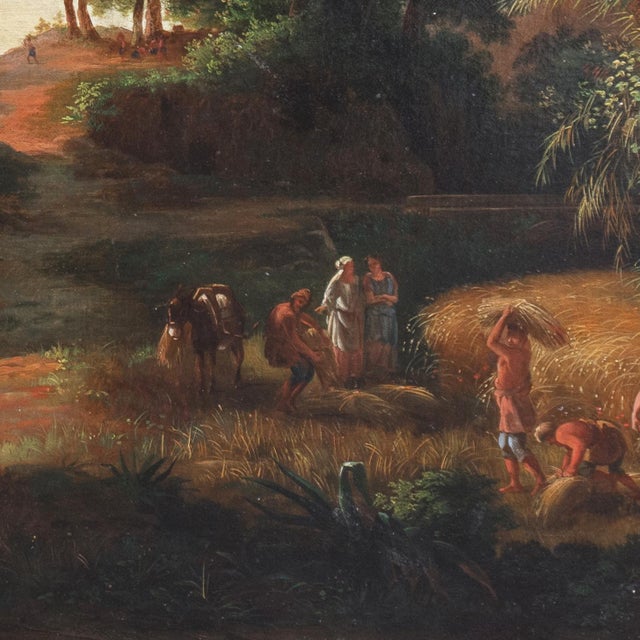
A substantial, 19th century figural showing the meeting of Ruth and …
Read more
After the original by Károly Markó the Elder (1791–1860).
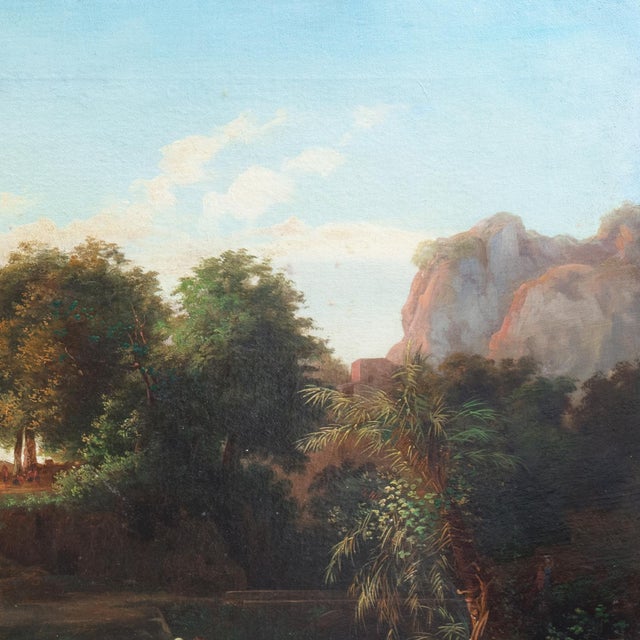
A substantial, 19th century figural showing the meeting of Ruth and Boaz, set in a romantic Italianate landscape peopled with numerous other figures.
Unsigned and painted circa 1840.
Displayed in substantial and period gilt frame.
Framed dimensions: 31.5 H x 3 D x 39.5 W inches
Ruth, a Moabite widow, remained loyal to her mother-in-law Naomi, declaring, “Your people shall be my people, and your God my God.” Together they returned to Bethlehem, where Ruth gleaned grain in the fields of Boaz, a wealthy kinsman. Boaz admired her devotion and integrity, offering protection and generosity. Following Naomi’s counsel, Ruth sought Boaz as kinsman-redeemer. He honored her request, married her, and secured their lineage. Their son Obed became grandfather to King David, situating Ruth—once an outsider—within Israel’s royal line. The story embodies loyalty, providence, and redemption, echoing themes of faith and inclusion.
Károly Markó the Elder (1791–1860), revered as the “Hungarian Claude,” was the first Hungarian painter to devote himself fully to landscape. Born in Lőcse (today Levoča, Slovakia), he trained as an engineer before turning to art, studying drawing in Pest and later at the Vienna Academy. Between 1826 and 1830 he painted for the Esterházy estates at Kismarton, producing celebrated views such as Visegrád.
In 1832 he departed for Italy, working in Florence, Venice, Bologna, and Rome, where he absorbed the traditions of Claude Lorrain and Poussin. Illness forced him to remain in Pisa from 1838 to 1843, yet his reputation grew, earning him election to the Hungarian Academy of Sciences. By 1848 he had settled near Florence under the patronage of Count Gherardesca, creating luminous Italianate landscapes that defined his mature style.
His sons, András and Károly the Younger, carried forward the family name, while his own works remain in major collections. Markó is cited in Benezit and Thieme-Becker as the founding figure of Hungarian landscape painting.
See less
- Dimensions
- 29ʺW × 0.13ʺD × 21ʺH
- Styles
- Religious
- Traditional
- Frame Type
- Framed
- Period
- Late 19th Century
- Item Type
- Vintage, Antique or Pre-owned
- Materials
- Canvas
- Masonite
- Oil Paint
- Condition
- Good Condition, Original Design Modified, Some Imperfections
- Color
- Brown
- Condition Notes
- Good: painting: canvas laid down on masonite, restoration to secondary areas totaling less than 3% of the surface area, minor … moreGood: painting: canvas laid down on masonite, restoration to secondary areas totaling less than 3% of the surface area, minor age-toning; frame: minor losses, minor marks; shows well. less
Questions about the item?
Returns & Cancellations
Return Policy - All sales are final 48 hours after delivery, unless otherwise specified in the description of the product.
Cancellation Policy - Prior to shipping or local pickup, buyers may cancel an order for up to 48 hours, unless otherwise specified.
Related Collections
- Photorealism Canvas Paintings
- Ed Ruscha Paintings
- Photorealism Paintings in New York
- Richard Serra Paintings
- Herman Miller Paintings
- BDDW Paintings
- Louise Nevelson Paintings
- Karl-Erik Ekselius Paintings
- Carl-Axel Acking Paintings
- Joseph Stella Paintings
- James McCray Paintings
- Milton Avery Paintings
- Photorealism Paintings in Los Angeles
- Leroy Neiman Paintings
- Jaanika Peerna Paintings
- Vienna Secession Paintings
- Jo Baskerville Paintings
- Nicola Simbari Paintings
- Soicher Marin Paintings
- Cassina Paintings
- Black Photorealism Paintings
- Lawson-Fenning Paintings
- Jean-Paul Barray Paintings
- Hans Andersen Paintings
- Johannes Andersen Paintings