









Details
Description
Description of the item
a large ceremonial plate made of glazed ceramic and entirely hand-painted, produced by the royal ceramic …
Read more
Description of the item
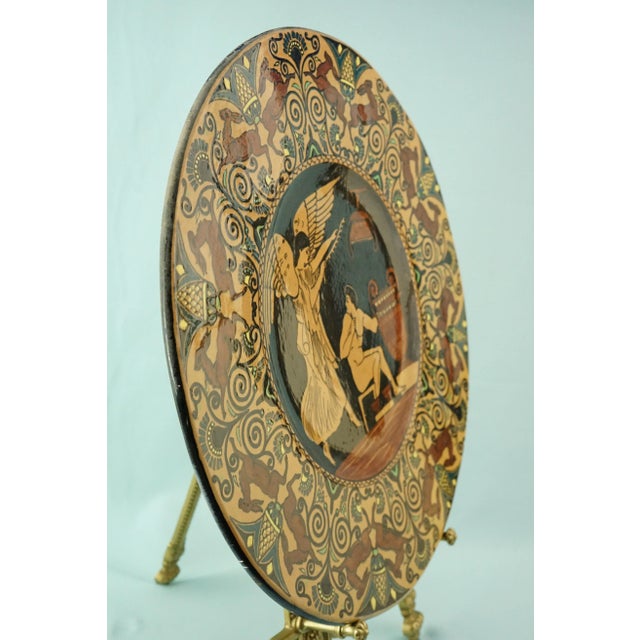
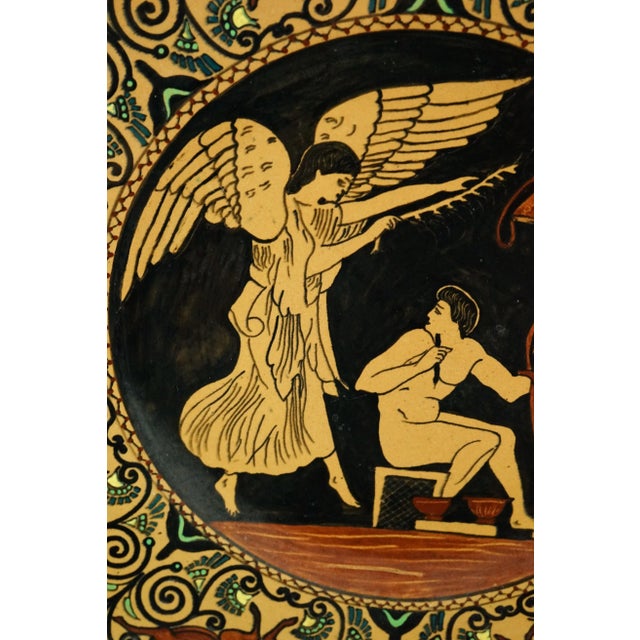
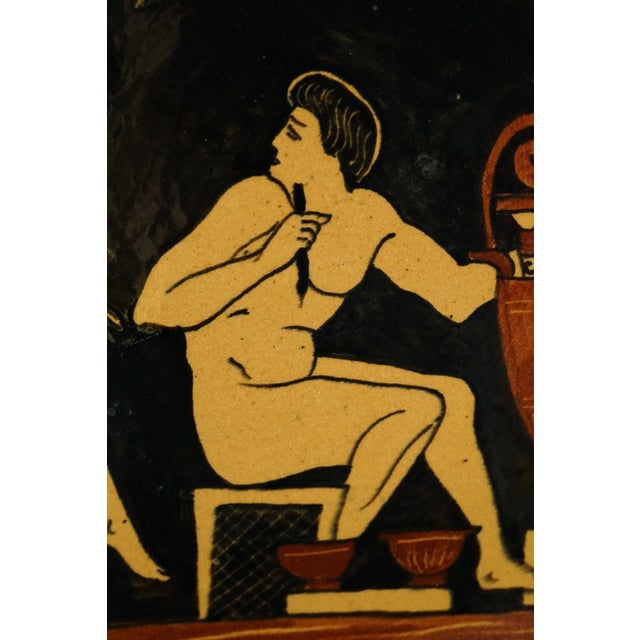
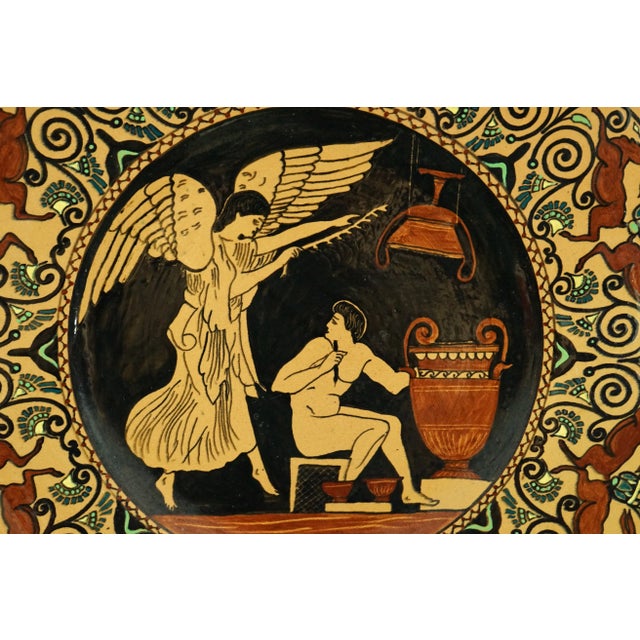
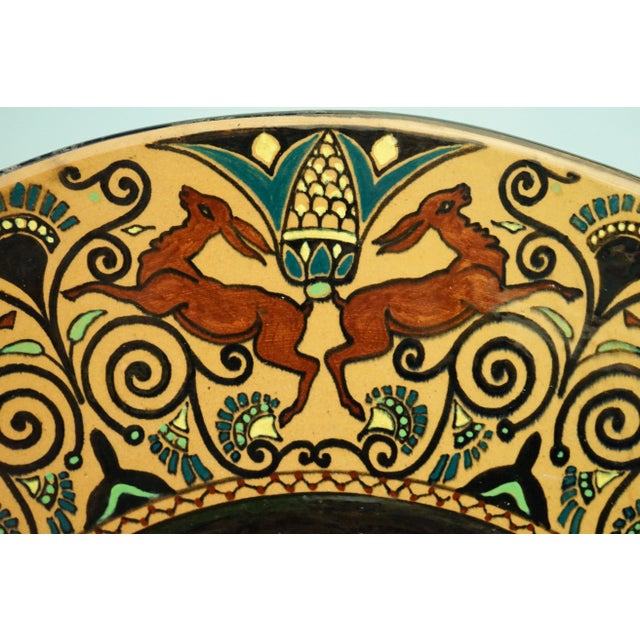
a large ceremonial plate made of glazed ceramic and entirely hand-painted, produced by the royal ceramic school of avellino in the 1920s and 1930s and signed “r.s.c. Avellino” on the back. It is a truly impressive piece, with a diameter of nearly half a meter and a thick, heavy bisque body, originally designed to be displayed on a wall like a genuine ceramic painting. The decoration is a refined homage to the vase painting of ancient greece. Within the rim, against an intense glossy black background, the figures are brush-painted in a warm ochre tone that mimics the color of ancient terracotta, and outlined with thin dark lines, just as in attic red-figure vases. A winged victory, nike from greek mythology, soars forward with her large wings spread and her light robe billowing in the wind, reaching out her arm toward a naked youth seated on a stool. Next to the young man stands a large volute krater; at his feet are two cups, and a small vase hangs on the wall: a collection of details that evokes life in the gymnasium and at the symposium, as well as the prize awarded to the winner. Some also interpret the figure as eos, the goddess of the dawn, who appears with the same wings in vase painting; in this case, the man would be tithonus. A narrow band of geometric motifs separates the scene from the wide rim, where an orientalizing-style frieze unfolds against a mustard-colored background: pairs of running hares, arranged back-to-back, alternate with large spirals, palmettes, fans of leaves, and lotus buds, embellished with touches of emerald green, turquoise, and yellow. The clean, stylized design of the animals, the bold colors, and the flat color fields reinterpret the greek repertoire with the modern sensibility of art deco style, which was very much in vogue during the years when the plate was created. The attribution is certain. On the reverse, on the exposed terracotta, appears the hand-painted initials “r.s.c. Avellino,” which stands for the regia scuola ceramica, accompanied by a name in cursive, likely that of the decorator who executed the plate. The designation “regia scuola” also allows us to date its creation to the years following 1924, when the institute adopted this name. The quality of the design, which precisely reinterprets greek models, is also consistent with the work of an art school that trained ceramic artists in the study of the great traditions of the past. The plate is in excellent condition on the front, with vivid colors and a glossy glaze, while the unglazed back shows natural signs of aging and retains the original cord for hanging on the wall. Ceramics from the regia scuola di avellino are now very rare on the market, and some examples are preserved in the collections of the city’s civic museum, attesting to the importance of this workshop.
information about the artist and/or manufacturer
the royal ceramics school of avellino was founded in 1882 as an evening school for applied arts in industry, one of many institutions established by the unified italian state to train skilled artisans and promote local artistic traditions. In 1905, it became the school of arts and crafts, offering daytime classes, and in 1924 it was transformed into the royal school of ceramic art, becoming part of the network of state-run schools dedicated to ceramics that—from faenza to castelli and grottaglie—revitalized the teaching of this art form in the early 20th century. Students were trained in drawing, modeling, and painting on ceramics, studying models from the classical and renaissance traditions. In campania, this study found an extraordinary point of reference in archaeological finds: the greek and magna graecian vases in the museums of naples, paestum, and the irpinia region inspired an “antique-style” production of great refinement, which already had a long tradition in nineteenth-century neapolitan workshops. The pieces produced in the school’s workshops—often created by the most talented teachers and students and presented in educational exhibitions—were made in limited quantities and are now very difficult to find. This piece has an attribution mark,
i am sure that it is completely authentic and take full responsibility for any authenticity
issues arising from misattribution
See less
- Dimensions
- 18.9ʺW × 1.57ʺD × 18.9ʺH
- Period
- 1920s
- Country of Origin
- Italy
- Item Type
- Vintage, Antique or Pre-owned
- Materials
- Ceramic
- Condition
- Good Condition, Original Condition Unaltered, Some Imperfections
- Color
- Red
Returns & Cancellations
Return Policy - All sales are final 48 hours after delivery, unless otherwise specified in the description of the product.
Cancellation Policy - Prior to shipping or local pickup, buyers may cancel an order for up to 48 hours, unless otherwise specified.
Related Collections
- Silk Decorative Plates
- Joseph Holdcroft Decorative Plates
- Ox Bow Decor Decorative Plates
- Kenneth Ludwig Chicago Decorative Plates
- Pickard China Decorative Plates
- Tatiana Alida Decorative Plates
- Soapstone Decorative Plates
- Tapio Wirkkala Decorative Plates
- Mixed-Media Decorative Plates
- Nickel Decorative Plates
- Japanese Decorative Plates
- Chinese Decorative Plates
- Fruit Plates
- Brass Decorative Plates
- Spanish Decorative Plates
- Copper Decorative Plates
- Italian Decorative Plates
- Chinoiserie Decorative Plates
- Piero Fornasetti Decorative Plates
- Blue Decorative Plates
- Wedgwood Decorative Plates
- Gold Decorative Plates
- Green Decorative Plates
- Metal Decorative Plates
- Folk Art Decorative Plates