

Details
Description
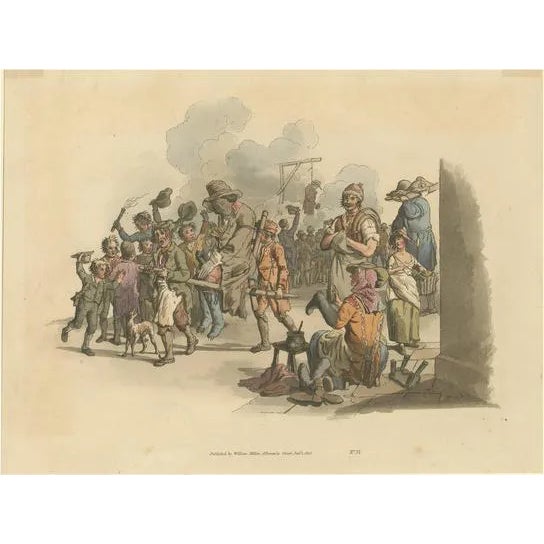
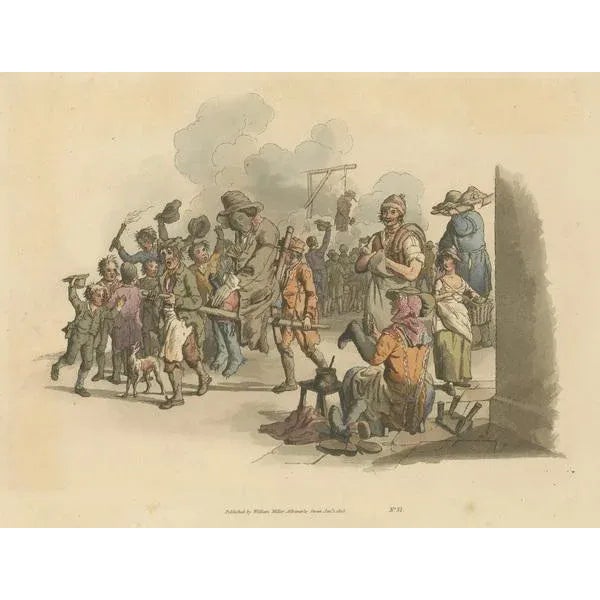
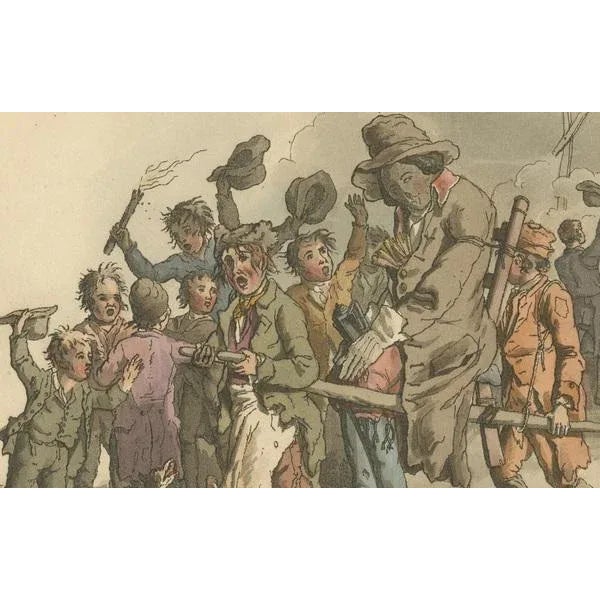
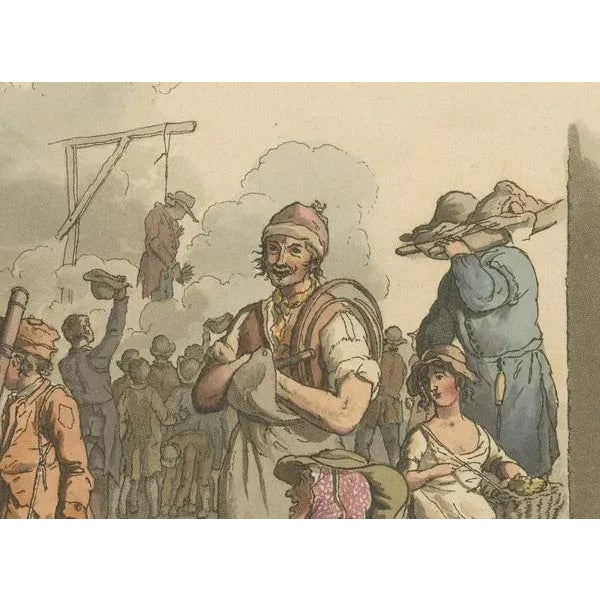
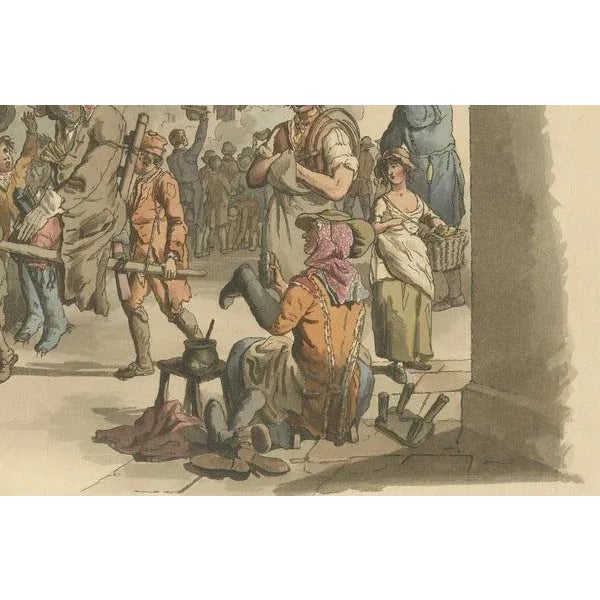
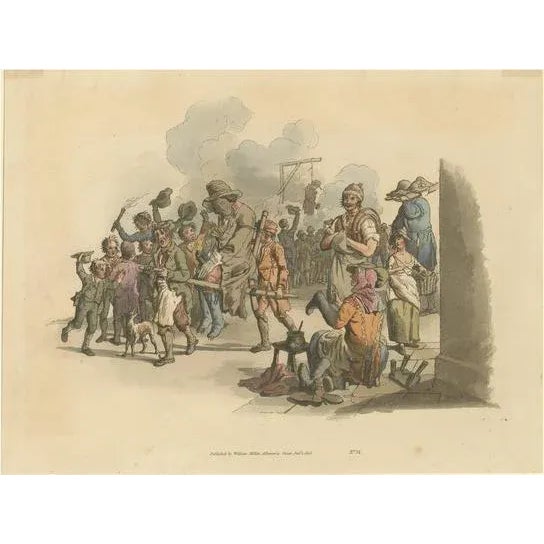
The mock procession of guy fawkes: a hand-colored aquatint by william henry pyne this captivating aquatint by william henry pyne, … Read more The mock procession of guy fawkes: a hand-colored aquatint by william henry pyne this captivating aquatint by william henry pyne, published by william miller, offers a vivid portrayal of a street scene that can be aptly related to the historical celebration of bonfire night, also known as guy fawkes night. The annual event on the 5th of november commemorates the foiled gunpowder plot of 1605, in which guy fawkes and his co-conspirators attempted to blow up the house of lords in london. In the print, we witness a chaotic yet lively scene filled with exuberant characters, mirroring the festive atmosphere of bonfire night. Central to the image is a mock procession, likely depicting a satirical reenactment of guy fawkes' capture and punishment, a common feature of the celebrations. Key elements of the scene: - foreground characters: the illustration brims with energy as a group of ragtag children and adults partake in the festivities. Some children wave hats and sticks, while others shout and cheer, embodying the spirited cries of "holler boys, holler boys, let the bells ring" from the famous rhyme. - central figure: a man dressed in tattered clothes, resembling guy fawkes, is carried on a makeshift chair by two other men. His weary expression hints at the gravity of his intended treason, now mocked by the jubilant crowd. - background activity: the background showcases additional figures, including a man carrying a large basket and another with a barrel, possibly filled with "three score barrels of powder" as mentioned in the rhyme. Rising smoke suggests bonfires burning in the distance, a hallmark of the night's celebrations. - right side of the scene: to the right, a seated woman cooks over a small pot, while another woman with a basket watches the spectacle. These details evoke the community gatherings around bonfires, where people share food and revel in the shared history. Historical context: the print beautifully encapsulates the essence of bonfire night, a tradition rooted in the failed gunpowder plot of 1605. Every year, on the 5th of november, people across the uk light bonfires, set off fireworks, and recite the rhyme: ``` remember, remember, the 5th of november, gunpowder, treason, and plot. I see no reason why gunpowder treason should ever be forgot. Guy fawkes, guy fawkes, 'twas his intent to blow up the king and the parliament. Three score barrels of powder below, poor old england to overthrow. By god's providence, he was catch'd with a dark lantern and burning match. Holler boys, holler boys, let the bells ring. Holler boys, holler boys, god save the king! ``` this print serves as a fascinating historical artifact, reflecting the enduring cultural memory and collective festivities that commemorate the thwarted attempt to change the course of english history. It invites viewers to not only appreciate the artistic skill of william henry pyne but also to remember the dramatic events of november 5th, 1605, and the centuries-old traditions that followed. ### of the aquatint technique used the aquatint technique, employed by william henry pyne in creating this vivid street scene, is a variant of etching that allows for the creation of tonal variations, giving prints a rich, watercolor-like effect. Here’s a detailed look at the process and its application in this artwork: #### the aquatint process: 1. **preparation of the plate**: a copper or zinc plate is used as the base. The plate is first cleaned thoroughly to remove any grease or impurities. 2. **applying the ground**: the plate is coated with a fine layer of powdered resin or a similar material. This resin will create a resist that protects the plate from acid. The plate is then heated so that the resin melts and adheres to the surface, forming a rough, grainy texture. 3. **etching the plate**: the artist immerses the prepared plate in an acid bath. The acid bites into the metal around the resin grains, creating tiny pits that will hold ink. The longer the plate is left in the acid, the deeper the pits and the darker the resulting tones. 4. **creating tones**: to achieve varying shades, the artist may apply a stop-out varnish to parts of the plate and re-immerse it in the acid bath multiple times. This step-by-step etching process allows for the creation of a range of tones, from light greys to deep blacks. 5. **detailing with line etching**: to add finer details, the artist can combine aquatint with traditional line etching. Lines are incised directly into the plate using an etching needle or other tools, allowing for precise and intricate details. 6. **inking and printing**: once the etching process is complete, the plate is inked. The ink fills the etched lines and pits. The surface is then wiped clean, leaving ink only in the etched areas. The plate is then pressed onto a damp sheet of paper using a printing press, transferring the ink to create the final print. #### application in pyne’s aquatint: - **tonal variation**: pyne skillfully uses the aquatint technique to create a dynamic range of tones, giving depth and dimension to the scene. The smoky background, varying shades of clothing, and the subtle shadows add realism and a three-dimensional quality to the print. - **detail and texture**: the combination of aquatint and line etching allows for detailed depictions of the characters’ expressions, clothing textures, and intricate elements like the smoke and distant figures. - **hand coloring**: after printing, the aquatint is hand-colored, enhancing the visual impact. The colors bring vibrancy to the scene, highlighting the lively atmosphere and intricate details that define the narrative of the street scene. By employing the aquatint technique, pyne achieves a balance of tonal richness and detailed precision, making his work not only a visual delight but also a testament to the intricate craftsmanship involved in historical printmaking. This method allows him to effectively capture the chaotic energy and communal spirit of the bonfire night celebrations depicted in the scene. See less
- Dimensions
- 12.99ʺW × 9.84ʺH
- Art Subjects
- Figure
- Period
- Early 19th Century
- Item Type
- Vintage, Antique or Pre-owned
- Materials
- Paper
- Condition
- Good Condition, Unknown, Some Imperfections
- Color
- Copper
- Condition Notes
- Very Good — This vintage item has no defects, but it may show slight traces of use\. Very good condition, … moreVery Good — This vintage item has no defects, but it may show slight traces of use\. Very good condition, especially considering its age. General age-related toning and/or occasional minor defects from handling. Loosely attached to a paper backing with two small pieces of acid free tape. Rare in this condition. less
Returns & Cancellations
Return Policy - All sales are final 48 hours after delivery, unless otherwise specified in the description of the product.
Cancellation Policy - Prior to shipping or local pickup, buyers may cancel an order for up to 48 hours, unless otherwise specified.
Related Collections
- Rattan Original Prints
- Medium-Density Fibreboard Original Prints
- Soicher Marin Original Prints
- Original Prints in Salt Lake City
- Original Prints in Panama City, FL
- Ralph Lauren Original Prints
- Damien Hirst Original Prints
- Sam Francis Original Prints
- Dye Transfer Original Prints
- Silver Finish Original Prints
- Johannes Kip Original Prints
- Original Prints in Lexington, KY
- Botanical Prints
- Framed Prints
- Bird Prints
- Woodblock Prints
- Screen Prints
- Japanese Woodblock Prints
- Thomas McKnight Original Prints
- George Barbier Original Prints
- Frank Stella Original Prints
- Gustave Baumann Original Prints
- Teak Original Prints
- Clay Original Prints
- Chaim Gross Original Prints