






Details
Description
This captivating 1601 copper engraving by Theodore de Bry from his "Indiae Orientalis" series portrays a vivid tableau of India’s …
Read more
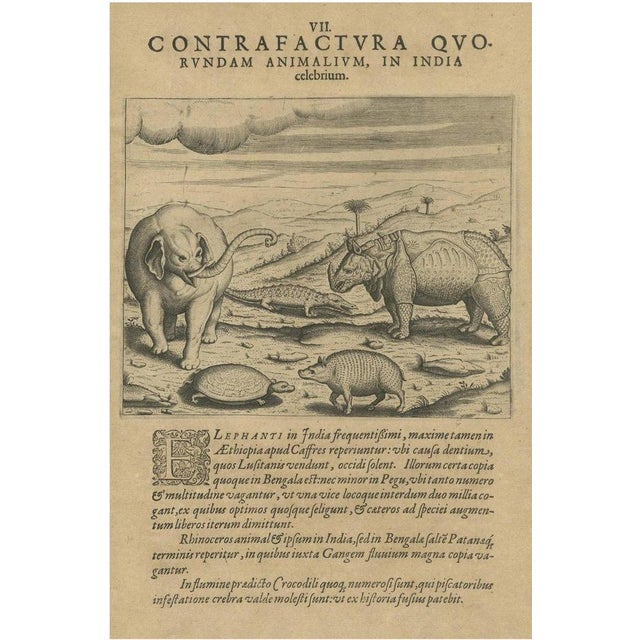
This captivating 1601 copper engraving by Theodore de Bry from his "Indiae Orientalis" series portrays a vivid tableau of India’s diverse wildlife, offering a snapshot of the region's exotic fauna as perceived by European explorers of the time. In the foreground, an elephant stands prominently, a symbol of the Indian subcontinent's rich natural heritage. It is accompanied by an armored rhinoceros and a crocodile, representing the dangerous and untamed aspect of the wild. A serene turtle completes the scene, providing a contrast to the more formidable creatures surrounding it.
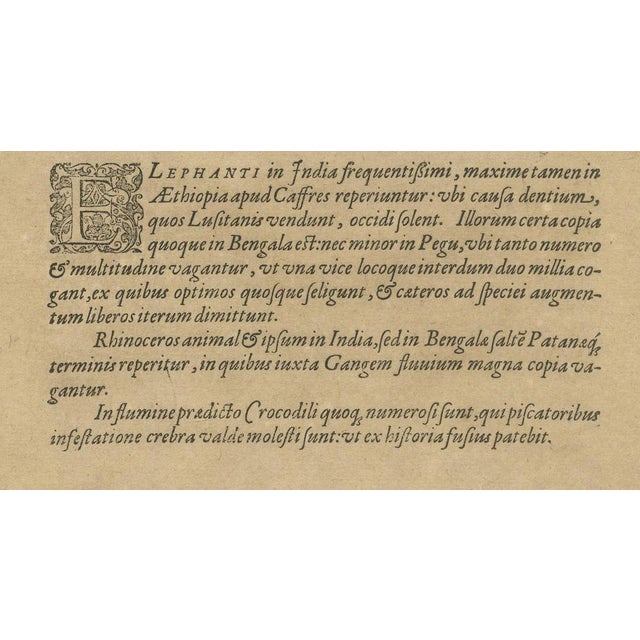
The text is a section of Latin writing, which appears to describe the wildlife in India. Here is the English translation: "Elephants are most frequent in India, especially in Ethiopia among the Kaffirs, where they are hunted for their tusks, which the Portuguese are known to sell to the west. Their great number also roams in Bengal, and not less in Pegu, where they are seen in such great numbers that they are occasionally found together in herds of up to two thousand. from these, the finest are selected, and the rest are let go to propagate their species. The rhinoceros is also an animal found in India, but especially in Bengal near Patna, within the territory where, near the Ganges River, a great number are hunted. In the aforesaid river, there are also numerous crocodiles which cause much trouble to the fishermen due to their frequent attacks, as the history of their behavior will relate."
This engraving reflects the European fascination with the natural world during the Age of Discovery. De Bry’s meticulous attention to detail and the dynamic composition of the scene capture the viewer's imagination and transport them to the landscapes of early modern India. Each animal is rendered with a blend of accuracy and artistic license, revealing the blend of observation and myth that characterized European views of distant lands. As an original piece from the first edition of Part VII of "Indiae Orientalis," this work is a valuable collector's item, not only for its historical significance but also for its aesthetic beauty and the window it opens onto the perceptions and curiosities of a bygone era. It stands as a testament to the wonder and allure that the flora and fauna of India held for the European mind, and it would serve as a prestigious and conversation-evoking piece for any collection.
This plate is part of the "Petit Voyages" or "Small Voyages," a series that complemented the "Grands Voyages" or "Great Voyages." Theodore de Bry, a noted engraver and publisher from Liège, Belgium, began these works to illustrate the New World and the Far East based on accounts and drawings from explorers. His works grew to comprise 30 volumes, with later editions published by his children after his death. This particular engraving is a testament to the enduring allure of the unknown that captivated the minds of Europeans during the Age of Exploration. This piece forms part of a larger corpus of works produced under the supervision of the de Bry family, a lineage of renowned engravers and publishers based in Frankfurt. Initiated by Theodore de Bry in 1590, this series aimed to visually document the epoch of European global exploration and the encounters with the natural world that ensued. The engraving is a page from Part IV of de Bry's "Petits Voyages," which narrates significant expeditions to the East Indies, including those led by Jan Juygen van Linschoten and Cornelis de Houtman between 1595-97, as well as the journey by Jacob van Neck and Wybrandt van Warwijck in 1598-99. These works were not merely artistic endeavors but also ethnographic records, showcasing indigenous peoples, fauna, flora, and the diverse riches of lands like India, Madagascar, and the East Indies. Though Theodore de Bry began this ambitious project, it was continued posthumously by his family and later completed by his son-in-law, Matthaus Merian, in 1644. This particular engraving, rich in detail and drama, offers a window into the perilous and wondrous experiences of early explorers, and the ways in which these moments were captured and communicated to a European audience hungry for knowledge of the wider world.
See less
- Dimensions
- 7.87ʺW × 11.81ʺH
- Art Subjects
- Nude
- Period
- 17th Century
- Item Type
- Vintage, Antique or Pre-owned
- Materials
- Paper
- Condition
- Good Condition, Unknown, Some Imperfections
- Color
- Beige
- Condition Notes
- Very Good — This vintage item has no defects, but it may show slight traces of use\. The condition of … moreVery Good — This vintage item has no defects, but it may show slight traces of use\. The condition of the print is very good, considering its age of over 400 years. Light brownish toning and some soiling due to handling, mainly around the edges. Please study this image carefully. less
Returns & Cancellations
Return Policy - All sales are final 48 hours after delivery, unless otherwise specified in the description of the product.
Cancellation Policy - Prior to shipping or local pickup, buyers may cancel an order for up to 48 hours, unless otherwise specified.
Related Collections
- Rattan Original Prints
- Soicher Marin Original Prints
- Medium-Density Fibreboard Original Prints
- Silver Finish Original Prints
- Original Prints in Panama City, FL
- Ralph Lauren Original Prints
- Original Prints in Salt Lake City
- Damien Hirst Original Prints
- Original Prints in Lexington, KY
- Johannes Kip Original Prints
- Sam Francis Original Prints
- Dye Transfer Original Prints
- Botanical Prints
- Framed Prints
- Bird Prints
- Woodblock Prints
- Screen Prints
- Japanese Woodblock Prints
- Thomas McKnight Original Prints
- George Barbier Original Prints
- Frank Stella Original Prints
- Gustave Baumann Original Prints
- Teak Original Prints
- Louis XIII Original Prints
- Clay Original Prints