


Details
Description
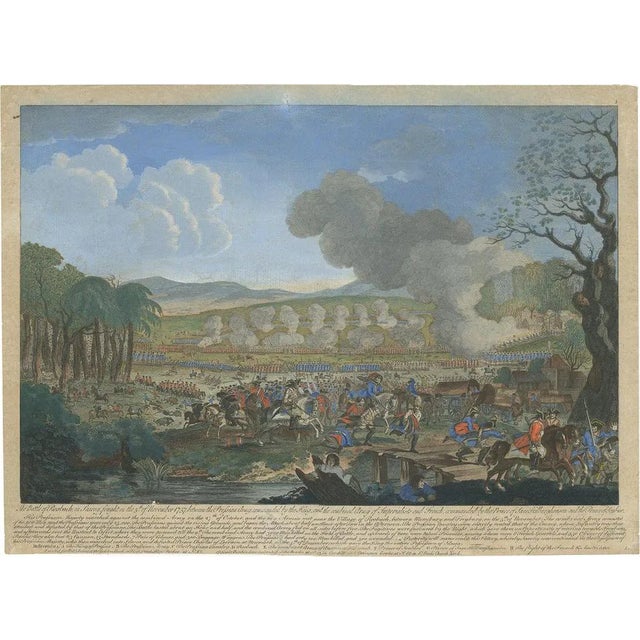
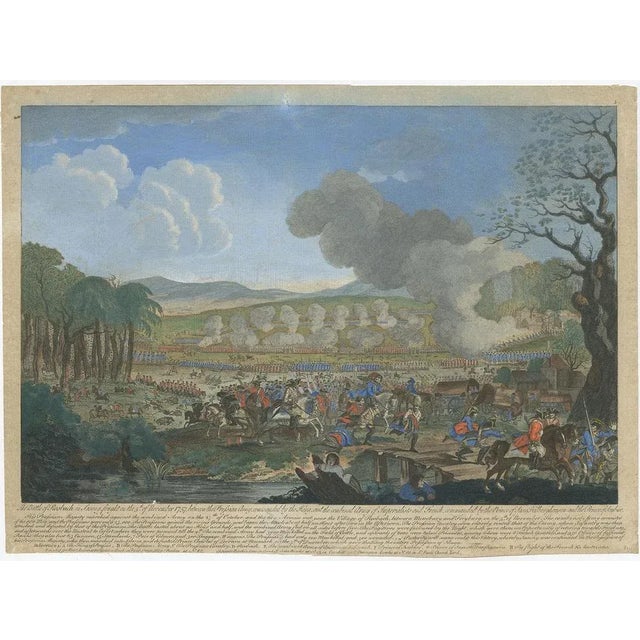
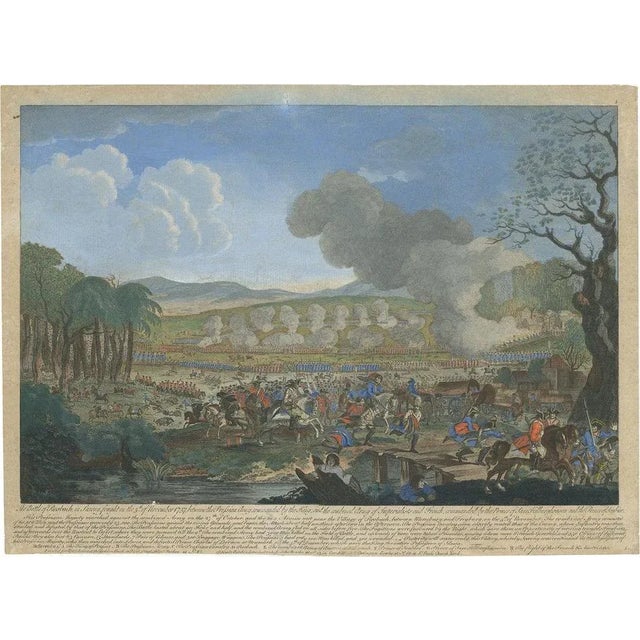
Antique print titled 'The Battle of Rosbach in Saxony, fought on the 5th of November 1757 (\.)'. Antique print depicting … Read more Antique print titled 'The Battle of Rosbach in Saxony, fought on the 5th of November 1757 (\.)'. Antique print depicting the Battle of Rossbach in Prussian Saxony. Frederick the Great defeated the allied armies of France and the Holy Roman/Austrian Empire. The Battle of Rossbach took place on 5 November 1757 during the Third Silesian War (1756–1763, part of the Seven Years' War) near the village of Rossbach, in the Electorate of Saxony. It is sometimes called the Battle of, or at, Reichardtswerben, after a different nearby town. In this 90-minute battle, Frederick the Great, king of Prussia, defeated an Allied army composed of French forces augmented by a contingent of the Reichsarmee (Imperial Army) of the Holy Roman Empire. The French and Imperial army included 41,110 men, opposing a considerably smaller Prussian force of 22,000. Despite overwhelming odds, Frederick employed rapid movement, a flanking maneuver and oblique order to achieve complete surprise. The Battle of Rossbach marked a turning point in the Seven Years' War, not only for its stunning Prussian victory, but because France refused to send troops against Prussia again and Britain, noting Prussia's military success, increased its financial support for Frederick. Following the battle, Frederick immediately left Rossbach and marched for 13 days to the outskirts of Breslau. There he met the Austrian army at the Battle of Leuthen; he employed similar tactics to again defeat an army considerably larger than his own. Rossbach is considered one of Frederick's greatest strategic masterpieces. He crippled an enemy army twice the size of the Prussian force while suffering negligible casualties. His artillery also played a critical role in the victory, based on its ability to reposition itself rapidly responding to changing circumstances on the battlefield. Finally, his cavalry contributed decisively to the outcome of the battle, justifying his investment of resources into its training during the eight-year interim between the conclusion of the War of Austrian Succession and the outbreak of the Seven Years' War. Artists and Engravers: Printed for R. Sayer. Condition: Fair, age-related toning. Some defects, repairs and tears. Please study image carefully. See less
- Dimensions
- 18.5ʺW × 13.78ʺH
- Item Type
- Vintage, Antique or Pre-owned
- Materials
- Paper
- Condition
- Unknown, Some Imperfections
- Color
- Black
- Condition Notes
- Good — This vintage item remains fully functional, but it shows sign of age through scuffs, dings, faded finishes, minimal … moreGood — This vintage item remains fully functional, but it shows sign of age through scuffs, dings, faded finishes, minimal upholstery defects, or visible repairs\. Repaired, Some defects, Repairs and tears less
Returns & Cancellations
Return Policy - All sales are final 48 hours after delivery, unless otherwise specified in the description of the product.
Cancellation Policy - Prior to shipping or local pickup, buyers may cancel an order for up to 48 hours, unless otherwise specified.
Related Collections
- Le Corbusier Posters
- Posters in Naples, FL
- Posters in Savannah
- Ceramic Posters
- Baroque Posters
- Claes Oldenburg Posters
- Silk Posters
- Screen Print Posters
- Marc Chagall Posters
- Art Deco Posters
- Mid-Century Modern Posters
- Mark Rothko Posters
- Pablo Picasso Posters
- French Posters
- Posters in Los Angeles
- Milton Avery Posters
- Peter Max Posters
- Museum Posters
- Lee Krasner Posters
- Japanese Posters
- Polish Posters
- Keith Haring Posters
- Framed Posters
- Posters in Orlando
- Woodcut Posters