





Details
Description
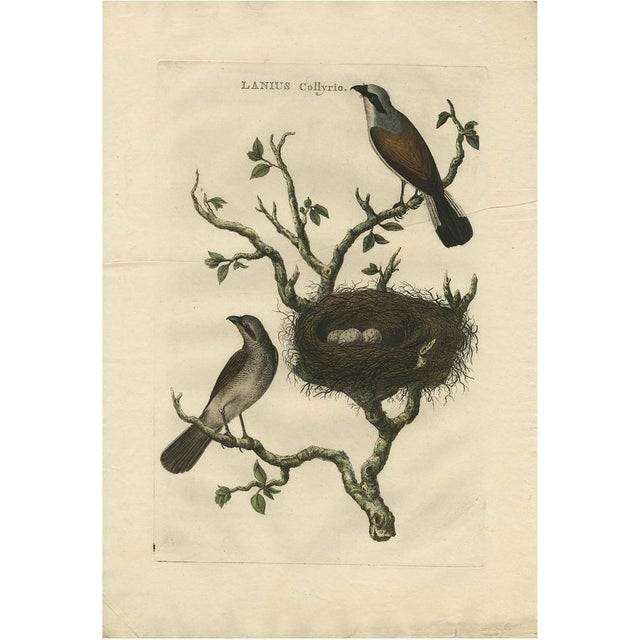
The image is an original antique hand-colored engraving from "Nederlandsche Vogelen" (Dutch Birds), which translates to "Dutch Birds; described according …
Read more
The image is an original antique hand-colored engraving from "Nederlandsche Vogelen" (Dutch Birds), which translates to "Dutch Birds; described according to their domestic, nature, and characteristics." This work was a monumental publication in the history of Dutch ornithology and was produced over a span of nearly six decades, from 1770 to 1829. Cornelis Nozeman initiated the project, and after his death, Martinus Houttuyn continued the work, which was later finished by Jan Christiaan Sepp, a Dutch engraver. Sepp was not only the engraver but also the publisher, which was quite common in the 18th century as engravers often took on multiple roles in the production of books. The engraving features the red-backed shrike (Lanius collurio), a bird known for its characteristic behavior of impaling prey on thorns. The level of detail in the image reflects the high standards of natural history illustration at the time, with an emphasis on accurate depictions of the birds in their natural habitat and, as mentioned, often close to life size. The birds are shown with a keen attention to detail, capturing their physical characteristics with scientific accuracy, which was essential for the study of ornithology. The natural setting includes a nest with eggs, which adds to the illustration's educational value by providing insight into the species' reproductive habits. "Nederlandsche Vogelen" was notable for its size, the beauty of its hand-colored plates, and its comprehensive approach to the subject matter. It is considered a significant contribution to the ornithological record and an exquisite example of Dutch craftsmanship in book production and natural history illustration of that era. The red-backed shrike depicted in the hand-colored engraving is an intriguing bird species, known scientifically as Lanius collurio. It's part of the shrike family, a group of birds that are also colloquially known as "butcher birds" due to their distinctive feeding habit of impaling prey on thorns or barbed wire as a form of storage. This behavior is particularly interesting from an ornithological perspective as it demonstrates a unique adaptation for hunting and food preservation. The bird itself is small to medium-sized and, as the name suggests, the male typically has a striking red back, which contrasts with its slate-gray head and black mask through the eyes. The female is usually less vividly colored, with brownish tones replacing the red. This sexual dimorphism is quite common in the animal kingdom and is often related to mating and territorial displays. In the engraving, the illustrator has taken great care to depict the birds with anatomical precision and in a naturalistic pose. The detailed illustration likely shows a male and a female due to the coloration differences, engaging in their natural behavior around a nest, which emphasizes the importance of family and species continuation. The hand-coloring process would have been done after the initial engraving, which involves etching the image onto a surface. Once the basic image was created, colorists would apply watercolors by hand to each individual print, making each one subtly unique. This labor-intensive process reflects the high value placed on such prints during the period they were produced. Moreover, the depiction of the bird's environment—the nest with eggs, the branch, the foliage—would have been an important aspect for the book's readers. During the time "Nederlandsche Vogelen" was produced, there was a burgeoning interest in natural history and the study of organisms in their natural context. Hence, showing birds in their habitats would have been both educational and appealing, capturing the attention of both scientific and lay audiences of the time. The attention to such detail in the engraving serves as an early example of ecological thinking in scientific illustration, portraying the organism within the complexity of its environment rather than in isolation. This piece is attributed to the mentioned designer/maker. It has no attribution mark and no
official proof of authenticity,
however it is well documented in design history. I take full responsibility for any authenticity
issues arising from misattribution
See less
- Dimensions
- 14.57ʺW × 21.26ʺH
- Art Subjects
- Nude
- Period
- 18th Century
- Country of Origin
- Netherlands
- Item Type
- Vintage, Antique or Pre-owned
- Materials
- Paper
- Condition
- Good Condition, Unknown, Some Imperfections
- Color
- Black
Returns & Cancellations
Return Policy - All sales are final 48 hours after delivery, unless otherwise specified in the description of the product.
Cancellation Policy - Prior to shipping or local pickup, buyers may cancel an order for up to 48 hours, unless otherwise specified.
Related Collections
- Rattan Original Prints
- Soicher Marin Original Prints
- Medium-Density Fibreboard Original Prints
- Silver Finish Original Prints
- Original Prints in Panama City, FL
- Ralph Lauren Original Prints
- Original Prints in Salt Lake City
- Damien Hirst Original Prints
- Original Prints in Lexington, KY
- Johannes Kip Original Prints
- Sam Francis Original Prints
- Dye Transfer Original Prints
- Botanical Prints
- Framed Prints
- Bird Prints
- Woodblock Prints
- Screen Prints
- Japanese Woodblock Prints
- Thomas McKnight Original Prints
- George Barbier Original Prints
- Frank Stella Original Prints
- Gustave Baumann Original Prints
- Teak Original Prints
- Louis XIII Original Prints
- Clay Original Prints