




Details
Description
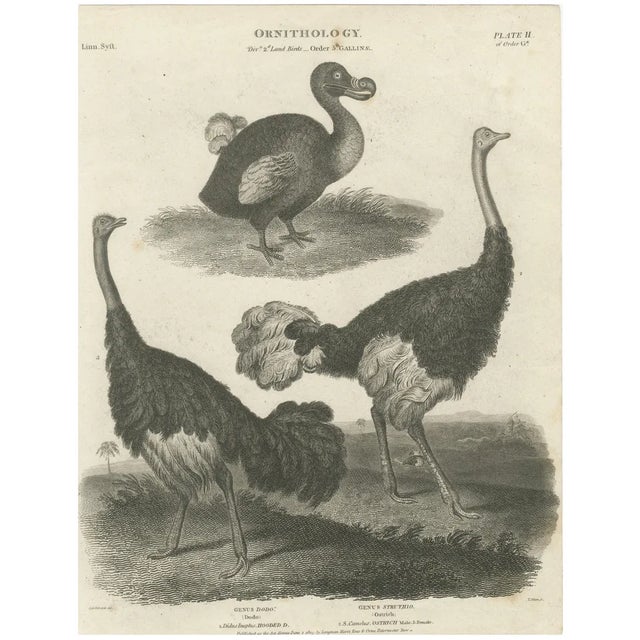
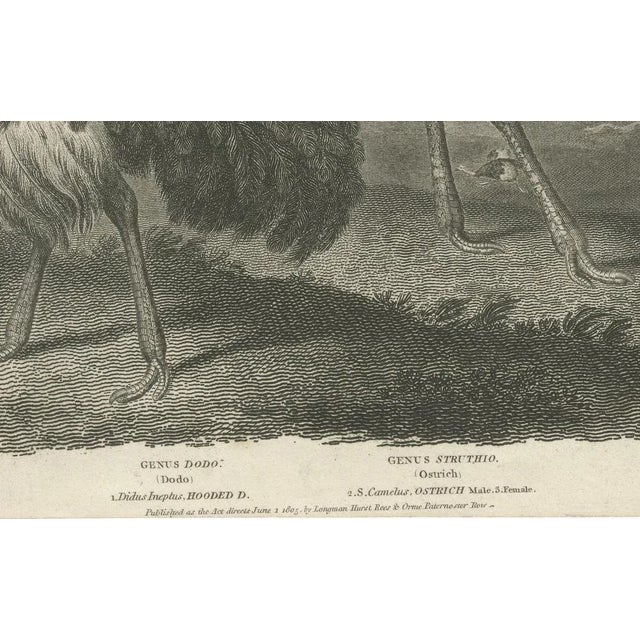
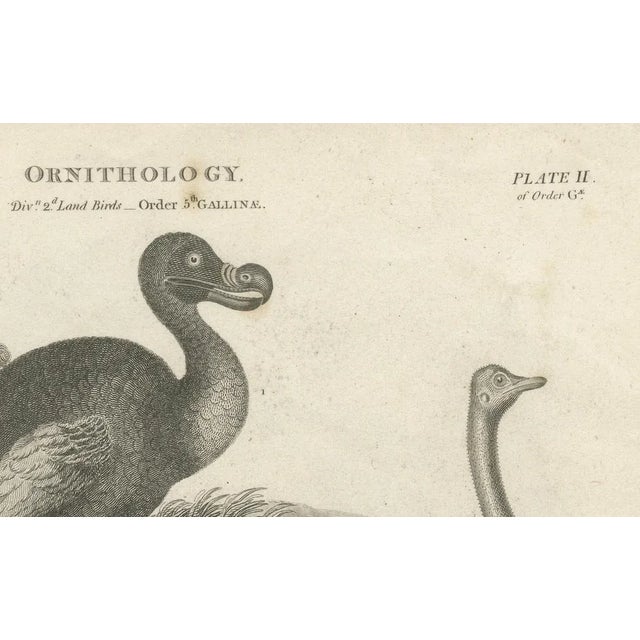
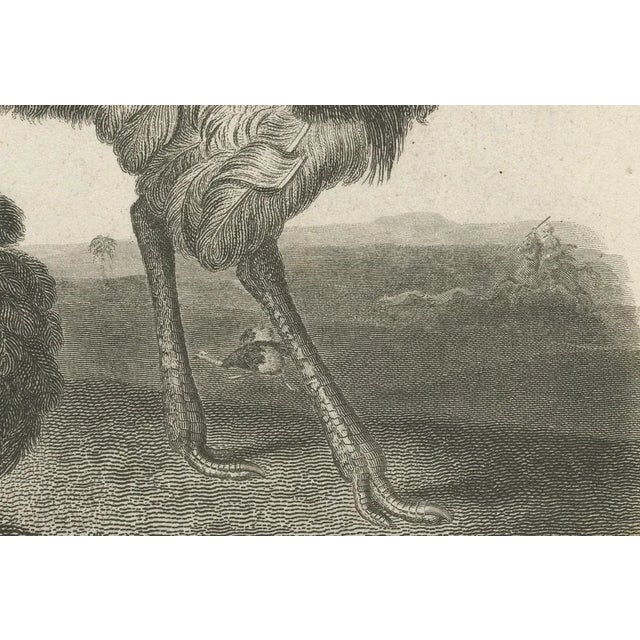
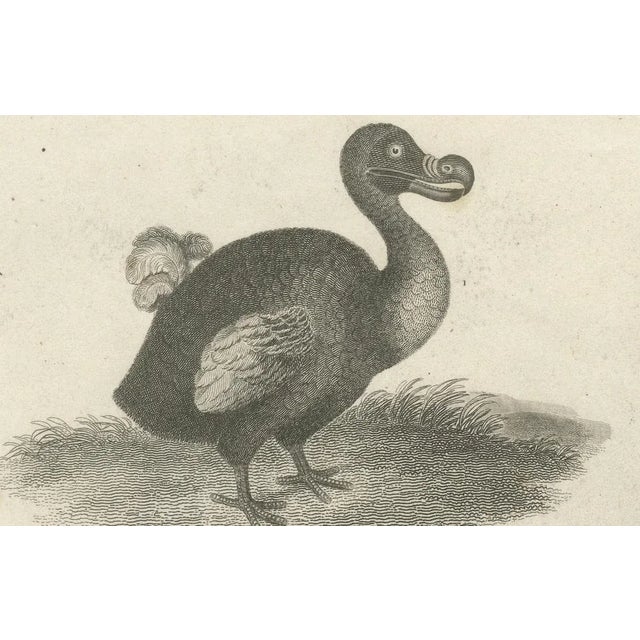
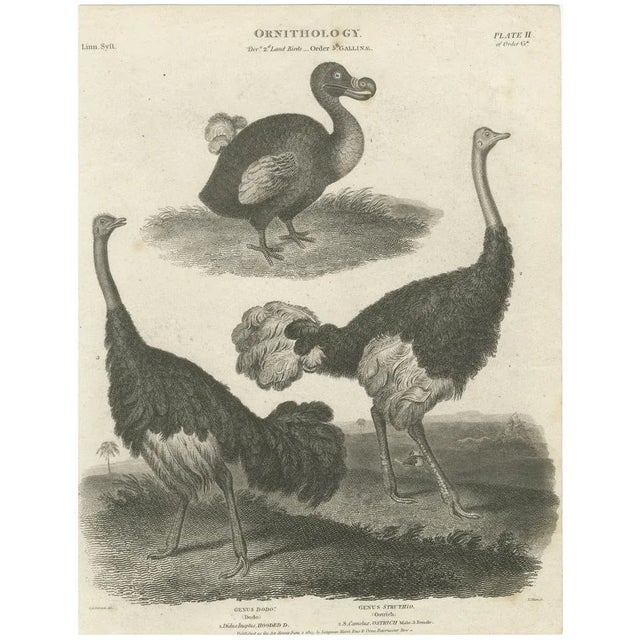
1805 Copperplate Engraving of Dodo and Ostrich from Abraham Rees' Cyclopaedia This rare and finely detailed copperplate engraving, created by … Read more 1805 Copperplate Engraving of Dodo and Ostrich from Abraham Rees' Cyclopaedia This rare and finely detailed copperplate engraving, created by T. Milton after an illustration by the renowned Sydenham Edwards, is a stunning piece of 19th-century natural history art. It was originally published in Abraham Rees' *Cyclopaedia or Universal Dictionary of Arts, Sciences, and Literature* in London, 1805. The engraving prominently features the extinct Dodo (Raphus cucullatus), a flightless bird native to Mauritius that became a symbol of human-driven extinction. The dodo is depicted with its iconic plump body, curved beak, and robust legs, offering a glimpse into the natural history of a species lost to time. Alongside the dodo are male and female Ostriches (Struthio camelus), the largest living birds, rendered with exquisite detail, showcasing their striking plumage and characteristic postures. Antique copper plate engraving from "The Cyclopædia: or, Universal dictionary of arts, sciences, and literature" by Abraham Rees, published in the early 19th century. The engraving features illustrations of two notable bird species, the dodo and the ostrich, classified under the order 'Gallinae' according to Linnaean taxonomy. Echoes of Avian Majesty: The Dodo and Ostrich of the Early 19th Century. This also would have been a good title, one that pays homage to the grandeur of these birds, with the dodo being an emblem of extinction and the ostrich representing the grand scale of birds still walking the Earth. It also reflects the time period and the scientific interest in ornithology. More facts about the Dodo explaining why the Dodo prints are so popular with collectors of antique prints: The dodo is a bird that has become an icon of extinction. Its story is a sad tale of the impact of human activity on the environment and the species that inhabit it. Discovery and : The dodo (Raphus cucullatus) was a flightless bird that lived on the island of Mauritius in the Indian Ocean. It was first discovered by Dutch sailors around 1598. The bird was about one meter tall and weighed about 10-18 kilograms (20-40 pounds). It had a large beak, a plump body, small wings, and stout, yellow legs. Extinction: The dodo's extinction is attributed to a combination of human exploitation and introduced species. Being flightless and having evolved without any natural predators, the dodo was not fearful of humans. This, along with its inability to fly, made it an easy target for the sailors who would hunt it for food. Additionally, the introduction of animals such as pigs, rats, and monkeys by humans led to increased competition for food resources and predation of dodo eggs and young. Cultural Impact: The dodo became extinct in the late 17th century, less than 100 years after it was discovered. It is often used as a cautionary example of how human intervention can inadvertently lead to the demise of a species. The term "dodo" has since become synonymous with anything outdated or destined for failure or obsolescence. Scientific Importance: In a scientific context, the dodo has been the subject of much interest and study. The lack of complete dodo specimens has made it difficult for researchers to fully understand its behavior, ecology, and exact appearance. However, the discovery of subfossil remains has allowed for some reconstruction of its physical form and genetics. Cultural Representation: Culturally, the dodo remains a fixture in literature and popular culture, most famously appearing in Lewis Carroll's "Alice's Adventures in Wonderland," which helped cement its image in the public imagination. The story of the dodo serves as a poignant reminder of the vulnerability of isolated ecosystems to human impacts and has informed conservation efforts for other species at risk of extinction. This plate exemplifies the synthesis of art and science in early 19th-century publications, providing both aesthetic and educational value. The detailed illustration and expert craftsmanship highlight the scientific rigor and artistic skill that went into Rees' monumental work. Condition: The engraving is in excellent condition for its age, with crisp detailing and only minimal signs of toning or foxing typical of historical prints. Lower border a bit cut short, otherwise fine for framing. This exceptional engraving is a must-have for collectors of natural history, antique prints, or those seeking to own a tangible piece of the past. It would make a striking addition to any collection or serve as a unique statement piece for display. See less
- Dimensions
- 8.27ʺW × 10.24ʺH
- Art Subjects
- Animals
- Period
- 19th Century
- Item Type
- Vintage, Antique or Pre-owned
- Materials
- Paper
- Condition
- Good Condition, Unknown, Some Imperfections
- Color
- Copper
- Condition Notes
- Very Good — This vintage item has no defects, but it may show slight traces of use\. Condition: The engraving … moreVery Good — This vintage item has no defects, but it may show slight traces of use\. Condition: The engraving is in excellent condition for its age, with crisp detailing and only minimal signs of toning or foxing typical of historical prints. Lower border a bit cut short, otherwise fine for framing. less
Returns & Cancellations
Return Policy - All sales are final 48 hours after delivery, unless otherwise specified in the description of the product.
Cancellation Policy - Prior to shipping or local pickup, buyers may cancel an order for up to 48 hours, unless otherwise specified.
Related Collections
- Soicher Marin Original Prints
- Rattan Original Prints
- Medium-Density Fibreboard Original Prints
- Silver Finish Original Prints
- Robert Kipniss Original Prints
- Dye Transfer Original Prints
- Original Prints in Panama City, FL
- Ralph Lauren Original Prints
- Original Prints in Salt Lake City
- Original Prints in Lexington, KY
- Damien Hirst Original Prints
- Sam Francis Original Prints
- Johannes Kip Original Prints
- Botanical Prints
- Framed Prints
- Bird Prints
- Woodblock Prints
- Screen Prints
- Japanese Woodblock Prints
- Thomas McKnight Original Prints
- George Barbier Original Prints
- Frank Stella Original Prints
- Gustave Baumann Original Prints
- Teak Original Prints
- Chaim Gross Original Prints