




Details
Description
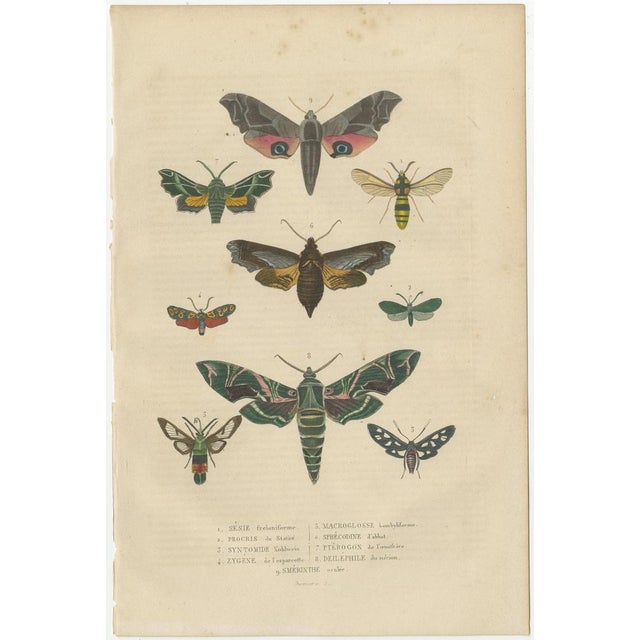
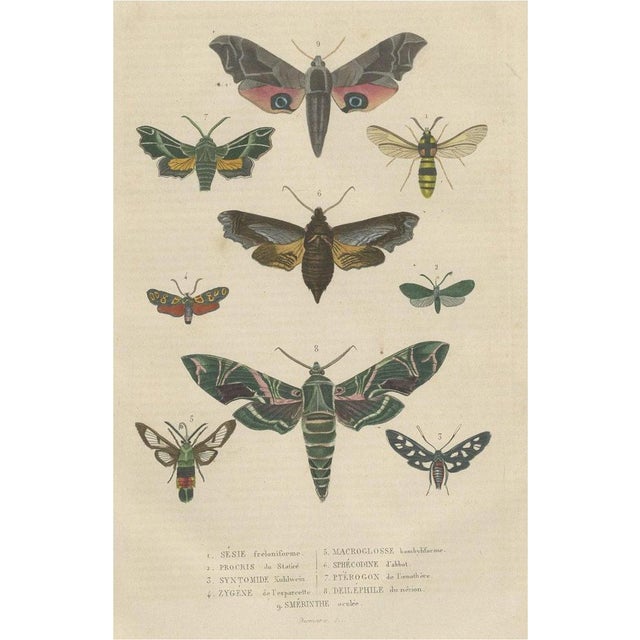
An antique hand-colored engraving. This particular illustration focuses on various moth and butterfly species, showcasing their wing patterns and body … Read more An antique hand-colored engraving. This particular illustration focuses on various moth and butterfly species, showcasing their wing patterns and body shapes in vibrant colors and with a high level of detail. The different specimens are numbered and named at the bottom, likely corresponding to their scientific names, which are partially legible and written in french. These include various types of moths and butterflies with distinct markings, such as eye-like spots on their wings, which are often used in nature as a form of mimicry or to ward off predators. The artistic style is consistent with scientific illustrations of the 19th century, aimed at providing an accurate representation of the insects for study and reference. The paper shows signs of aging, indicating the historical value of the print. This type of illustration would have been a vital educational tool at the time, combining scientific interest with an appreciation for the beauty of these creatures. The illustrator has captured both the structural and aesthetic qualities of the insects, which would have been important for both scientific taxonomy and for those with a general interest in natural history. The image appears to be a caption section from an antique hand-colored engraving, listing the names of various moth and butterfly species. The names are in french and are likely to correspond to the illustrations of the specimens on the main engraving. Here's the list of the species with a based on the names provided: 1. **sésie freloniforme**: this is likely a species of clearwing moth, which mimics the appearance of a hornet or wasp (hence "freloniforme", resembling a hornet). Clearwing moths are known for their transparent wings and mimicry for defense against predators. 2. **procris du statice**: this could refer to a species of moth or butterfly associated with sea-lavender plants (genus statice). The genus procris can refer to a few different things in entomology, so without additional context, it's hard to be specific. 3. **syntomide kuhlwein**: this might refer to a species within the syntomidae family, known for their brightly colored wings and wasp-like appearance. The name "kuhlwein" could be the person who either discovered the species or is otherwise associated with it. 4. **zygene de l'esparcette**: this is likely a species of burnet moth (genus zygaena), which are brightly colored and often associated with certain plants, such as sainfoin (esparcette). 5. **macroglosse bombiliforme**: this likely refers to a species of hummingbird moth (family sphingidae), named for their resemblance to bumblebees ("bombiliforme") and their long proboscises ("macroglossa" means large-tongued). 6. **sphécodine d'abbot**: this could be a species within the sphingidae family (hawk moths), with "d'abbot" possibly referring to the abbot's sphinx moth. 7. **ptérogon de l'énothère**: this is likely another species of hawk moth (sphingidae), with "énothère" possibly referring to the evening primrose plant, which some hawk moths pollinate. 8. **deilephile du néron**: this could be a type of hawk moth, with "du néron" possibly indicating a specific host plant or region associated with this species. 9. **smérinthe oculée**: this name suggests a type of eyed hawk moth ("oculée" meaning "eyed"), known for the eye-like spots on their wings which are used to scare off predators. The term "desmarres s\." at the bottom might indicate the engraver, publisher, or scientist associated with the creation of the original illustration. This list provides insight into the diversity of moth and butterfly species, with a focus on their physical characteristics and ecological associations. The hand-coloring of the print indicates that it was likely colored by an artist after printing, which was a common practice in the production of high-quality scientific books in the 19th century. The condition of the print, showing signs of aging and wear, tells us that it has been well-studied and has survived the passage of time, preserving a visual record from drapiez's influential publication. The style of the illustration is reminiscent of 19th-century scientific prints, which were often used in natural history books to document various species. More info on the book in which it was published: the 'dictionnaire classique des sciences naturelles' by pierre auguste joseph drapiez stands as a remarkable testament to 19th-century natural sciences. Published in brussels in 1845, this work represents an expansive collation of knowledge, building upon the pioneering works of buffon, daubenton, lacepede, cuvier, de jussieu, and other influential naturalists. The prints within this compendium likely showcase a rich amalgamation of artistic precision and scientific accuracy. Drapiez, himself a belgian naturalist, would have aimed for detailed representations of flora, fauna, and scientific phenomena, mirroring the illustrative styles prevalent during his time. Given the era's emphasis on illustration, these prints were likely engraved meticulously, possibly portraying intricate anatomical details or lifelike depictions of the natural world. With drapiez's background in natural history, the prints might bear testament to his commitment to scientific authenticity, aiming to educate and inspire scholars and enthusiasts alike. These engravings would have complemented the text, offering visual aids that elucidate the concepts and specimens discussed in the volume. Overall, the prints of 'dictionnaire classique des sciences naturelles' likely serve as both artistic representations and invaluable scientific resources, encapsulating the essence of 19th-century natural history exploration and documentation. See less
- Dimensions
- 6.69ʺW × 10.24ʺH
- Art Subjects
- Animals
- Period
- Mid 19th Century
- Item Type
- Vintage, Antique or Pre-owned
- Materials
- Paper
- Condition
- Good Condition, Unknown, Some Imperfections
- Color
- Gold
- Condition Notes
- Very Good — This vintage item has no defects, but it may show slight traces of use\. Condition: Good. Overal … moreVery Good — This vintage item has no defects, but it may show slight traces of use\. Condition: Good. Overal toning but more foxing in the top. The images itself clean and hand-colored in expliciet colors. Light offset from a opposite text plate in the original book. Left side cut short. Please study scan carefully. less
Returns & Cancellations
Return Policy - All sales are final 48 hours after delivery, unless otherwise specified in the description of the product.
Cancellation Policy - Prior to shipping or local pickup, buyers may cancel an order for up to 48 hours, unless otherwise specified.
Related Collections
- Tatiana Alida Original Prints
- Byzantine Original Prints
- Frank Stella Original Prints
- Greg Copeland Original Prints
- Robert Kipniss Original Prints
- Balmain Original Prints
- George Barbier Original Prints
- Gustave Baumann Original Prints
- Damien Hirst Original Prints
- Shaun Ellison Original Prints
- Abraham Rattner Original Prints
- Botanical Prints
- Japanese Woodblock Prints
- Bird Prints
- Framed Prints
- Woodblock Prints
- Thomas McKnight Original Prints
- Screen Prints
- Paul Wunderlich Original Prints
- Black and White Prints