




Details
Description
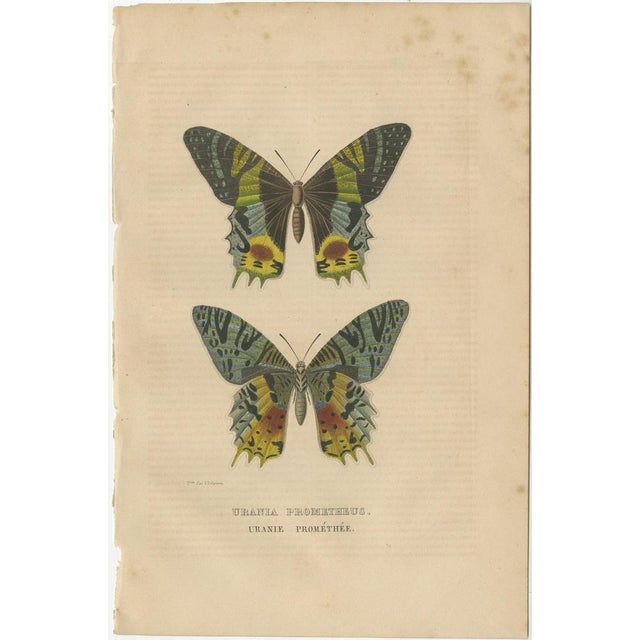
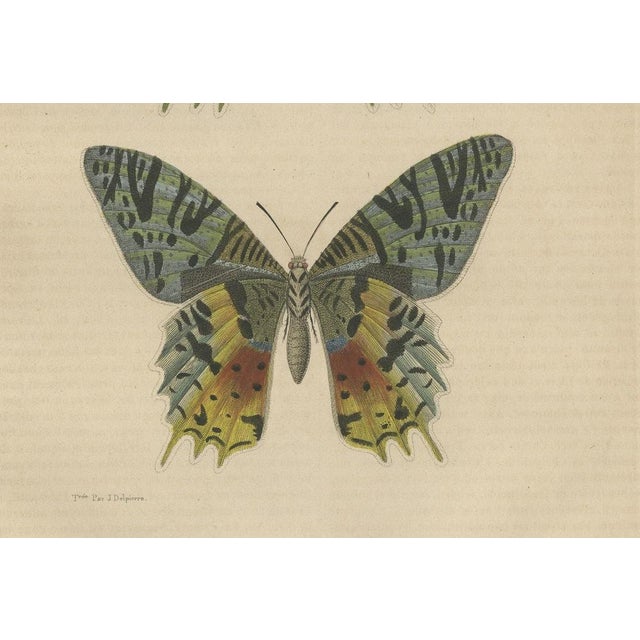
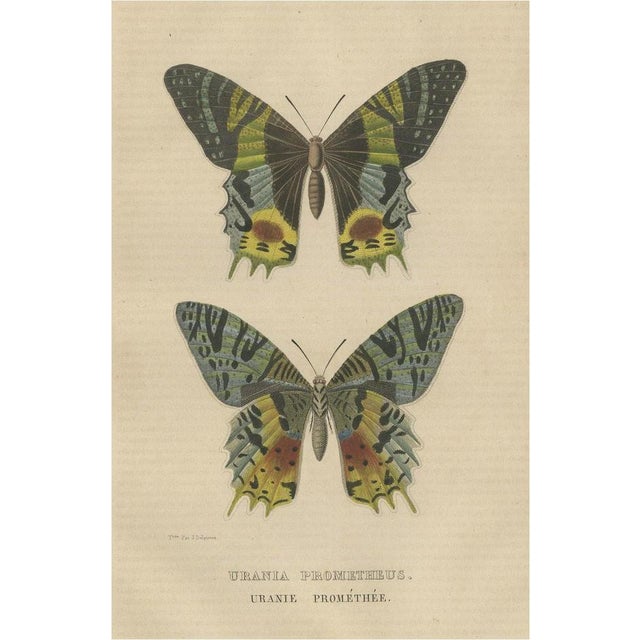
This original antique print of the butterfly "Urania prometheus" is a detailed illustration that served as a plate in "Dictionnaire … Read more This original antique print of the butterfly "Urania prometheus" is a detailed illustration that served as a plate in "Dictionnaire Classique des Sciences Naturelles" by Pierre Auguste Joseph Drapiez. The "Dictionnaire Classique des Sciences Naturelles" was a comprehensive work that provided detailed s and illustrations of the natural world, encompassing various species of plants, animals, and minerals known at the time. Given the era and the scientific nature of the work, this print would have been one of many intended to educate and inform readers about the vast diversity of life. The meticulous detail in the engraving suggests that it was designed not only to be visually impressive but also to serve as a scientific tool for identification and study. The hand-coloring of the print indicates that it was likely colored by an artist after printing, which was a common practice in the production of high-quality scientific books in the 19th century. The condition of the print, showing signs of aging and wear, tells us that it has been well-studied and has survived the passage of time, preserving a visual record from Drapiez's influential publication. The Urania genus of butterflies, particularly known for the Urania leilus and Urania ripheus species, are typically found in tropical regions. Urania leilus is native to Central and South America, while Urania ripheus, also known as the Madagascar sunset moth, is indigenous to the island of Madagascar. They inhabit rainforests and are often seen in clearings and along riverbanks where their host plants grow. These butterflies are diurnal and are known for their iridescent wing colors and distinctive flight patterns. The specific habitat of "Urania prometheus" would depend on the precise species, but given the tropical nature of the Urania genus, it is likely found in similar environments. The print is a typical representation of entomological studies from the 18th and 19th centuries, where detailed illustrations were crucial for the study and classification of animals. The style suggests it may have been created for a scientific book or collection. The labels are in French, and the terms used may be either outdated or using older nomenclature, as common names and scientific understanding of these species have evolved. This print not only serves as a scientific record but also as a work of art, reflecting the dual interests of the Victorian era in both natural history and illustration. It is a remarkable piece that would be a significant addition to any collection of natural history art or an elegant decorative piece for those with a taste for the historic and the natural world. The style of the illustration is reminiscent of 19th-century scientific prints, which were often used in natural history books to document various species. More info on the book in which it was published: The 'Dictionnaire Classique des Sciences Naturelles' by Pierre Auguste Joseph Drapiez stands as a remarkable testament to 19th-century natural sciences. Published in Brussels in 1845, this work represents an expansive collation of knowledge, building upon the pioneering works of Buffon, Daubenton, Lacepede, Cuvier, de Jussieu, and other influential naturalists. The prints within this compendium likely showcase a rich amalgamation of artistic precision and scientific accuracy. Drapiez, himself a Belgian naturalist, would have aimed for detailed representations of flora, fauna, and scientific phenomena, mirroring the illustrative styles prevalent during his time. Given the era's emphasis on illustration, these prints were likely engraved meticulously, possibly portraying intricate anatomical details or lifelike depictions of the natural world. with Drapiez's background in natural history, the prints might bear testament to his commitment to scientific authenticity, aiming to educate and inspire scholars and enthusiasts alike. These engravings would have complemented the text, offering visual aids that elucidate the concepts and specimens discussed in the volume. Overall, the prints of 'Dictionnaire Classique des Sciences Naturelles' likely serve as both artistic representations and invaluable scientific resources, encapsulating the essence of 19th-century natural history exploration and documentation. See less
- Dimensions
- 6.69ʺW × 10.24ʺH
- Art Subjects
- Animals
- Period
- Mid 19th Century
- Item Type
- Vintage, Antique or Pre-owned
- Materials
- Paper
- Condition
- Good Condition, Unknown, Some Imperfections
- Color
- Gold
- Condition Notes
- Very Good — This vintage item has no defects, but it may show slight traces of use\. Condition: Good. Overal … moreVery Good — This vintage item has no defects, but it may show slight traces of use\. Condition: Good. Overal toning but heavier foxing in the top right corner. The images itself clean and hand-colored in expliciet colors. Light offset from a opposite text plate in the original book. Please study scan carefully. less
Returns & Cancellations
Return Policy - All sales are final 48 hours after delivery, unless otherwise specified in the description of the product.
Cancellation Policy - Prior to shipping or local pickup, buyers may cancel an order for up to 48 hours, unless otherwise specified.
Related Collections
- Soicher Marin Original Prints
- Rattan Original Prints
- Medium-Density Fibreboard Original Prints
- Silver Finish Original Prints
- Robert Kipniss Original Prints
- Dye Transfer Original Prints
- Original Prints in Panama City, FL
- Ralph Lauren Original Prints
- Original Prints in Salt Lake City
- Original Prints in Lexington, KY
- Damien Hirst Original Prints
- Sam Francis Original Prints
- Johannes Kip Original Prints
- Botanical Prints
- Framed Prints
- Bird Prints
- Woodblock Prints
- Screen Prints
- Japanese Woodblock Prints
- Thomas McKnight Original Prints
- George Barbier Original Prints
- Frank Stella Original Prints
- Gustave Baumann Original Prints
- Teak Original Prints
- Chaim Gross Original Prints