

Details
Description
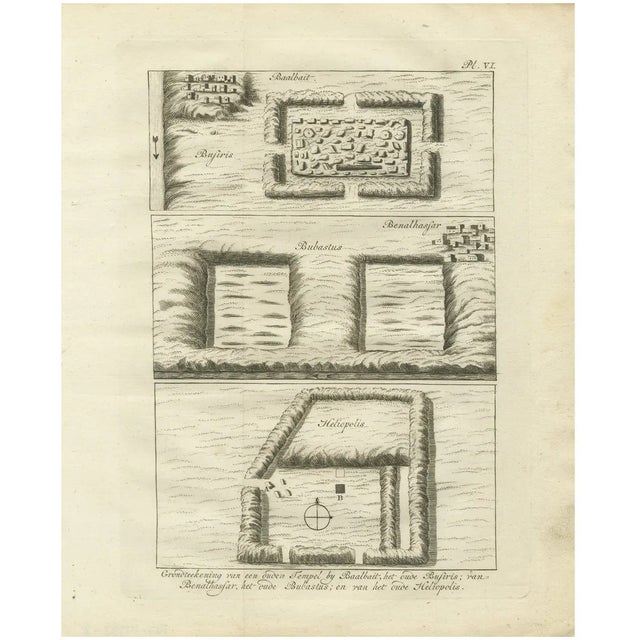
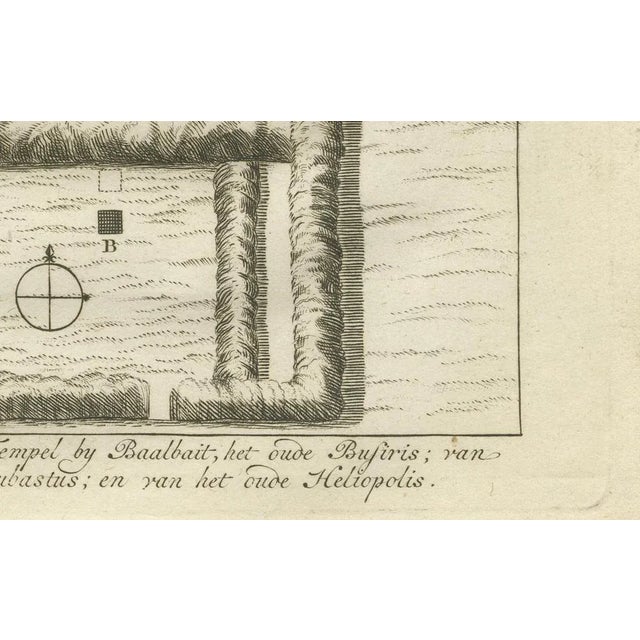
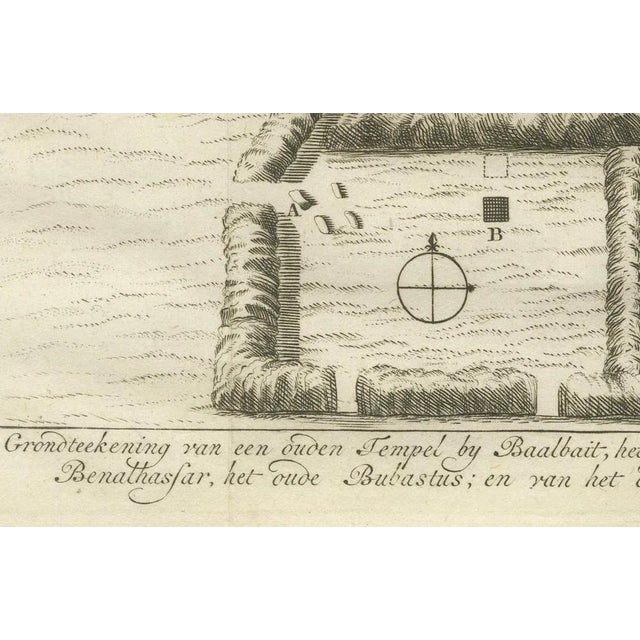
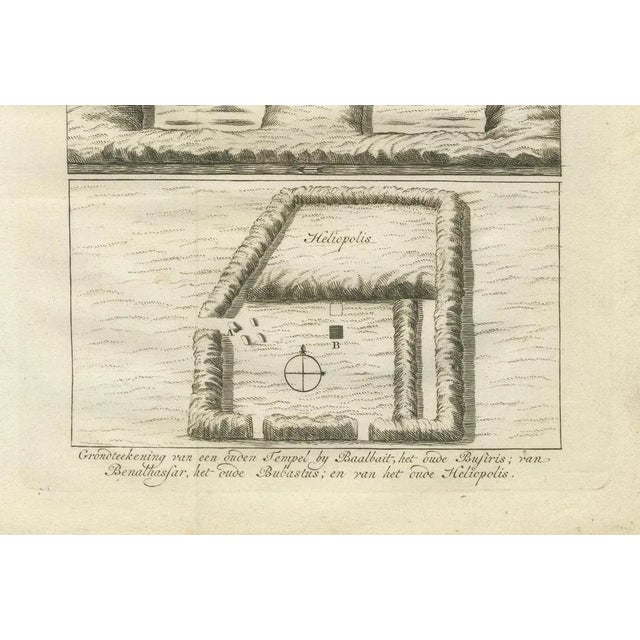
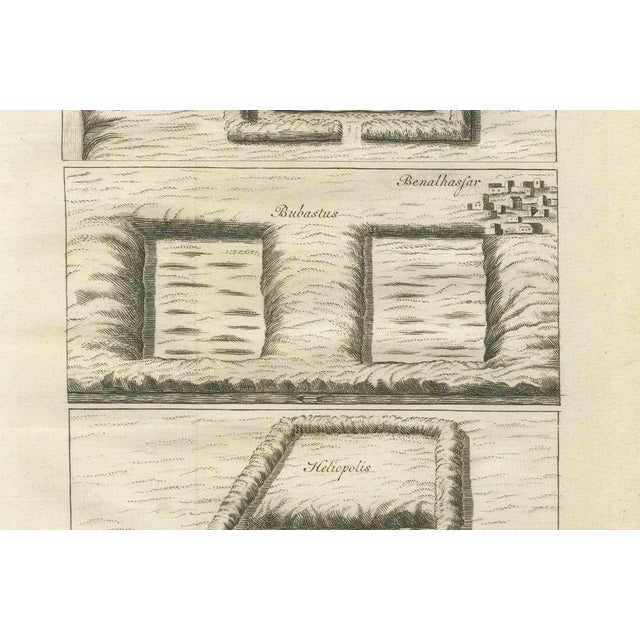
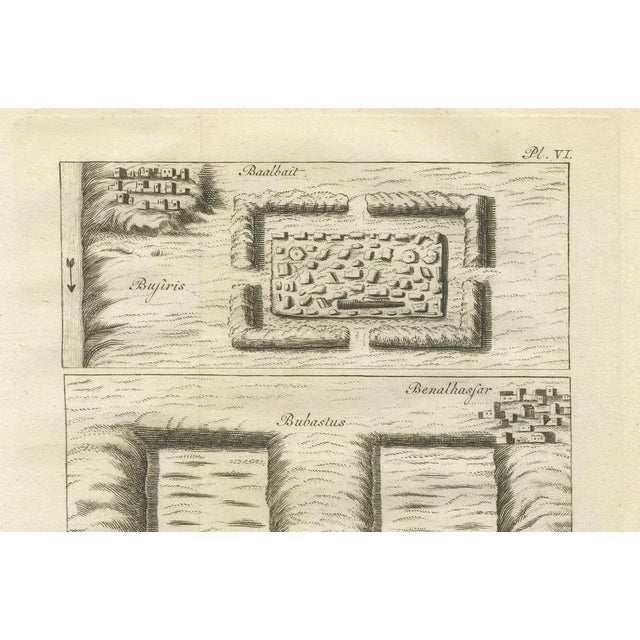
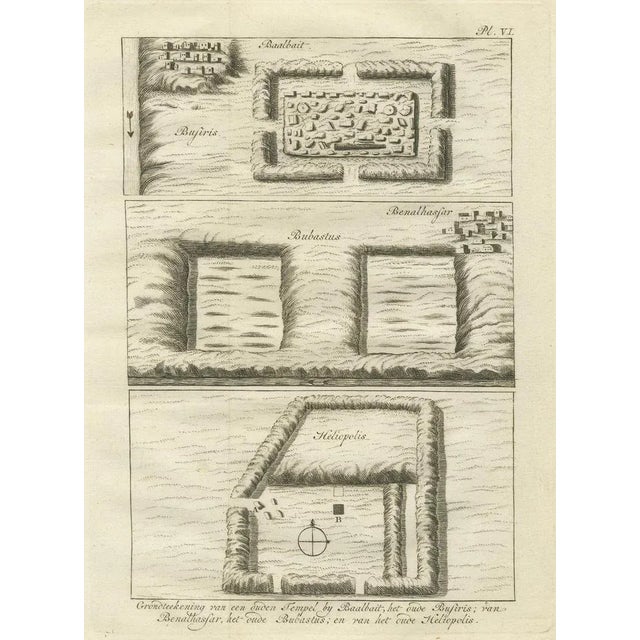
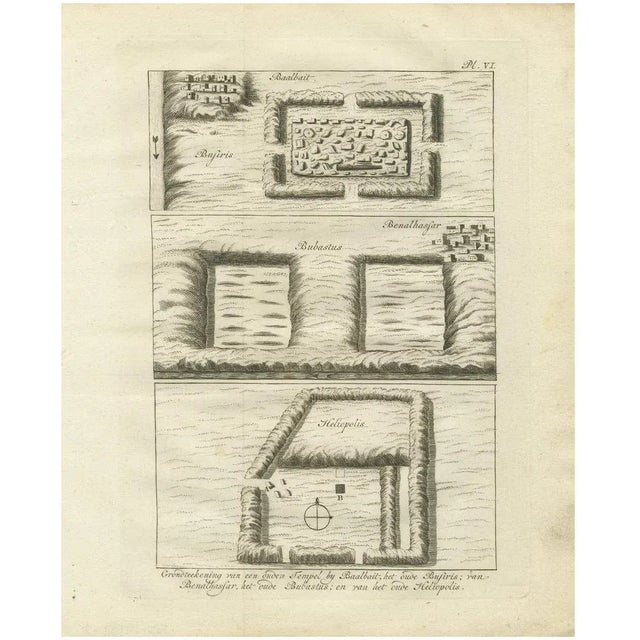
Title: Temple and Ruins Plans Egypt Baalbait Bubastus Heliopolis 1776 : This original engraving from 1776 illustrates schematic plans of … Read more Title: Temple and Ruins Plans Egypt Baalbait Bubastus Heliopolis 1776 : This original engraving from 1776 illustrates schematic plans of ancient Egyptian temple sites and ruins in several historically significant locations: Baalbait, Buyiris, Benathasfar, Bubastus, and Heliopolis. These architectural layouts, shown in three registers on the plate, were based on observations made by the English traveler Richard Pococke and published in the Dutch edition of his travel account. At the top is a ground plan labeled Baalbait and Buyiris, showing an enclosed temple area and the layout of surrounding ruins. The central register illustrates the site of Bubastus, associated with the ancient city dedicated to the cat goddess Bastet, as well as the neighboring site of Benathasfar. The bottom portion features a plan of Heliopolis, the ancient city of the sun, including a central enclosure, directional compass, and structural remnants. These plans are found in the work titled Beschryving van het Oosten en van eenige andere landen, translated from English and annotated by Ernst Willem Cramerus. The volume in which this engraving appears is the first part of the Dutch edition, which focuses on Egypt and was published in 1776 in Utrecht, Rotterdam, and Amsterdam. Richard Pococke, an 18th-century English cleric and traveler, documented his journeys through Egypt, the Levant, and other parts of the East with meticulous detail. His travel books were widely read and formed the basis of early European understanding of ancient Middle Eastern civilizations. This engraving, marked as Plate VI, served to visually represent the ground-level remains of sacred sites as they were seen in the mid 18th century, combining travel reportage with antiquarian interest. Condition report: In very good condition. Light general age toning and slight foxing near the right edge. A few faint creases, mostly in the margin. Strong plate impression with clear detail. Verso is blank. Folding line as issued. Framing tips: This print is ideal for framing in a walnut or ebony wood frame with a neutral ivory mat. A thin gold inner line can enhance the antique aesthetic. Suitable for display in a room focused on travel, archaeology, or early exploration. Technique: Engraving Maker: Unknown engraver after Richard Pococke, Netherlands 1776 See less
- Dimensions
- 9.84ʺW × 10.63ʺH
- Period
- 18th Century
- Country of Origin
- Netherlands
- Item Type
- Vintage, Antique or Pre-owned
- Materials
- Paper
- Condition
- Good Condition, Unknown, Some Imperfections
- Color
- Gold
- Condition Notes
- Very Good — This vintage item has no defects, but it may show slight traces of use\. In very good … moreVery Good — This vintage item has no defects, but it may show slight traces of use\. In very good condition. Light general age toning and slight foxing near the right edge. A few faint creases, mostly in the margin. Strong plate impression with clear detail. Verso is blank. Folding line as issued. less
Returns & Cancellations
Return Policy - All sales are final 48 hours after delivery, unless otherwise specified in the description of the product.
Cancellation Policy - Prior to shipping or local pickup, buyers may cancel an order for up to 48 hours, unless otherwise specified.
Related Collections
- Medium-Density Fibreboard Original Prints
- Rattan Original Prints
- Soicher Marin Original Prints
- Johannes Kip Original Prints
- Sam Francis Original Prints
- Damien Hirst Original Prints
- Silver Finish Original Prints
- Dye Transfer Original Prints
- Original Prints in Lexington, KY
- John Kiraly Original Prints
- Donald Sultan Original Prints
- Original Prints in Panama City, FL
- Original Prints in Salt Lake City
- Ralph Lauren Original Prints
- Botanical Prints
- Framed Prints
- Bird Prints
- Woodblock Prints
- Screen Prints
- Japanese Woodblock Prints
- Thomas McKnight Original Prints
- George Barbier Original Prints
- Frank Stella Original Prints
- Gustave Baumann Original Prints
- Teak Original Prints