



Details
Description
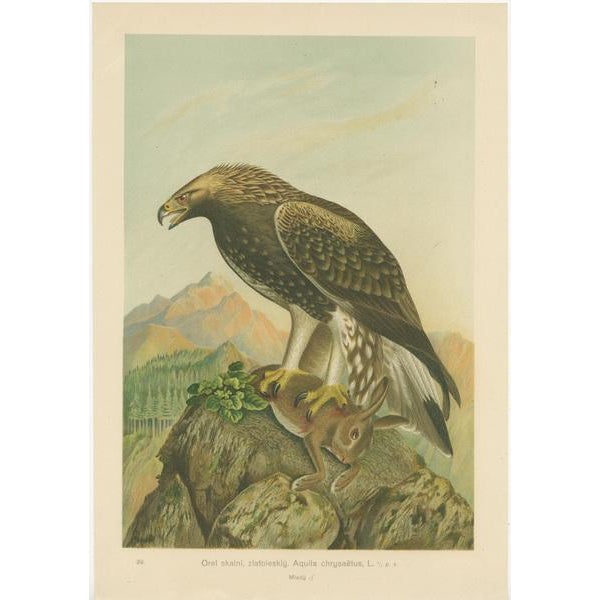
The birds depicted in the provided chromolithographs are: 1. In the first image, the bird is labeled as "Astur palumbarius," … Read more The birds depicted in the provided chromolithographs are: 1. In the first image, the bird is labeled as "Astur palumbarius," which is the scientific name for the Northern Goshawk. It's a bird of prey that is larger than a common hawk, known for its powerful build and agility in flight, particularly in wooded areas where it often hunts. 2. The second image shows "Aquila chrysaetos," also known as the Golden Eagle. This majestic bird is one of the best-known birds of prey in the Northern Hemisphere and is notable for its size, powerful build, and swift flight. Both illustrations display the birds in a natural setting, with attention to detail in their plumage and a clear representation of their physical characteristics, which would be typical of Naumann's work aiming for both scientific accuracy and aesthetic appeal. The chromolithographs are linked to the legacy of Johann Friedrich Naumann, a pivotal figure in ornithology, whose comprehensive studies and detailed taxonomies laid the foundation for modern bird science in Europe. Naumann’s influence extended beyond his lifetime into the early 20th century, where his works continued to be a reference point for ornithological studies and were often republished with updated illustrations to reflect the latest scientific findings. Published in 1901, these prints likely form part of an expanded or revised edition of Naumann’s original volumes, possibly "Naturgeschichte der Vögel Mitteleuropas" (Natural History of the Birds of Central Europe). This work, continuously updated, was not just a scientific endeavor but also a cultural treasure, capturing the fascination with the natural world that was prevalent at the time. The publisher, Fr. Eugen Köhler from Gera-Untermhaus, was known for producing high-quality natural history illustrations. The use of chromolithography, a method for making multi-color prints, allowed for the mass production of these detailed images. This printing technique was a complex and labor-intensive process that involved creating separate printing plates for each color used in the final image. The result was a vibrant and accurately colored print that could be widely distributed, making the knowledge of natural history more accessible to the public. The craftsmanship involved in these works reflects a period where scientific precision and artistic beauty were combined to educate and inspire. See less
- Dimensions
- 10.24ʺW × 14.96ʺH
- Art Subjects
- Nude
- Period
- Early 20th Century
- Item Type
- Vintage, Antique or Pre-owned
- Condition
- Good Condition, Unknown, Some Imperfections
- Color
- Gold
- Condition Notes
- Very Good — This vintage item has no defects, but it may show slight traces of use\. Good condition. Minor … moreVery Good — This vintage item has no defects, but it may show slight traces of use\. Good condition. Minor discoloring due to age and handling, but overall in very good condition. Study the image carefully. less
Returns & Cancellations
Return Policy - All sales are final 48 hours after delivery, unless otherwise specified in the description of the product.
Cancellation Policy - Prior to shipping or local pickup, buyers may cancel an order for up to 48 hours, unless otherwise specified.
Related Collections
- Soicher Marin Original Prints
- Rattan Original Prints
- Medium-Density Fibreboard Original Prints
- Silver Finish Original Prints
- Robert Kipniss Original Prints
- Dye Transfer Original Prints
- Original Prints in Panama City, FL
- Ralph Lauren Original Prints
- Original Prints in Salt Lake City
- Original Prints in Lexington, KY
- Damien Hirst Original Prints
- Johannes Kip Original Prints
- Sam Francis Original Prints
- Botanical Prints
- Framed Prints
- Bird Prints
- Woodblock Prints
- Screen Prints
- Japanese Woodblock Prints
- Thomas McKnight Original Prints
- George Barbier Original Prints
- Frank Stella Original Prints
- Gustave Baumann Original Prints
- Teak Original Prints
- Chaim Gross Original Prints