

Details
Description
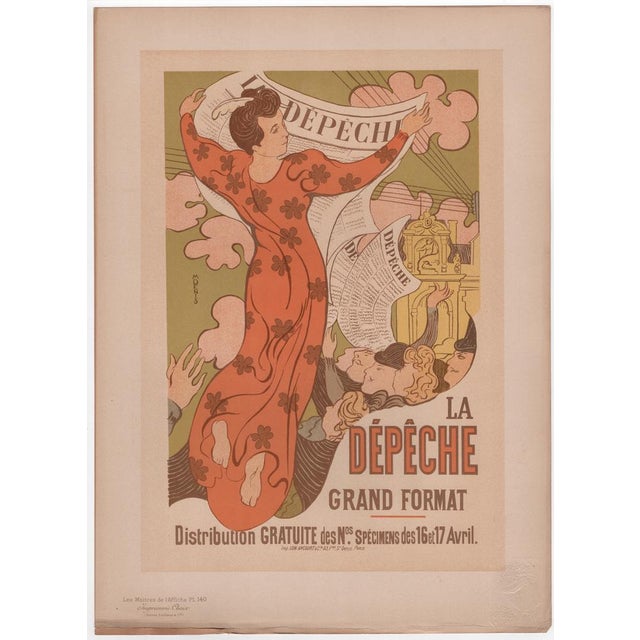
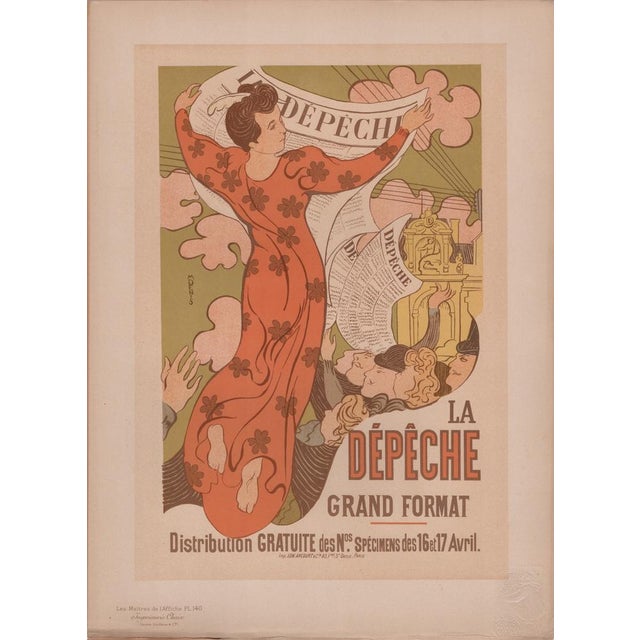
Maurice Denis (1870 - 1943)
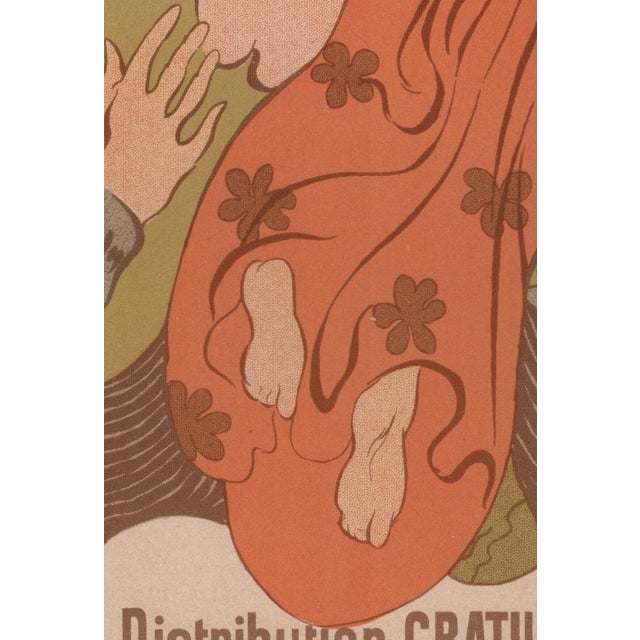
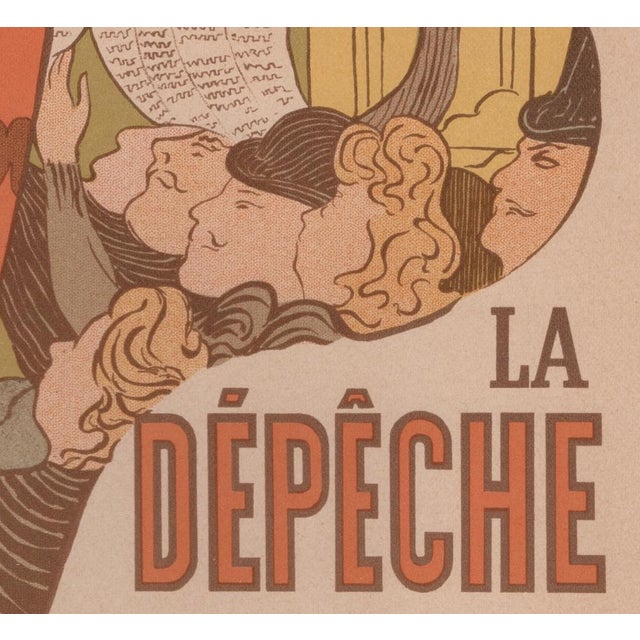
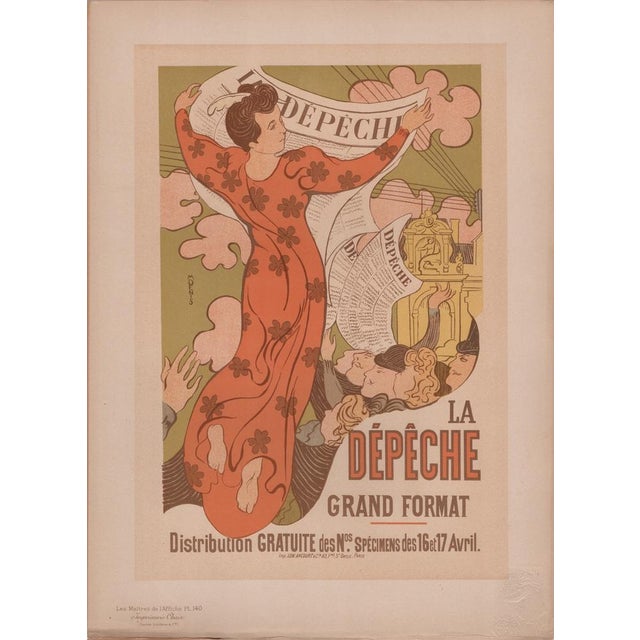
La Dêpêche
Year of ideation: 1892
Year of printing: 1898
Lithograph on wove paper
Publisher: …
Read more
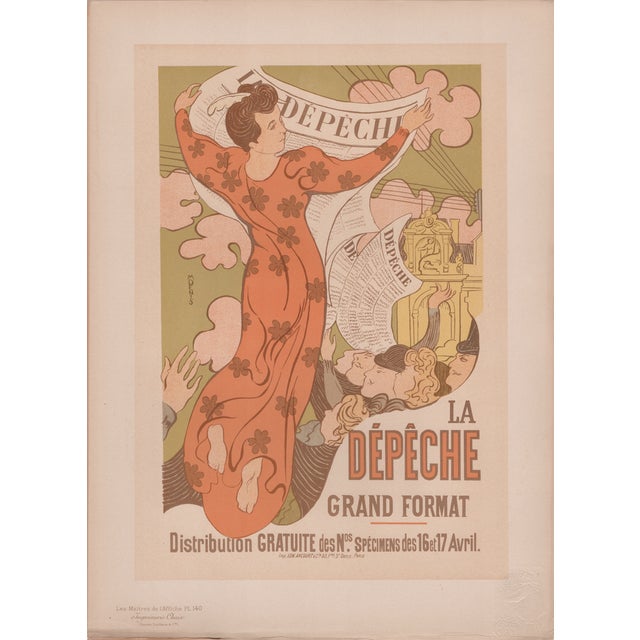
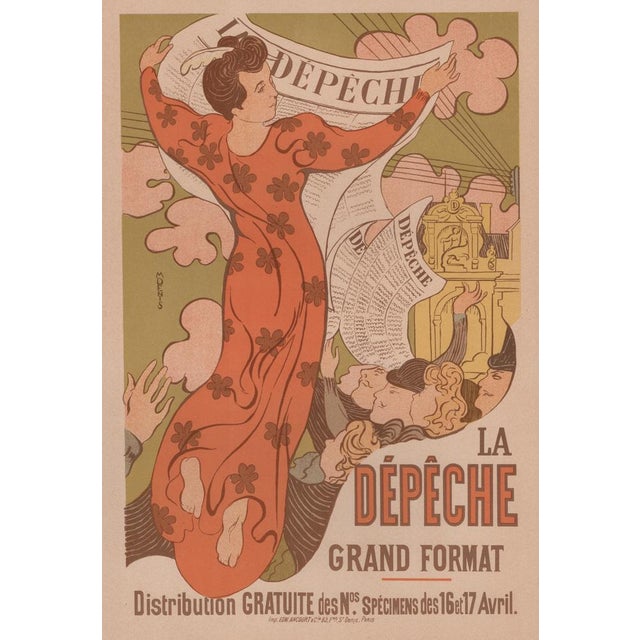
Maurice Denis (1870 - 1943)
La Dêpêche
Year of ideation: 1892
Year of printing: 1898
Lithograph on wove paper
Publisher: Chaix
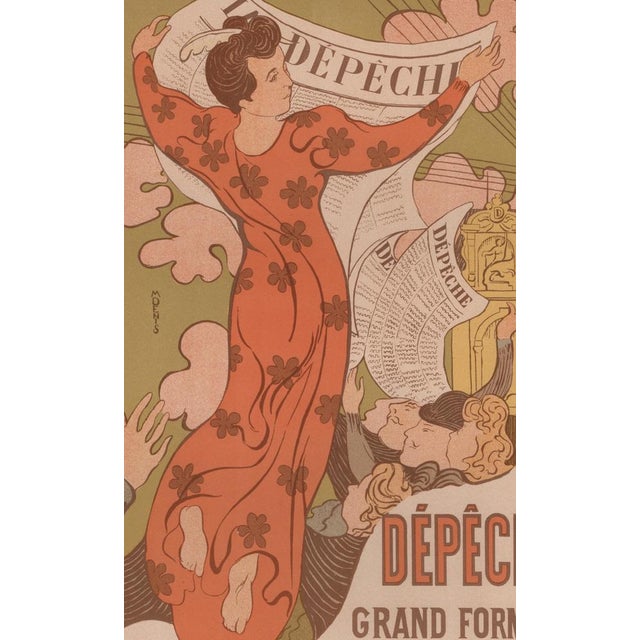
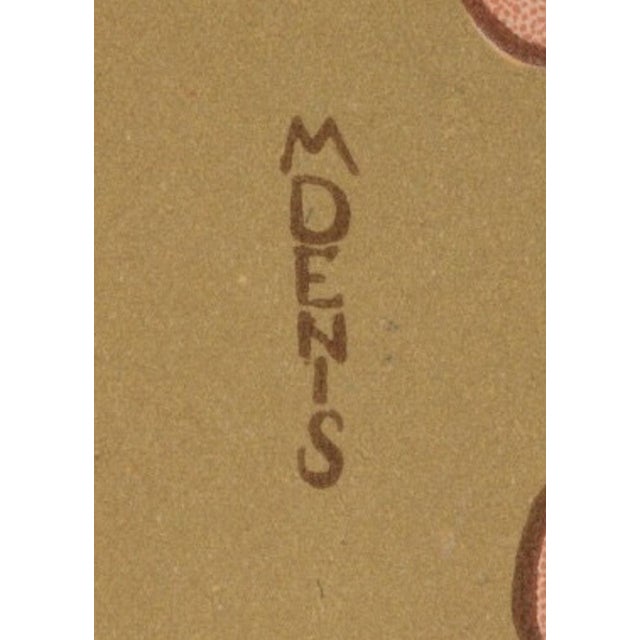
Signed in the plate, left
from the famous collection "Les Maîtres de l'Affiche"
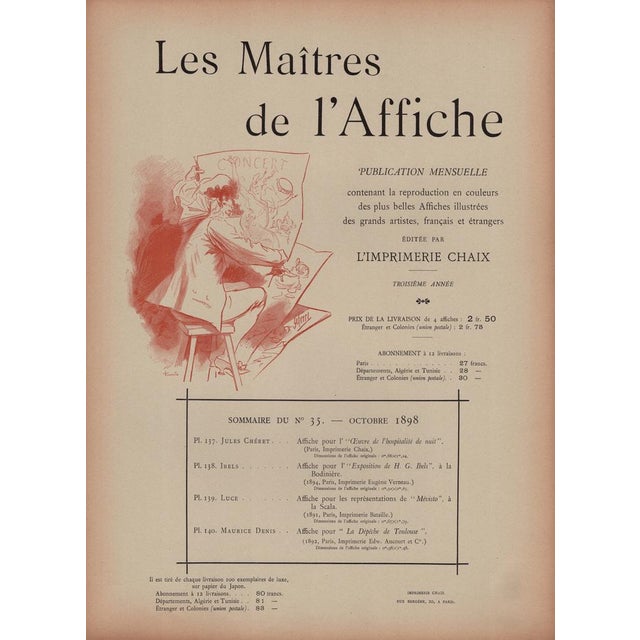
Issue # 35, Plate #140, October 1898
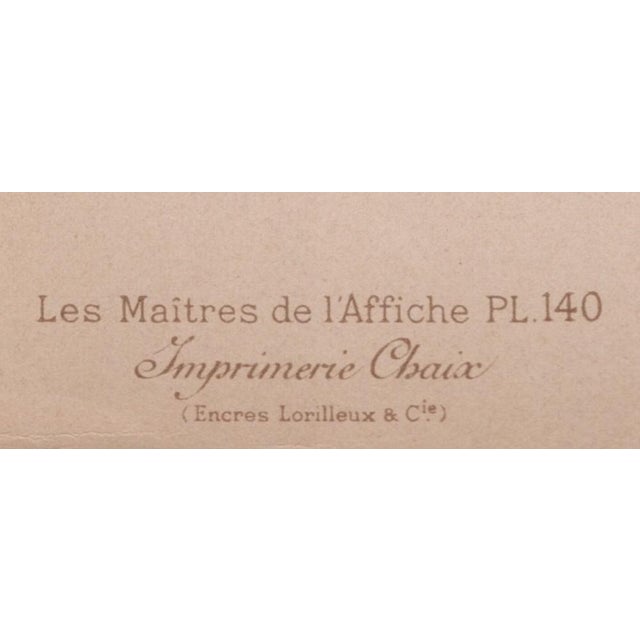
Bottom left:
Les Maîtres de l'Affiche PL. 140
Imprimerie Chaix
(Encres Lorilleux & Cie.)
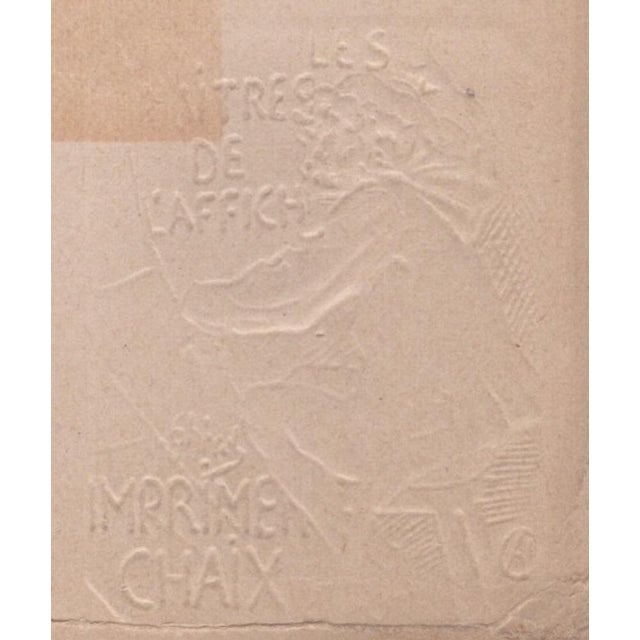
Bottom right, blind stamp of publisher / edition
Very Good Condition (see pictures)
Literature:
"The Complete Masters of the Poster", edited by Stanley Appelbaum, Dover, New York, 1990, p. 140
___
About the collection "Les Maîtres de l'Affiche"
Les Maîtres de l'Affiche (The Masters of the Poster) is one of the most prestigious and influential art publications in history Its 256 color plates have preserved for each succeeding generation a wide-ranging selection of outstanding posters from the turn of the century, when that popular art form had reached its first peak.
The earliest printed posters were chiefly typographic, with relatively few illustrated examples. But in the second half of the nineteenth century, when all types of commercial products, including printed matter, were being aesthetically upgraded, largely thanks to various arts-and-crafts movements, serious artists such as Manet began to see new possibilities in the poster medium. It was especially Jules Chéret (1836-1932) whose unique combination of artistic, technical and entrepreneurial talents was to pave the way for a true poster industry. After Chéret opened his own print shop in Paris in 1866, his work continued to inspire numerous emulators in Europe and America. from 1881 on, his shop operated as a branch of the large Chaix firm (Imprimerie Chaix)
By the 1890s the streets of every great metropolis were enlivened by large, colourful posters.
This Chaix publication, Les Maîtres de l'Affiche, was issued as separate numbered sheets measuring 40 x 29 cm. Every month for 60 months, from December 1895 through November 1900, subscribers received a wrapper containing four consecutively numbered poster. On 16 occasions the monthly wrapper also contained a bonus plate, a specially created art lithograph. Jules Chéret, artistic director of Chaix and father of the modern poster, emerged with the lion's share of the plates, one Chéret being included in each monthly issue of four, and seven of the 16 unnumbered bonus plates.
Of the 97 artists represented in Les Maîtres de l'Affiche, some were preeminent painters and printmakers at various stages of their careers: Toulouse-Lautrec, Denis, Bonnard, Vallotton, Puvis de Chavannes. Others were famous illustrators and cartoonists of the period, still well known to art collectors and bibliophiles. Forain, Caran d'Ache, Ibels, Willette, Boutet de Monvel, Léandre. But there were also all those whose names say "poster," the conquering pioneers of the new medium. Chéret himself, Mucha, Steinlen, the Beggarstaffs, Grasset, Penfield, Parrish, Bradley, Hardy The list could go on and on.
___
About the Artist
Maurice Denis (1870 – 1943) was a French painter, decorative artist, and writer. An important figure in the transitional period between impressionism and modern art, he is associated with Les Nabis, symbolism, and later neo-classicism. His theories contributed to the foundations of cubism, fauvism, and abstract art. Following the First World War, he founded the Ateliers d'Art Sacré (Workshops of Sacred Art), decorated the interiors of churches, and worked for a revival of religious art.
By the early 1890s, Denis had arrived at the artistic philosophy which guided most of his later work, and which changed very little; that the essence of art was to express love and faith, which to him were similar things. On 24 March 1895 he wrote in his journal: "Art remains a sure refuge, the hope of a reason in life from now on, and the consoling thought that little beauty manifests itself in our lives, and that we are continuing the work of Creation\.\.Therefore the work of art has merit, inscribed in the marvelous beauty of flowers, of light, in the proportion of trees and shape of waves, and the perfection of faces; to inscribe our poor and lamentable life of suffering, of hope and of thought."
The art world was in transition in the early 1890s, with the death of Van Gogh in 1890 and of Seurat in 1891, and the first departure of Gauguin to Tahiti. The French State was gradually giving up its dominance of art through the annual salons it organised. An independent Salon had been formed in 1884 and in 1890 the official Salon broke into two parts, with the formation of the Société national des Beaux-Arts, with its own annual show. Denis showed his works in both salons, as well as the La Libre Esthétique salon in Brussels, a leading European showcase for avantgarde art. The literary movement called symbolism was launched by Jean Moréas in an article in Le Figaro in 1891. In March 1891 the critic George-Albert Dourer wrote an article for the Mercure-de-France calling Denis the leading example of "symbolism in painting". The work of Denis attracted the attention of critics and of important patrons, most notably Arthur Huc, the owner of the prominent newspaper La Dépêche de Toulouse who organised his own art salons and purchased a number of works by Denis.
Denis experimented with other art forms and with decorative art. Beginning in 1889, to illustrate an edition of the book of poems Sagesse by Paul Verlaine, Denis carved a series of seven highly stylised woodblock prints, distilling the essence of his work. His patron Huc commissioned two large decorative panels, in the form of tapestries, for his Toulouse office. Denis, like other artists of the period, also designed colorful lithograph posters with the arabesque curves of the Art Nouveau.
Beginning in 1891, shortly after his engagement, Denis made Marthe the most frequent subject of his paintings; she was depicted, in purified and idealised form, doing household tasks, taking naps, and at the dining room table. She appeared in his landscapes, and in his most ambitious works of the time, The series called The Muses, which he began in 1893, and showed at the Salon of Independents in 1893. He sold the first painting to his friend Arthur Fontaine; In 1899 The French state acquired one of the paintings, his first official recognition.
The published writings and the private journal of Denis give an extensive view of his philosophy of art, which he developed over his lifetime.
"Remember that a picture, before being a battle horse, a female nude or some sort of anecdote, is essentially a flat surface covered with colors assembled in a certain order." (Art et Critique August 1890)
"Art remains a sure refuge, the hope of a reason for our life here, and this consoling thought that a little beauty is also found in our life, and that we are continuing the work of creation\.\.the labor of art has merit; to inscribe the marvelous beauty of flowers, of the light, of the proportion of trees and the form of waves, and the perfection of face, to inscribe our poor and lamentable life of suffering, of hope and of thought." (Journal, 24 March 1895)
"Decorative and edifying. That is what I want art to be before anything else." (Nouvelles Théories (1922)
"Painting is first of all the art of imitation, and not the servant of some imaginary 'purity'". (Nouvelles Théories (1922)
"Don't lose sight of the essential objectives of painting, which are expression, emotion, delectation; to understand the means, to paint decoratively, to exalt form and color." (Journal, 1930)
___
Important:
. The listing is for the original lithograph.
. The cover of the issue by Jules Chéret is shown for reference.
This piece has an attribution mark,
I am sure that it is completely authentic and take full responsibility for any authenticity
issues arising from misattribution
See less
- Dimensions
- 11.42ʺW × 15.75ʺH
- Art Subjects
- Nude
- Period
- Late 19th Century
- Country of Origin
- France
- Item Type
- Vintage, Antique or Pre-owned
- Condition
- Good Condition, Unknown, Some Imperfections
- Color
Returns & Cancellations
Return Policy - All sales are final 48 hours after delivery, unless otherwise specified in the description of the product.
Cancellation Policy - Prior to shipping or local pickup, buyers may cancel an order for up to 48 hours, unless otherwise specified.
Related Collections
- Frank Stella Original Prints
- George Barbier Original Prints
- Byzantine Original Prints
- Robert Kipniss Original Prints
- Silver Finish Original Prints
- Dye Transfer Original Prints
- Medium-Density Fibreboard Original Prints
- Gustave Baumann Original Prints
- Louis XIII Original Prints
- Johannes Kip Original Prints
- Botanical Prints
- Framed Prints
- Bird Prints
- Woodblock Prints
- Screen Prints
- Japanese Woodblock Prints
- Thomas McKnight Original Prints
- Teak Original Prints
- Red Grooms Original Prints
- Paul Wunderlich Original Prints
- Chaim Gross Original Prints