

Details
Description
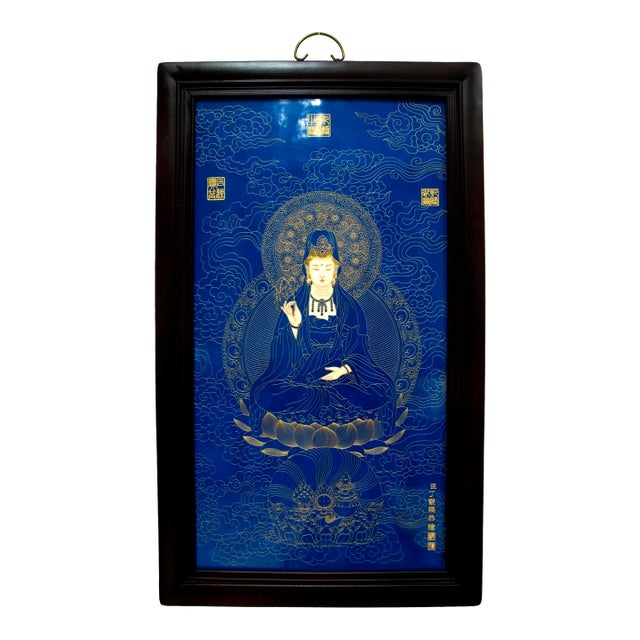
Chinese framed porcelain Buddhist temple plaque, Kuan Yin with Buddhist symbols, seated on a finely detailed, lotus throne with an …
Read more
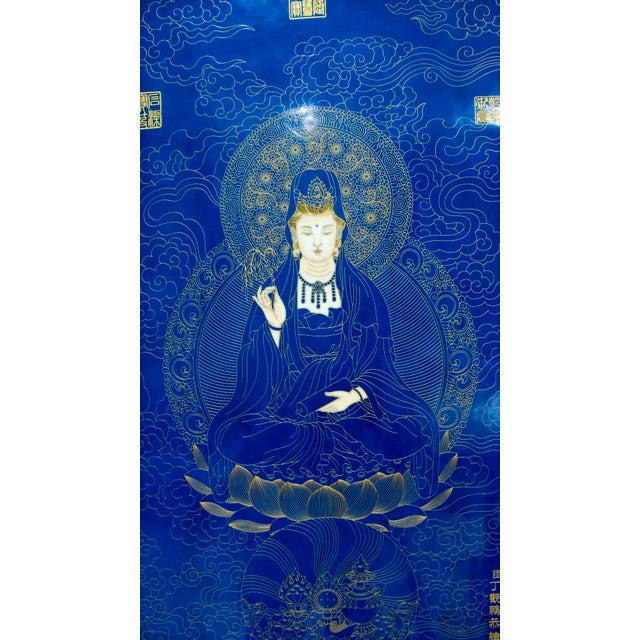
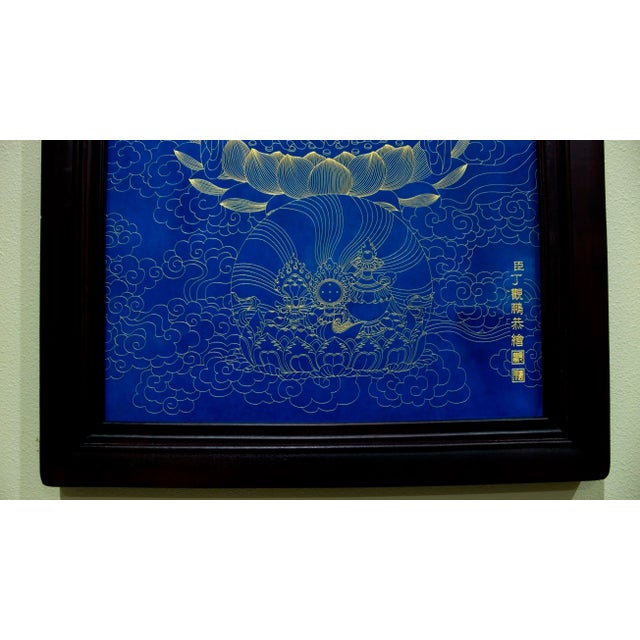
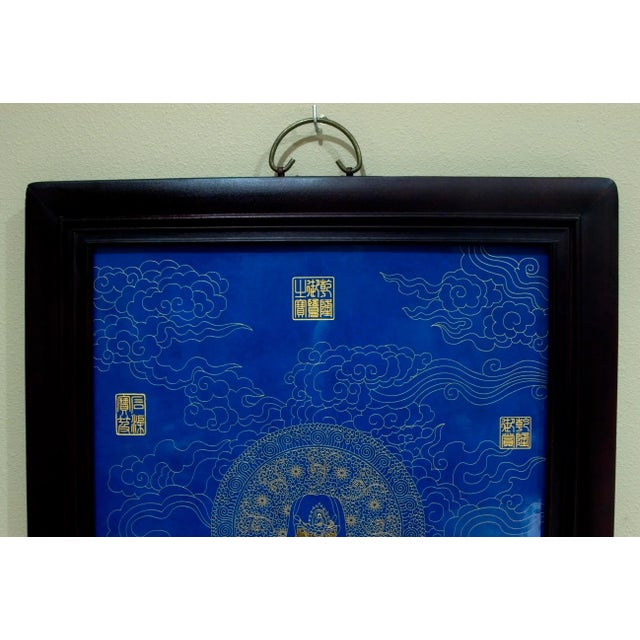
Chinese framed porcelain Buddhist temple plaque, Kuan Yin with Buddhist symbols, seated on a finely detailed, lotus throne with an ornate mandorla and halo, wearing the crown of Amitabha Buddha, among stylized Xiangyun (auspicious clouds) in the heavens, all in finely carved, gilt line drawing on a deep, blue glazed background. The signature of the artist, "Minister Ding Guanpeng, with two small seal marks, is found at the lower right of the image. Three larger seal marks are seen at the top of the image. The plaque is mounted in its original, finely carved, Chinese, heavy, hongmu frame with fine joinery, removable back and original bronze hanger. Circa, Republic of China Era.
Kuan Yin's left hand holds the Royal emblem, the Sacred Vase (Chinese: 寶瓶, Bao Ping) with the divine nectar of life, symbolizing longevity, abundance and prosperity.
Kuan Yin's right hand holds a willow branch used for sprinkling the divine nectar of life upon the devotees to bless them with physical and spiritual peace. The willow branch is also a symbol of being able to bend (or adapt) but not break.
Xiangyun: Cloud motifs are rooted in the agrarian culture of the Chinese people. Clouds are associated with good luck as the cloud makes rain which moisten all things, and therefore, it brings good fortune to people. In the Chinese language, clouds are called yun (云; 雲; yún) which is a homonym for the Chinese character yun "good fortune" (运; 運; yùn). In Chinese culture, clouds (especially the five-coloured clouds) are perceived as an auspicious sign (e.g. an omen of peace, a symbol of Heaven, and the expression of the Will of Heaven. They also symbolize happiness and good luck. Early in its history, clouds were often perceived under a ritual or liturgical lens where xiangyun were oftentimes associated with the presence of deities and were considered a good omen indicating the arrival of good fortune.
In Chinese mythologies, mythological creatures and deities use clouds as their mount. Clouds were also closely associated with the Chinese immortals (called xian) and their residence on Mount Penglai.
See less
- Dimensions
- 20.75ʺW × 1.25ʺD × 35.5ʺH
- Period
- 1930s
- Country of Origin
- China
- Item Type
- Vintage, Antique or Pre-owned
- Materials
- Bronze
- Porcelain
- Wood
- Condition
- Good Condition, Original Condition Unaltered, Some Imperfections
- Color
- Royal Blue
- Condition Notes
- Restoration consists of removal of dust and dirt, neoprene strips added at the interior sides of the frame for cushioning, … moreRestoration consists of removal of dust and dirt, neoprene strips added at the interior sides of the frame for cushioning, wood frame treated with restoring oils. A few small dents and small color variations to the wood frame, small scattered areas of gold pinpoints are seen, as made, on the plaque. Excellent vintage condition less
Questions about the item?
Returns & Cancellations
Return Policy - All sales are final 48 hours after delivery, unless otherwise specified in the description of the product.
Cancellation Policy - Prior to shipping or local pickup, buyers may cancel an order for up to 48 hours, unless otherwise specified.
Related Collections
- Helmut Friedrich Schäffenacker Sculptural Wall Objects
- Antique Copper Finish Sculptural Wall Objects
- Medium-Density Fibreboard Sculptural Wall Objects
- Dada Sculptural Wall Objects
- Maison Jansen Sculptural Wall Objects
- Ralph Lauren Sculptural Wall Objects
- Asian Sculptural Wall Objects
- Greg Copeland Sculptural Wall Objects
- Mid-Century Modern Sculptural Wall Objects
- Curtis Jere Sculptural Wall Objects
- Plaster Sculptural Wall Objects
- Brutalist Sculptural Wall Objects
- Japanese Sculptural Wall Objects
- Sarreid Ltd. Sculptural Wall Objects
- Wenge Sculptural Wall Objects
- Arteriors Home Sculptural Wall Objects
- Silverplate Sculptural Wall Objects
- Stainless Steel Sculptural Wall Objects
- Platinum Sculptural Wall Objects
- The American School Sculptural Wall Objects