




Details
Description
A substantial and architecturally evocative Roman mosaic pavement fragment, dating to the 4th - 5th century CE (or AD) possibly …
Read more
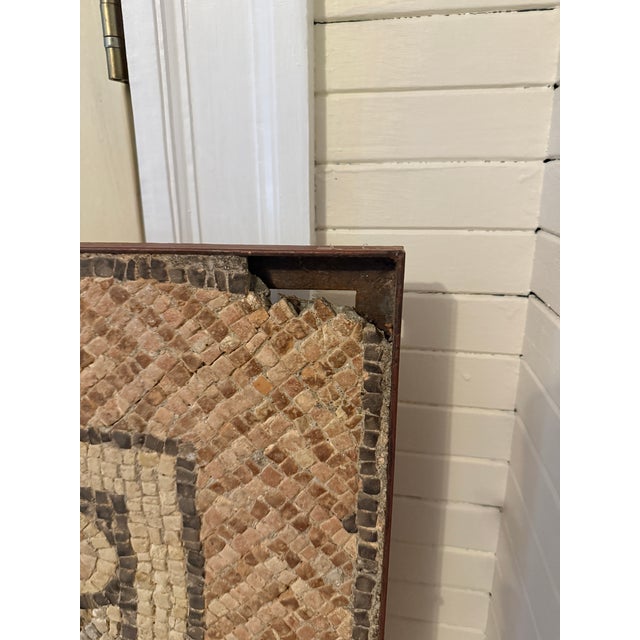
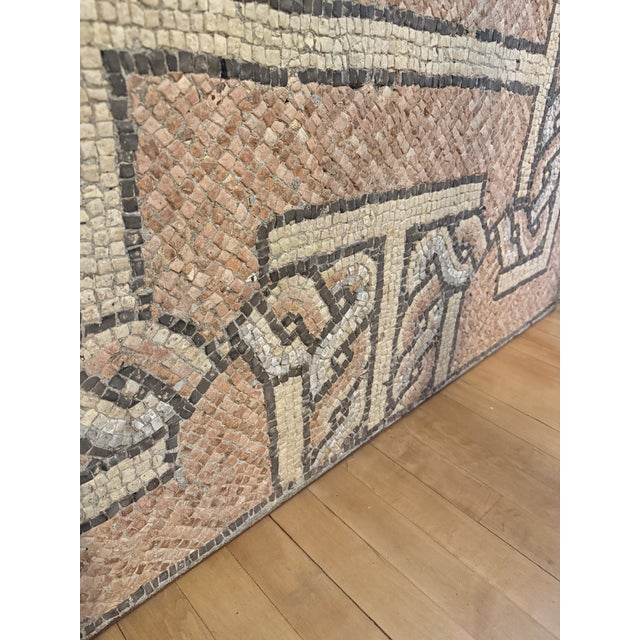
A substantial and architecturally evocative Roman mosaic pavement fragment, dating to the 4th - 5th century CE (or AD) possibly as early as the 2nd century CE, likely originating from the Eastern Mediterranean provinces of the Roman Empire—such as Syria, Asia Minor, or the Levant. Measuring approximately 49 inches wide by 35 inches high, the mosaic has been carefully preserved and stabilized in a modern concrete support matrix, likely for the purposes of conservation following excavation.
Executed in opus tessellatum with hand-cut tesserae of natural colored stone—predominantly warm ochre, reddish sandstone, pale limestone, and deep basalt—the composition displays a sophisticated arrangement of interlaced borders enclosing rectilinear panels. The four corners and the central panels are unified by a continuous and symmetrical ribbon motif, outlined in dark stone and filled with light and reddish tones to create a vivid three-dimensional twisting effect. The field is composed of pinkish tesserae set in diagonal lozenged patterns, creating a dense herringbone-like texture that once served as the ground plane of a Roman domestic or civic interior, possibly a triclinium, peristyle, or small bath complex.
The mosaic is mounted in a later, mid-20th-century iron frame, and the reverse reveals its preservation context: the tesserae are embedded in mortar and set within a thick cementitious bed, with circular drafting lines still visible—likely remnants of the original floor layout or an aid used in the conservation process. The work survives with areas of minor loss and expected surface abrasion but retains strong visual integrity and a well-preserved palette.
The use of interlaced geometric ornament and restrained, non-figural decoration is characteristic of late Roman pavements from Antioch to Gerasa, aligning this example with a broad provincial tradition of geometric mosaic design. Closely comparable fragments appear in the collections of the Yale University Art Gallery (from Dura-Europos), the Israel Museum, and the Louvre’s Department of Greek, Etruscan and Roman Antiquities. As a fragment of architectural decoration, this mosaic offers both a powerful visual record and a physical relic of the classical world's domestic artistry and decorative geometry.
See less
- Dimensions
- 49ʺW × 2ʺD × 35ʺH
- Styles
- Byzantine
- Classical Roman
- Art Subjects
- Abstract
- Period
- 15th Century & Earlier
- Country of Origin
- Italy
- Item Type
- Vintage, Antique or Pre-owned
- Materials
- Iron
- Mosaic
- Stone
- Condition
- Good Condition, Original Condition Unaltered, Some Imperfections
- Color
- Brown
- Condition Notes
- Typical wear expected with ancient objects. A few missing stone tesserae and top right corner with missing section. Typical wear expected with ancient objects. A few missing stone tesserae and top right corner with missing section. less
Questions about the item?
Returns & Cancellations
Return Policy - All sales are final 48 hours after delivery, unless otherwise specified in the description of the product.
Cancellation Policy - Prior to shipping or local pickup, buyers may cancel an order for up to 48 hours, unless otherwise specified.
Related Collections
- Straw Sculpture
- Roman Bronze Works Sculpture
- Constantin Brancusi Sculpture
- Fernando Botero Sculpture
- Louis XIV Sculpture
- Georgian Sculpture
- Bakelite Sculpture
- Antique Iron Finish Sculpture
- Gold-Plate Sculpture
- Medium-Density Fibreboard Sculpture
- Sculpture in Columbus
- Polished Brass Finish Sculpture
- René Lalique Sculpture
- Albert Ernest Carrier-Belleuse Sculpture
- Sculpture in Panama City, FL
- Gourd Sculpture
- Recycled/Repurposed Sculpture
- Geode Sculpture
- Photography Sculpture
- Worlds Away Sculpture
- Maison Jansen Sculpture
- Flavio Poli Sculpture
- Barovier and Toso Sculpture
- Far Pavilions Sculpture
- Emmanuel Villanis Sculpture