







Details
Description
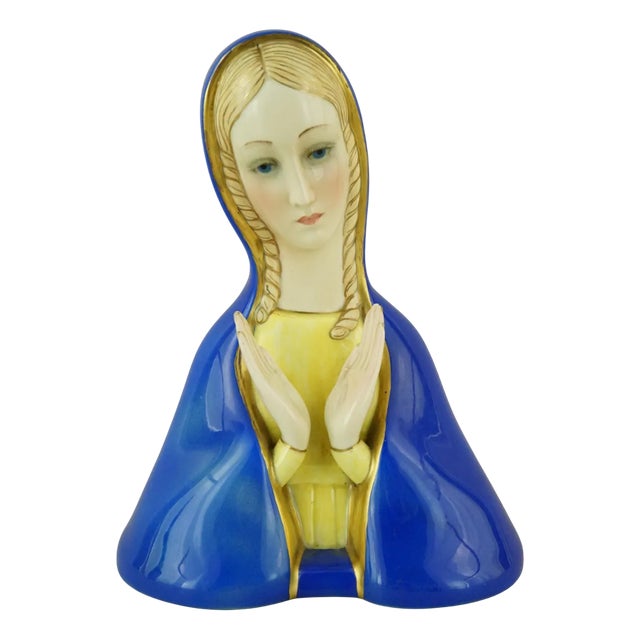
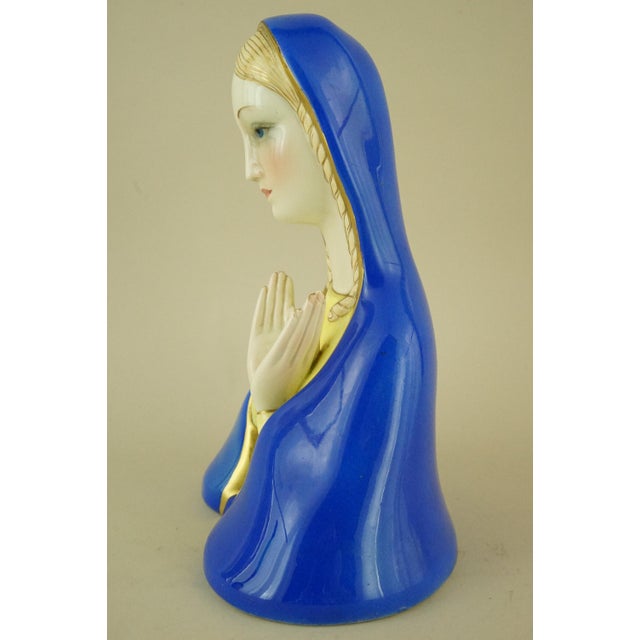
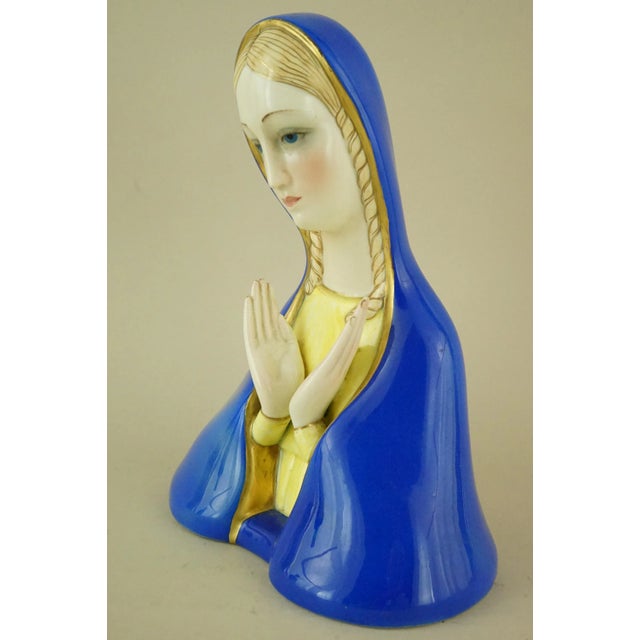
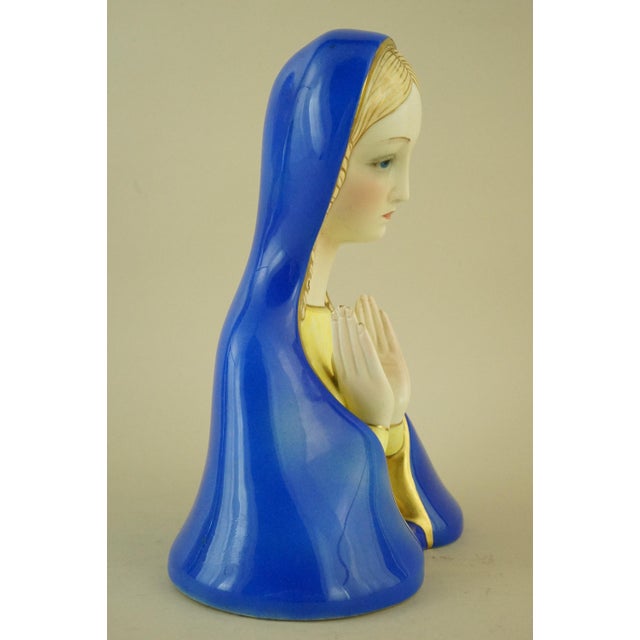
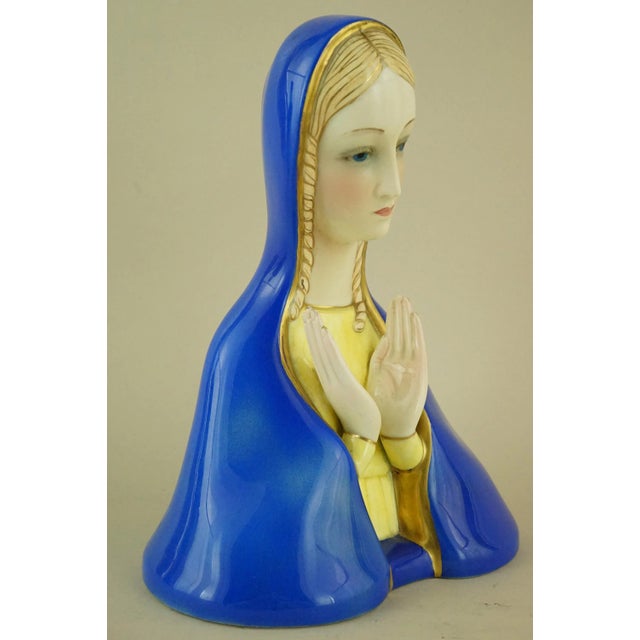
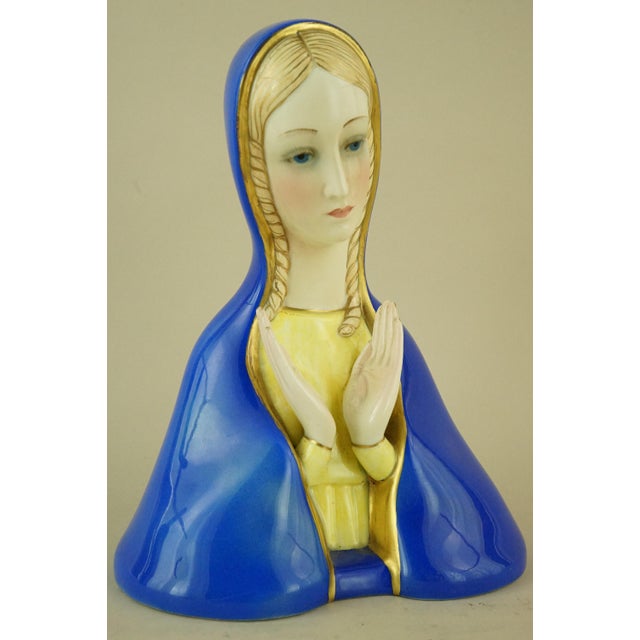
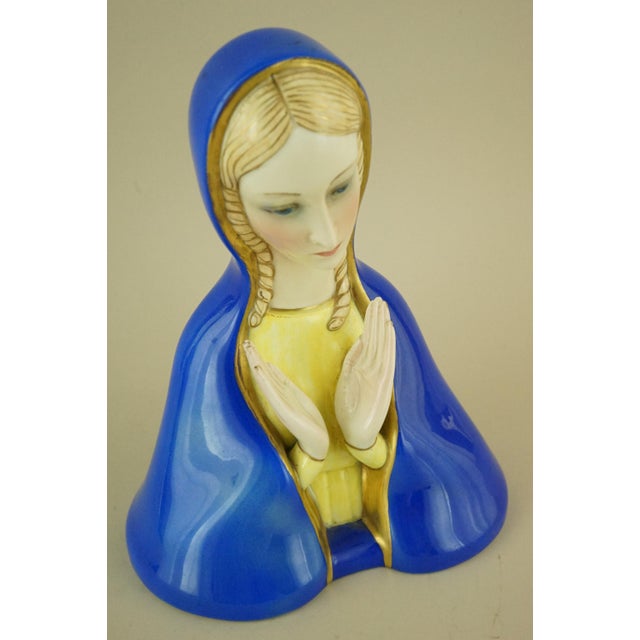
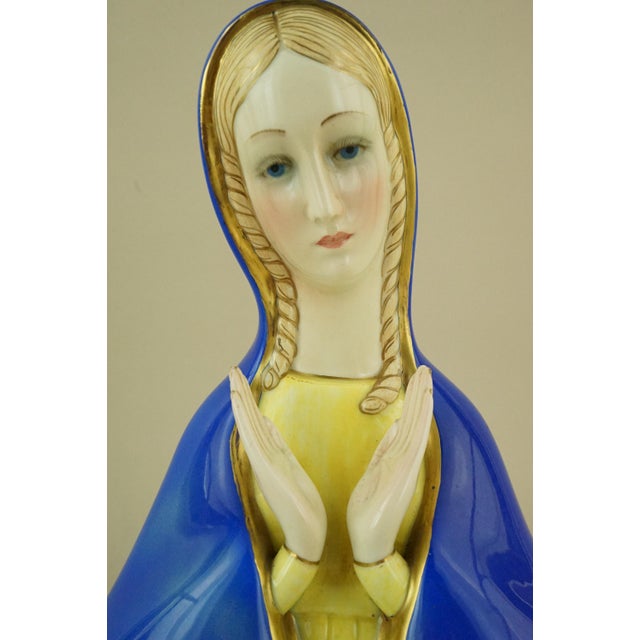
A magnificent, hand-decorated, vitrified ceramic sculpture depicting a bust of the madonna. Made by lenci of turin, it is signed …
Read more
A magnificent, hand-decorated, vitrified ceramic sculpture depicting a bust of the madonna. Made by lenci of turin, it is signed under the base with the manufacturer's mark and the original cartouche, which has oxidized over the years. The bust is listed in the lenci general catalog, number 664, as you can see from the photo immediately below this . It is of a good size and of excellent artistic quality. Notice the beauty of the slightly open hands, as if the madonna were intent on blessing the human race, or the marvelous braids that fall to the sides of the face and neck, a style rarely used in depictions of the madonna, making this sculpture particularly rare. The enamels used are of the highest quality, rich in feldspars, which make the vitrification extremely thick and brilliant, as is true of all lenci sculptures.
useful information for item valuation:
consider that lenci is one of the most important italian manufacturers of the early 1900s, boasting numerous auction results, with the largest and most important sculptures achieving top prices even above €30,000. Our research shows that lenci madonnas all fetch very high prices at auction, ranging from a minimum of €400-500 to a maximum of €2,000-3,000 depending on their size and the artist who created them.
information on the artist and/or manufacturer:
in 1919, helen konig and her husband, enrico scavini, founded a small artisanal factory in turin, producing wooden toys and dolls' furniture. After a few months of business, they began producing a series of felt dolls that quickly achieved great commercial success. The lenci company (the acronym was derived from helen's nickname, elenchen, given to the owner by her husband and later renamed "ludus et nobis constanter industria") hired hundreds of employees and began collaborating with famous artists such as sandro vacchetti, who also served as artistic director of production, and gigi chessa. In 1925, the company exhibited its dolls at the exposition des arts décoratifs in paris, where they won three grand prix, seven honorary diplomas, six gold medals, and three silver medals. Around 1928, perhaps influenced by the success of danish and austrian porcelain female figurines, lenci decided to begin producing ceramics. That same year, they presented their first creations at the turin international exhibition, immediately achieving significant success and the praise of giò ponti. Also in 1928, the factory's production expanded beyond national borders with an exhibition at the callows gallery in london. In 1929, lenci ceramics were presented in a solo exhibition dedicated to the company at the pesaro art gallery in milan. In 1930, the company participated, again with great success, in the prestigious "galleria della ceramica" at the 4th international exhibition of modern decorative and industrial art in monza. Using a very fine biscuit, made from a mixture of domestic kaolins with the addition of holland's earth, kiln firing at 1000°c (3,000°f), and the use of richly transparent mezzotints enabled by the use of underglaze colors, the production achieved results of the highest quality. Although production focused on multiples, cast but always individually decorated, thanks to the collaboration of around twenty major artists, lenci's creations transcended the confines of craftsmanship to achieve the plastic and chromatic results of artistic sculpture. In addition to the aforementioned vacchetti and chessa, "lenci" also collaborated with artists of great caliber such as giovanni grande and his wife ines panchieri grande, mario sturani, felice tosalli, abele jacopi, michele polito, beppe porcheddu, giulio da milano, giovanni riva, clelia bertetti, massimo quaglino, paola bologna, claudia formica, teonesto deabate, nillo beltrami, lino berzoini, renata ponti, otto maraini, valerio pisano, bona sancipriano, camillo ghigo, and the brothers giovanni, giuseppe, tina, and antonio ronzan, as well as numerous artisan molders, sculptors, and decorators, often of great skill. Between 1928 and 1931-32, production reached its peak in style and quality, with the creation of models molded by the artists and decorated under their strict supervision. Alessandro mola also collaborated externally during these years. Production from this period is recognizable by the model numbers up to 420, listed under the base of the completed pieces. Despite its success, lenci soon ran into difficulties due to high production costs, and in 1931 clelia bertetti left the turin company and founded le bertetti, followed in 1933 by sandro vacchetti, who, together with nello franchini, opened essevi. In 1934, the artistic direction of the company passed to mario sturani, who held the position until the firm's final closure in 1964. The models produced between 1931 and 1936, some of high quality and others more commercial in nature, are recognizable by the model numbers between 421 and 1160. The factory's last appearance at an important event dates back to 1936, with lenci ceramics exhibiting at the vi triennale d'arte in milan.
in 1937, due to serious financial difficulties, mrs. Scavini was forced to sell the company to mr. Beppe garella of turin, who continued production under the same name, but without achieving the stylistic results of the previous management. In the years immediately preceding the second world war, giovanni girardi also collaborated with the company. Postwar production can be identified by model numbers starting from 1170 up to the more recent alphanumeric numbering.
in the postwar period, the company continued to produce its most successful models alongside new ones of lesser artistic importance. However, in the early 1950s, thanks to the creativity and genius of artistic director mario sturani, new models of great artistic quality and great success entered production. In the following years, in addition to helen konig's continued collaboration, her daughter anili scavini also created several models for the company. Among the company's postwar collaborators was the modeler sciancalepore. Among the various factory trademarks, all easily identifiable with the company, we note one, found primarily on ceramics molded by scavini, consisting of the acronym "icnel" and therefore not easily identifiable with the factory's work. Production ceased definitively in 1964. This piece has an attribution mark,
i am sure that it is completely authentic and take full responsibility for any authenticity
issues arising from misattribution
See less
- Dimensions
- 6.69ʺW × 4.33ʺD × 8.66ʺH
- Country of Origin
- Italy
- Item Type
- Vintage, Antique or Pre-owned
- Materials
- Ceramic
- Condition
- Original Condition Unaltered, Some Imperfections
- Color
- Condition Notes
- Excellent — This vintage piece is in near original condition. It may show minimal traces of use and/or have slight … moreExcellent — This vintage piece is in near original condition. It may show minimal traces of use and/or have slight restorations\. Sculture in ottime condizioni. less
Returns & Cancellations
Return Policy - All sales are final 48 hours after delivery, unless otherwise specified in the description of the product.
Cancellation Policy - Prior to shipping or local pickup, buyers may cancel an order for up to 48 hours, unless otherwise specified.
Related Collections
- Wildwood Models and Figurines
- Rose Quartz Models and Figurines
- Ralph Lauren Models and Figurines
- Vienna Secession Models and Figurines
- Models and Figurines in Lexington, KY
- Jasper Models and Figurines
- Maison Jansen Models and Figurines
- Lava Models and Figurines
- Ardalt Models and Figurines
- Acrylic Paint Models and Figurines
- Deruta Models and Figurines
- Villeroy and Boch Models and Figurines
- Bennington Potters Models and Figurines
- Political and Patriotic Models and Figurines
- Tony Duquette Models and Figurines
- Pastel Models and Figurines
- Byzantine Models and Figurines
- Bright Pink Models and Figurines
- Brass Models and Figurines
- Staffordshire Dog Figurines
- Ceramic Cats
- Bird Figurines
- Dog Figurines
- Elephant Figurines
- Antique Model Ships