






Details
Description
Louise Catherine Breslau (1856 - 1927)
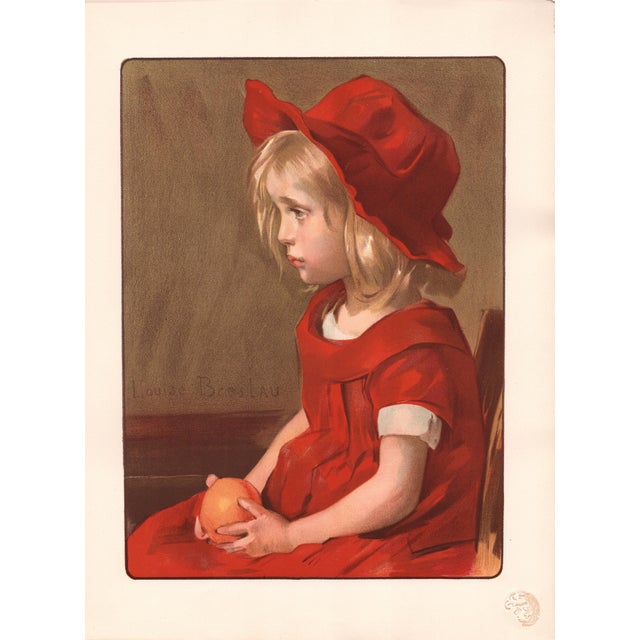
Fillette à l'Orange
(Little girl with Orange)
Original Lithograph from the glorious portfolio "L'Estampe …
Read more
Louise Catherine Breslau (1856 - 1927)
Fillette à l'Orange
(Little girl with Orange)
Original Lithograph from the glorious portfolio "L'Estampe Moderne", issue #18 (October 1898)
On wove paper
Year: 1898
Size (sheet): 405 x 305 mm
Size (image): 329 x 239 mm
Signed in the plate, bottom left
Blind stamp of the publisher, bottom right, out of the image
Excellent condition: minor signs of age and handling
Great colours
Full margins (not cropped, not trimmed)
___
About the Collection (L'Estampe Moderne)
L'Estampe Moderne appeared in 1897-1899 as a series of 24 monthly fascicles, each containing 4 original lithographs, printed by Parisian Imprimerie Champenois. Many accomplished European Art Nouveau painters contributed works to this publication, which contained only Original prints invented and produced especially for this collection. The publication was edited by Charles Masson and H. Piazza. Each issue came in a paper cover bearing an original lithograph by Alphonse Mucha.
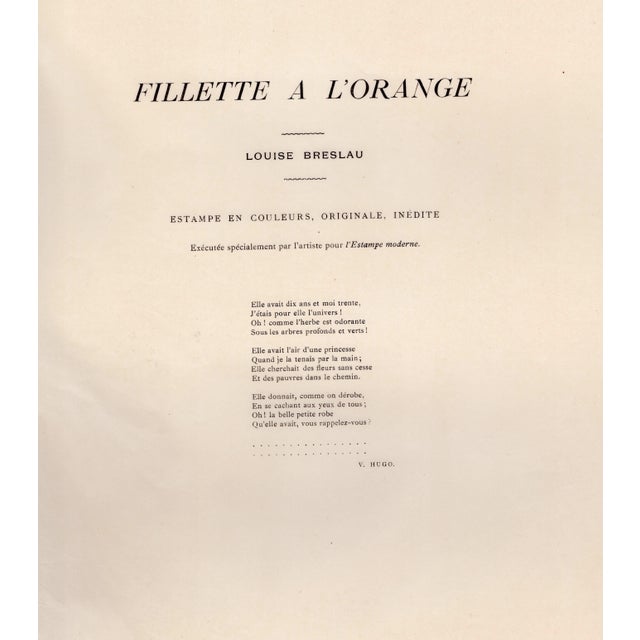
Each lithograph was accompanied by a tissue containing the details (title of the artwork, name of the artist, etc.) and a short text by a well-known author who inspired the artist (this one being by Victor Hugo).
___
About the artist
Louise Catherine Breslau (6 December 1856 – 12 May 1927) was a German-born Swiss painter, who learned drawing to pass the time while bedridden with chronic asthma. She studied art at the Académie Julian in Paris, and exhibited at the salon of the Société Nationale des Beaux-Arts, where she became a respected colleague of noted figures such as Edgar Degas and Anatole France.
Born Maria Luise Katharina Breslau into an apparently-assimilated Munich-based German Jewish family of Polish Jewish descent. In 1858, when Breslau was two years old, her father accepted the position of professor and head physician of Obstetrics and Gynecology at the University of Zurich, and the family moved to Switzerland. In December 1866, Dr. Breslau died suddenly from a staph infection contracted while performing a post-mortem examination. Suffering from asthma all her life, Breslau turned to drawing as a child to help pass the time while confined to her bed. She spent her childhood in Zürich, Switzerland, and as an adult made Paris her home where she also stopped using her first name "Maria".
After her father's death, Breslau was sent to a convent near Lake Constance in hopes of alleviating her chronic asthma. It is believed that during her long stays at the convent her artistic talents were awakened. In the late 19th century young bourgeois ladies were expected to be educated in the domestic arts including drawing and playing the piano. These were admirable attributes for a respectable wife and mother. Pursuing a career was quite unusual and often prohibited. By 1874, after having taken drawing lessons from a local Swiss artist, Eduard Pfyffer (1836–1899), Breslau knew that she would have to leave Switzerland if she wanted to realize her dream of seriously studying art. One of the few places available for young women to study was at the Académie Julian in Paris.
At the Académie, Breslau soon gained the attention of its highly regarded instructors and the jealousy of some of her classmates, including the Russian Marie Bashkirtseff. She also met her life-long friend, the Irish artist Sarah Purser and Sophie Schaeppi (Switzerland), Maria Feller (Italy), Jenny Zillhardt and her sister, Madeleine Zillhardt.
In 1879, with a portrait “Tout passé”, Breslau was the only student from the Académie Julian women's atelier to debut at the Paris Salon. “Tout passé” was a self-portrait that included her two friends. Shortly afterwards Breslau had changed her name to Louise Catherine, opened her own atelier, and was becoming a regular contributor and medal winner at the annual Salon. Due to her success at the Salon and favorable notice from the critics, Breslau received numerous commissions from wealthy Parisians. She joined the Salon de la Société Nationale des Beaux-Arts in Paris in 1890, not only exhibiting in its salons but also serving on the jury. She eventually became the third woman artist, and the first foreign woman artist to be bestowed France's Legion of Honor award.
Over the years, Breslau became a well-regarded colleague to some of the day's most popular artists and writers including Edgar Degas and Anatole France. One person who was very special in Breslau's life was Madeleine Zillhardt with whom she spent over forty years. Madeleine, a fellow student at the Académie Julian, became Breslau's muse, model, confidant, and supporter. Zillhardt inherited Breslau's estate and later donated sixty of the artist's pastels and drawings to the Musée des Beaux-Arts in Dijon. In 1932, Zillhardt published a book about Louise Breslau titled Louise Catherine Breslau et ses amis (Louise Catherine Breslau and her Friends).
Breslau died in 1927, and in 1928, the École des Beaux-Arts in Paris honored her with a retrospective. Her work was also featured in a 1932 retrospective at Galerie Charpentier dedicated to women who trained at the Académie Julian.
___
from the text on the tissue paper, by Victor Hugo:
Elle avait dix ans et moi trente,
J'étais pour elle l'univers !
Oh ! comme l'herbe est odorante
Sous les arbres profonds et verts!
Elle avait l'air d'une princesse
Quand je la tenais par la main;
Elle cherchait des fleurs sans cesse
Et des pauvres dans le chemin.
Elle donnait, comme on dérobe,
En se cachant aux yeux de tous ;
Oh ! la belle petite robe
Qu'elle avait, vous rappelez-vous ?
___
Important:
. The listing is for the original print, in the above mentioned very good / excellent condition.
. The original tissue paper introduction has some folds and tears, especially along the margins, and it will be given as is to the buyer as a gift for confirming the authenticity.
. The cover by Mucha is shown as a reference This piece has an attribution mark,
I am sure that it is completely authentic and take full responsibility for any authenticity
issues arising from misattribution
See less
- Dimensions
- 11.81ʺW × 15.75ʺH
- Art Subjects
- Figure
- Period
- Late 19th Century
- Country of Origin
- France
- Item Type
- Vintage, Antique or Pre-owned
- Condition
- Good Condition, Original Condition Unaltered, Some Imperfections
- Color
Returns & Cancellations
Return Policy - All sales are final 48 hours after delivery, unless otherwise specified in the description of the product.
Cancellation Policy - Prior to shipping or local pickup, buyers may cancel an order for up to 48 hours, unless otherwise specified.
Related Collections
- Frank Stella Original Prints
- George Barbier Original Prints
- Byzantine Original Prints
- Abraham Rattner Original Prints
- Silver Finish Original Prints
- Louis XIII Original Prints
- Gustave Baumann Original Prints
- Pedro Friedeberg Original Prints
- Rosenthal Original Prints
- Toledo Original Prints
- Botanical Prints
- Framed Prints
- Woodblock Prints
- Japanese Woodblock Prints
- Screen Prints
- Bird Prints
- Thomas McKnight Original Prints
- Teak Original Prints
- Paul Wunderlich Original Prints
- Spray Paint Original Prints
- Chaim Gross Original Prints