






Details
Description
Dimensions:
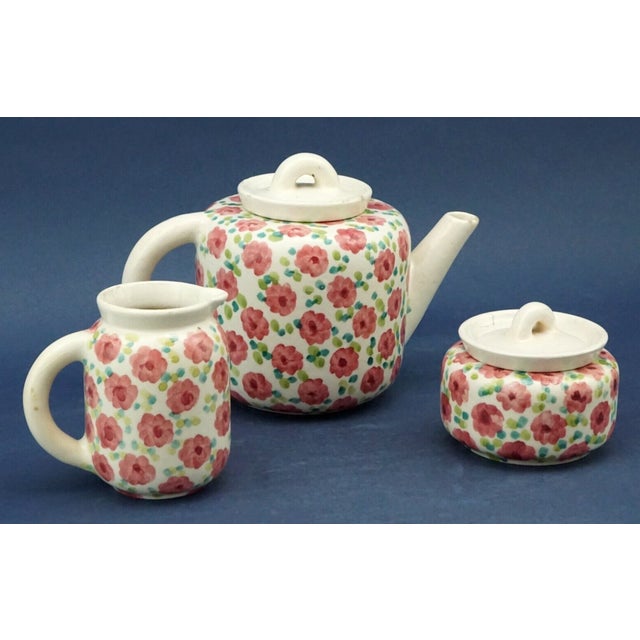
sugar bowl: height: 8 cm; diameter: 10 cm
teapot: height: 14.5 cm; width: 21.5 cm; depth: 13 cm
milk …
Read more
Dimensions:
sugar bowl: height: 8 cm; diameter: 10 cm
teapot: height: 14.5 cm; width: 21.5 cm; depth: 13 cm
milk jug: height: 10 cm; width: 10.5 cm; depth: 7.5 cm
description of the item
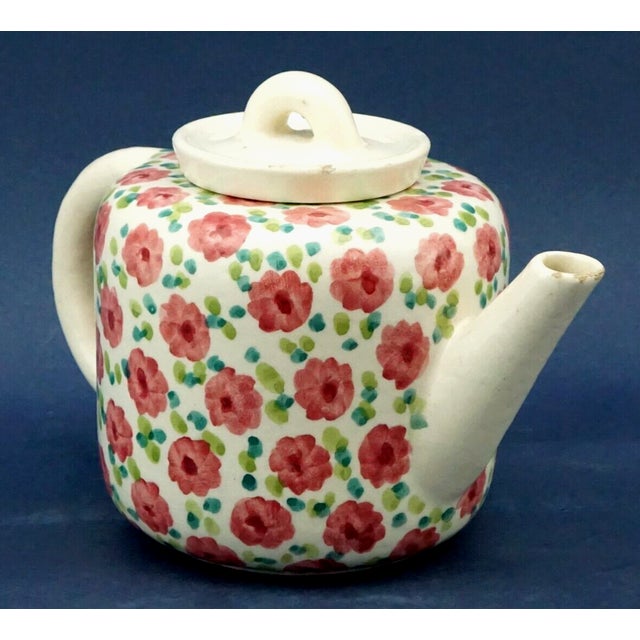
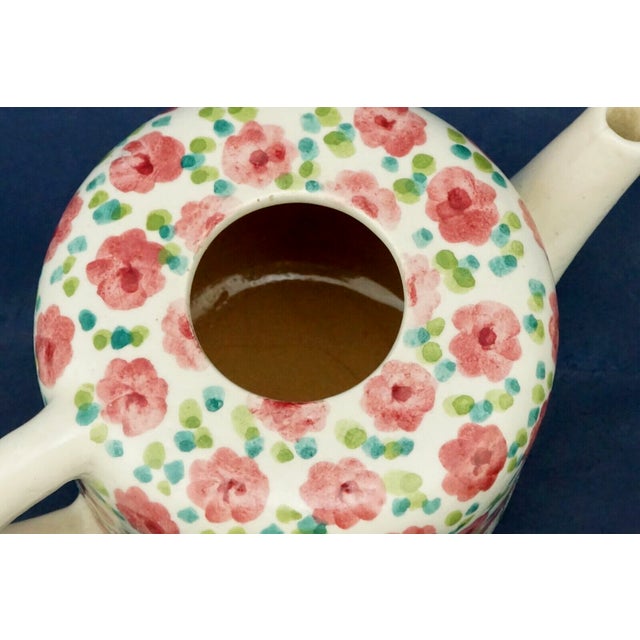
a beautiful three-piece tea or coffee set consisting of a teapot, a milk jug, and a sugar bowl, made of ceramic and hand-painted with a floral design on a white background. It is hand-signed in green on the underside of the base: “ceramiche rometti umbertide.” this set is particularly significant as it was entirely hand-shaped on the potter’s wheel by the artist; we are therefore dealing with three unique pieces. This is clearly evident in the shape of the handles and lids, which are irregular and distinct from one another. Furthermore, the surfaces are not completely smooth but slightly uneven, as is characteristic of hand-shaped ceramics. The classic floral decorations are also beautiful, featuring a pattern of small roses dotted in pink with green shading (in a “stencil” or light sponging style) that evokes a rustic or traditional cottagecore aesthetic. The large handles on the teapot and milk jug are also very beautiful and distinctive, crafted from a thick, semicircular ceramic tube—entirely handmade—that extends from the top all the way to the bottom of the milk jug and teapot, truly a touch of great class. The extended green signature “ceramiche rometti umbertide” is the one used in the 1940s and 1950s. The rometti factory in umbertide, famous above all for its futurist and art deco ceramics from the 1930s—created under the artistic direction of corrado cagli—is among the most sought-after by collectors of 20th-century italian ceramics. Its works appear regularly at major italian and international auctions, and the most important pieces command truly high prices.
information about the artist and/or manufacturer
the rometti factory was founded in umbertide, in the province of perugia, in october 1927 by settimio rometti and his nephew aspromonte, known as riego. The very first pieces, produced between 1927 and 1928, bear the “ars umbra” mark and consist mainly of art nouveau-style home furnishings and tableware. In 1928, artistic direction passed to dante baldelli, aspromonte’s cousin, marking the beginning of the factory’s most successful period. Working alongside baldelli were corrado cagli, from 1928 to 1930, and the sculptor mario di giacomo. During these years, rometti perfected the famous “nero fratta”—a glossy black glaze with metallic sheen, used primarily for the monochromatic works of the three artists—and produced several futurist ceramics based on designs by giacomo balla and fortunato depero. In 1931, it won the gold medal at the international exposition in nice and at the fiera del littorio in bologna. In 1933, it participated in the milan triennale, where it received major awards, and employed over sixty workers. In 1934, the company went bankrupt and was taken over under the name s.a.c.u. (società anonima ceramiche umbertide). In 1937, the founders and baldelli rejoined the company, which was renamed s.a.c.r.u. (società anonima ceramiche rometti umbertide). During the 1930s, nino strada and beppe porcheddu also collaborated with the factory. From 1938 to 1942, the sculptor leoncillo leonardi worked there, as did the painter eugenio carmi during that period. In 1942, settimio rometti founded his own company, which resumed production after the war in the new factory on via tiberina and later passed to the finocchi family. In the years that followed, the factory collaborated with artists such as giorgio ricciardi, takis, paladini, and zieger. In the 1970s, technical and artistic consultation was entrusted to the ceramicist massimo baldelli. In 1977, rometti won the “critics’ award” at m.a.c.e.f. For a series of kitchenware designed by ambrogio pozzi. The factory is still in operation today and remains one of the most significant names in 20th-century italian artistic ceramics. This piece has an attribution mark,
i am sure that it is completely authentic and take full responsibility for any authenticity
issues arising from misattribution
See less
- Dimensions
- 8.27ʺW × 5.12ʺD × 5.51ʺH
- Period
- 1920s
- Country of Origin
- Italy
- Item Type
- Vintage, Antique or Pre-owned
- Materials
- Ceramic
- Condition
- Good Condition, Original Condition Unaltered, Some Imperfections
- Color
- Cream
- Condition Notes
- Excellent — This vintage piece is in near original condition. It may show minimal traces of use and/or have slight … moreExcellent — This vintage piece is in near original condition. It may show minimal traces of use and/or have slight restorations\. Small chips scattered here and there on the spout of the teapot and on the mouths of the three objects, A small break correctly glued back on the lid of the sugar bowl less
Returns & Cancellations
Return Policy - All sales are final 48 hours after delivery, unless otherwise specified in the description of the product.
Cancellation Policy - Prior to shipping or local pickup, buyers may cancel an order for up to 48 hours, unless otherwise specified.
Related Collections
- Port 68 Bottles and Jars and Jugs
- Ralph Lauren Bottles and Jars and Jugs
- Vallauris Bottles and Jars and Jugs
- Medieval Bottles and Jars and Jugs
- Vintage Italian Glass Bottles and Jars and Jugs
- Borosilicate Glass Bottles and Jars and Jugs
- Khaki Bottles and Jars and Jugs
- Bottles and Jars and Jugs in Lexington, KY
- Rosenthal Netter Bottles and Jars and Jugs
- Bottles and Jars and Jugs in Panama City, FL
- Roger Capron Bottles and Jars and Jugs
- Cherry Wood Bottles and Jars and Jugs
- Crocks
- Wicker Bottles and Jars and Jugs
- Apothecary Jars
- 1800s Perfume Bottles
- Japanese Bottles and Jars and Jugs
- Cookie Jars
- Candy Jars
- Antique Water Jugs
- Murano Glass Bottles and Jars and Jugs
- Apothecary Bottles
- 1950s Perfume Bottles
- Svenskt Tenn Bottles and Jars and Jugs
- Portieux Vallerysthal Bottles and Jars and Jugs