




Details
Description
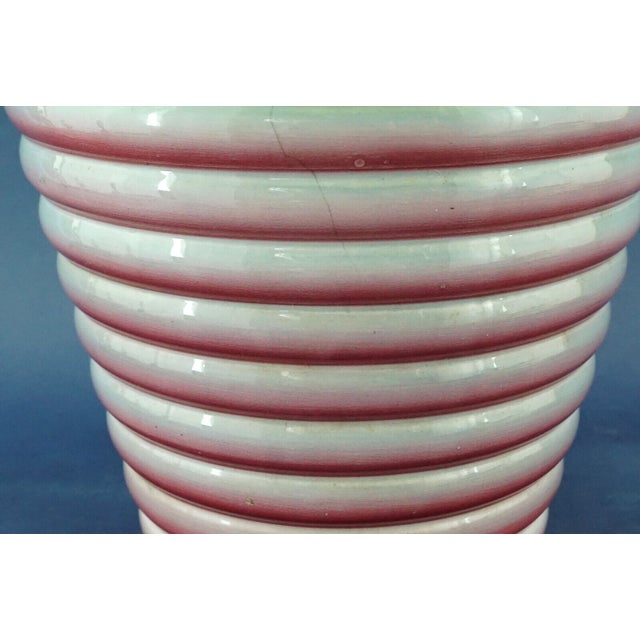
Glazed ceramic vase made entirely by hand on a lathe with large concentric rings of decreasing size from top to …
Read more
Glazed ceramic vase made entirely by hand on a lathe with large concentric rings of decreasing size from top to bottom. Glazed and entirely decorated with an airbrush, with beautiful shades ranging from blue to purple, signed under the base galvani pordenone with the brand used until 1968 and catalog number with decoration code. This vase was made by angelo simonetto for the galvani factory from 1920 to 1930 in full futurist style and is called "chameleon vase" for its shape with concentric rings and for the color that changes from blue to purple by changing the viewing angle, like a chameleon in fact.
useful information for the evaluation of the object:
from an internet search we find that the auction prices for the ceramics of this manufacture range from a minimum of 400-500 euros, for the smallest and least valuable objects, up to maximum estimates of 5,000-7,000 euros, for a vase only 28 cm high. Then consider that the auction fees of 25-30% must be added to the hammer price. Finally we found a vase very similar to ours, the "chameleon" model, which was quoted in the distant 2006 sant'agostino di torino, a good 1,500-2,000 euros. Our request is much lower than the real value of the vase also considering the slight threading present in the vase.
information on the artist and/or manufacture:
the "galvani" ceramic manufacture of pordenone was founded in 1811 by giuseppe galvani. Since 1823, the hard earthenware products produced by the "galvani" factory have been marked with the graphic symbol of an anchor. In 1836, the factory became the property of giuseppe's nephew, andrea, and in 1855 it was inherited by his brothers giuseppe and giorgio, who were the first to use the cockerel symbol as a trademark. In 1885, luciano, giorgio's eldest son, became the owner of the company. In 1911, the management of the factory passed to andrea galvani, who changed its name to "società anonima andrea galvani" and the graphic symbol to a stylised cockerel, or the head of a rooster, joined to a g. In 1921, the factory, destroyed by a large fire, was rebuilt in a modern way, allowing for a larger and more heterogeneous production.
in these years, the company availed itself of the collaboration of teonesto deabate, eugenio polesello and gino rossi. Starting from the beginning of the 1920s, under the artistic direction of angelo simonetto, and later in the 1930s with the collaboration of armando pizzinato and roberto rosati, the factory left traditional production and began to produce works with a modernist flavour, often decorated with airbrush designs using stencils. In these years, a ceramics school was active in the factory premises, among whose students we find loris dell'anese. Among the collaborators of these years, external to the factory, who created models for the production, we remember anselmo bucci from faenza. In 1925, teonesto deabate left the company to move, a few months later, to "lenci". In 1929, the company, which stood out for its interesting attempts at stylistic and chromatic renewal, created a table service designed by giacomo balla. In 1930, thanks to the family inheritance, the factory became the exclusive property of andrea galvani. In the same year, anselmo bucci supplied some models to the factory. In 1933, "s.a. Galvani" of pordenone successfully presented some interesting earthenware vases at the v triennale in milan. In 1938, the painter and sculptor ruffo giuntini began his collaboration with the company, which continued until 1942, leaving a profound mark of renewal in production. In 1939, the management of the factory passed to pino galvani who maintained the decorative themes of twentieth-century flavour, typical of the factory, until the mid-1940s. In 1942, "galvani" was present at the venice biennale. In the post-war period, due to a lack of artistic technological renewal, the production of "galvani" took on a more commercial orientation that did not find much response on the market and, in 1969, the factory, still active but now in clear decline, was downsized and moved to villanovia. The collaboration with "galvani" of clarimbaldo tognana dates back to these years. In 1973 the company became the property of ugo orlandi who, in turn, sold it to "tognana ceramiche" in 1979. In 1983 "galvani" was closed to be reopened by enrico and giorgio galvani as a small ceramic laboratory that employed only two workers until its final closure in 2000. This piece has an attribution mark,
i am sure that it is completely authentic and take full responsibility for any authenticity
issues arising from misattribution
See less
- Dimensions
- 9.06ʺW × 9.06ʺD × 7.48ʺH
- Period
- 1920s
- Country of Origin
- Italy
- Item Type
- Vintage, Antique or Pre-owned
- Materials
- Ceramic
- Condition
- Good Condition, Original Condition Unaltered, Some Imperfections
- Color
- Blue
- Condition Notes
- Excellent — This vintage piece is in near original condition. It may show minimal traces of use and/or have slight … moreExcellent — This vintage piece is in near original condition. It may show minimal traces of use and/or have slight restorations\. Tust a crack that reaches less than half the vase from the mouth less
Returns & Cancellations
Return Policy - All sales are final 48 hours after delivery, unless otherwise specified in the description of the product.
Cancellation Policy - Prior to shipping or local pickup, buyers may cancel an order for up to 48 hours, unless otherwise specified.
Related Collections
- Clarice Cliff Vases
- Franco Bucci Vases
- Dorothy Draper Vases
- Rude Osolnik Vases
- Liz Marsh Vases
- Gesso Vases
- Kähler Keramik Vases
- The American School Vases
- Ralph Lauren Home Vases
- Karl Springer Vases
- Vases in Panama City, FL
- Cristalleries De Sevres Vases
- Southeast Asia Vases
- Louis Dage Vases
- From Vienna Vases
- Bimini Glass Vases
- Libbey Glass Co. Vases
- Workaday Handmade Vases
- St. Louis Crystal Vases
- Lenox Vases
- Blenko Vases
- Swung Vases
- Fenton Art Glass Company Vases
- Viking Glass Company Vases
- Haeger Vases