




Details
Description
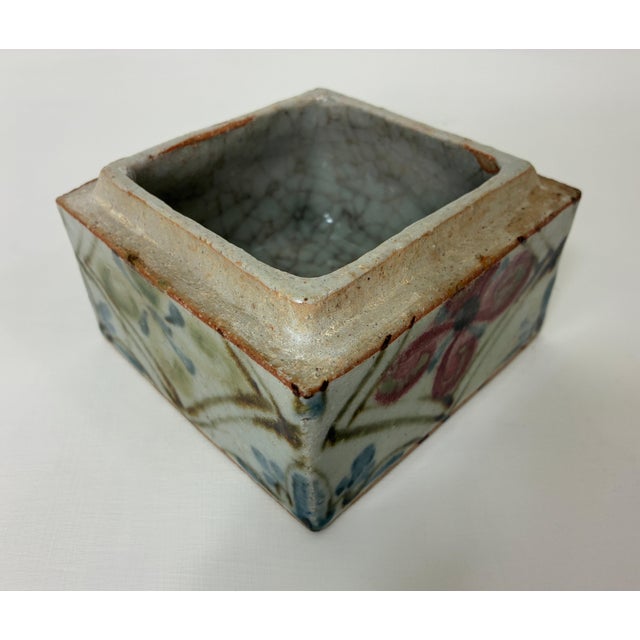
Kyoto Mingei Covered Box (Casket), Attributed to Takéichi Kawai or Kanjiro Kawai.
Offered is a ceramic casket (covered box) attributed …
Read more
Kyoto Mingei Covered Box (Casket), Attributed to Takéichi Kawai or Kanjiro Kawai.
Offered is a ceramic casket (covered box) attributed to either Takéichi Kawai or his uncle, Kanjiro Kawai. Ocassionally, it can be difficult to tell what is by Kanjiro Kawai or his nephew, Takéichi Kawai. I have another piece listed where the authorship is also unknown, but I believe it was most likely a Takéichi Kawai piece. I am leaning towards Kanjiro Kawai here. A not dissimilar caltrop design in cinnabar is shown in the last photo. That piece by Kawai is in the collections of the National Museum of Modern Art in Tokyo.
I have highlighted a flea bite along the rim in the 7th photo.
As an apprentice to his uncle, Takéichi learned the same glaze formulas, forming of slabs, and casting techniques. A coarser clay body suggests this could be an earlier piece by either artist. The crackle glaze applied to the base could be another identifier. It repeats on the inside of the box and the interior of the lid. That glaze is deliciously thick, not unlike icing on a cake. The glaze on the exterior is intentionally crazed and quite crystalline. Both are unique enough details that could confirm the approximate date of production, if not authorship.
The glaze technique and brushwork are more subjective. The brushwork of the designs is both precise and painterly. Often
Portions of the following biography come with my gratitude to 2000 Cranes
Kawai Takéichi (nicknamed “Bu’ichi”) 1908-1989:
In the late 1920s in Japan, a small group of artists started the mingei, or "folk craft" movement. It was a reaction to what they saw as the increasing threat of industrialization upon traditional, handmade crafts.
Among those was a group of potters, including Bernard Leach, Hamada Shōji, and Kawai Kanjirō. The works they made were functional, expressive, yet unassuming. As a matter of principle, mingei wares were hardly ever signed.
Among that group of potters was Kawai Takéichi. He was the nephew of Kawai Kanjirō and, at the age of 18, began apprenticing under his legendary uncle in 1926. The two were very close. As Kawai Kanjirō had only a daughter in his family, the younger Kawai was looked upon as a son. Collaboration between the two artists lasted over 40 years until the elder Kawai’s death in 1966.
Earlier in his career, Kawai worked reverently to preserve the aesthetics that grew from his uncle's vision of mingei, and his pots from this era are sometimes mistaken for those of his master, having that distinctive “Kawai school” flavor. Obeying a principle set by the founding fathers of mingei, Kawai never signed the footring of his works, which may explain this misidentification.
If it can be determined that it is by his uncle, Kawai Kanjiro, it is being sold at an absolute steal. A wonderful and fun piece in either case.
See less
- Dimensions
- 4.5ʺW × 4.38ʺD × 3.25ʺH
- Period
- Mid 20th Century
- Country of Origin
- Japan
- Item Type
- Vintage, Antique or Pre-owned
- Materials
- Stoneware
- Condition
- Good Condition, Original Condition Unaltered, Some Imperfections
- Color
- Burgundy
Questions about the item?
Returns & Cancellations
Return Policy - All sales are final 48 hours after delivery, unless otherwise specified in the description of the product.
Cancellation Policy - Prior to shipping or local pickup, buyers may cancel an order for up to 48 hours, unless otherwise specified.
Related Collections
- Acacia Wood Boxes
- Tony Duquette Boxes
- Polyester Boxes
- Enzo Mari Boxes
- Alessandro Albrizzi Boxes
- Port 68 Boxes
- Ettore Sottsass Boxes
- Anthony Redmile Boxes
- Bright Green Boxes
- Silk Velvet Boxes
- Abaca Boxes
- Violet Boxes
- Jewelry Boxes
- Burlwood Boxes
- Hat Boxes
- Silver Boxes
- Japanese Boxes
- Pill Boxes
- Maitland - Smith Boxes
- Alabaster Boxes
- Tool Boxes
- Cigar Boxes
- Porcupine Quill Boxes
- Porcelain Boxes
- Marble Boxes