

Details
Description
English Redware Engine-Turned Stoneware Coffee Pot and Cover
Staffordshire
Circa 1765
This handsome Staffordshire red stoneware coffee pot and cover …
Read more
English Redware Engine-Turned Stoneware Coffee Pot and Cover
Staffordshire
Circa 1765
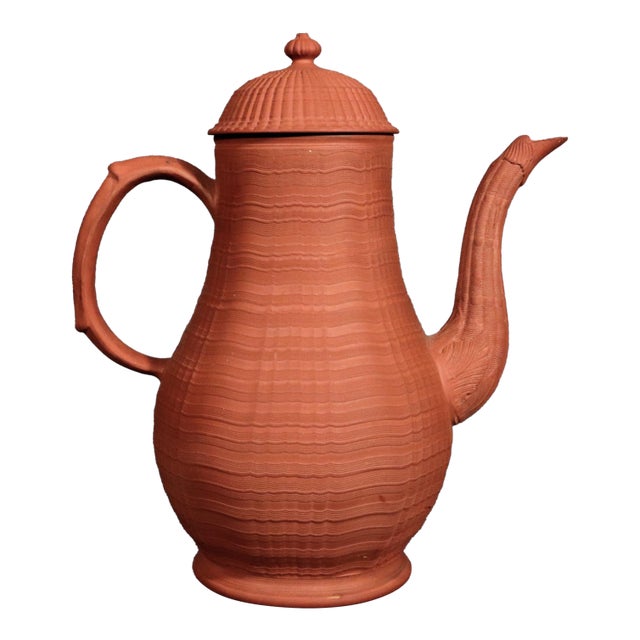
This handsome Staffordshire red stoneware coffee pot and cover stands at the threshold of the Neoclassical style, bridging the exoticism of the Rococo and the geometric restraint of the decades that followed. The tall baluster-shaped body is of unglazed red stoneware, a body developed in England to rival the prized Yixing wares of China, and the whole surface of both pot and cover is worked on the engine-turning lathe: the body with bands of finely cut wavy and zigzag parallel lines, the domed cover with a basketweave pattern of vertical fluting crossed by horizontal lines.
The form follows the vasiform baluster of Renaissance architecture, translated first into English silver and then into pottery. The gracefully curved spout is molded with feather-like ornament and terminates in a stylized bird’s head, with molded leaves to either side of its base. The loop handle rises to a thumb-rest at the top, and the cover is surmounted by an acorn finial.
The warm terracotta color and crisp lathe-cut texture make this a strong single object for a bookshelf, mantel or console, and it sits equally well among English pottery, Georgian silver or a modern interior where its geometry reads as surprisingly contemporary.
Dimensions
Height: 9 3/4 inches (24.8 cm)
Width: 8 1/2 inches (21.6 cm)
Depth: 5 inches (12.7 cm)
Marks
Impressed pseudo-Chinese seal mark (“chop mark”) to the base, a convention on Staffordshire red stonewares of the period acknowledging the Chinese origins of the body.
Provenance
Earle D. Vandekar of Knightsbridge.
Condition
Good antique condition.
Historical Context
In June 1763 Josiah Wedgwood’s assistant William Cox wrote from Birmingham that he was trying to find a maker who would build an engine-turning lathe for the pottery, and Wedgwood’s letters to Thomas Bentley of 1767 refer to the standard text on the subject, Charles Plumier’s L’Art de Tourner (1701, enlarged 1749). Adapted from the metal-working and lapidary trades, the lathe held a leather-hard pot against a cutting tool while a cam rocked or pumped the work, producing wavy, zigzag, fluted and basketweave patterns of a precision impossible by hand. No marked Wedgwood engine-turned pieces of the 1760s and 1770s are known to survive, and fine examples such as this are attributed to Staffordshire generally.
The new technique marked a pivotal moment in English pottery. While the red stoneware body looked to China and the baluster form to European silver, the linear geometric ornament signaled the shift away from the asymmetrical curves of the Rococo and the fanciful imagery of chinoiserie toward the Neoclassical taste that would define the later 18th century.
See less
- Dimensions
- 8.5ʺW × 5ʺD × 9.75ʺH
- Styles
- English
- Period
- Mid 18th Century
- Country of Origin
- United Kingdom
- Item Type
- Vintage, Antique or Pre-owned
- Materials
- Pottery
- Stoneware
- Condition
- Good Condition, Original Condition Unaltered, Some Imperfections
- Color
- Coffee
- Condition Notes
- Good condition- no repairs Good condition- no repairs less
Questions about the item?
Returns & Cancellations
Return Policy - All sales are final 48 hours after delivery, unless otherwise specified in the description of the product.
Cancellation Policy - Prior to shipping or local pickup, buyers may cancel an order for up to 48 hours, unless otherwise specified.