

Details
Description
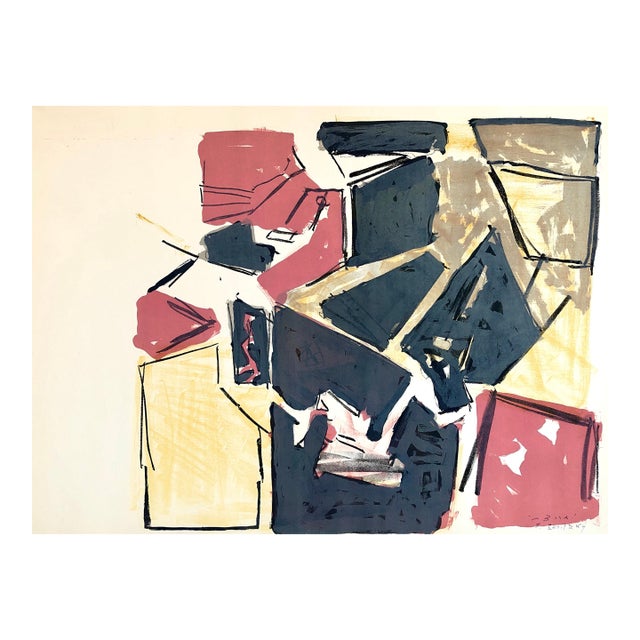
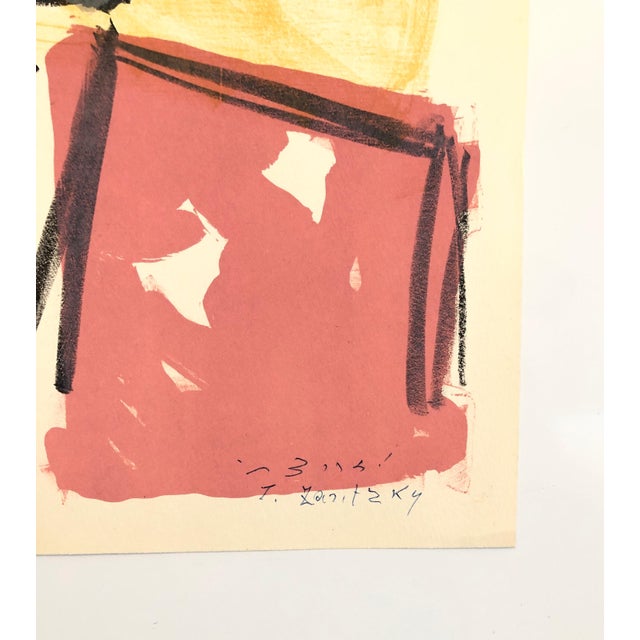
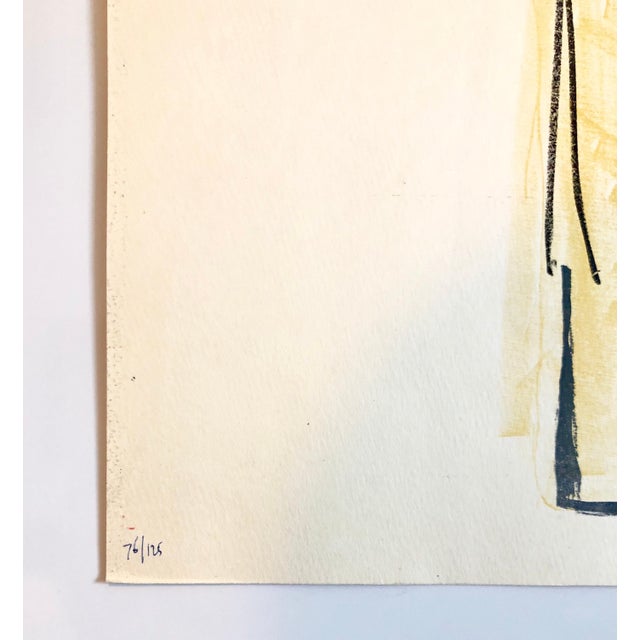
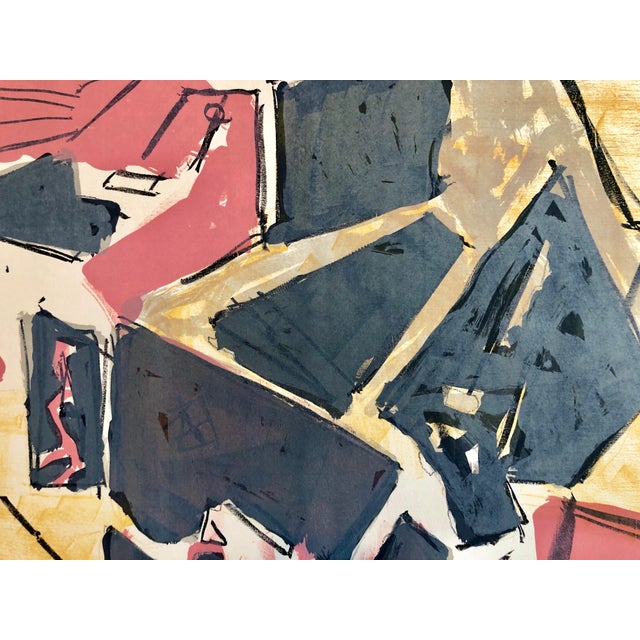
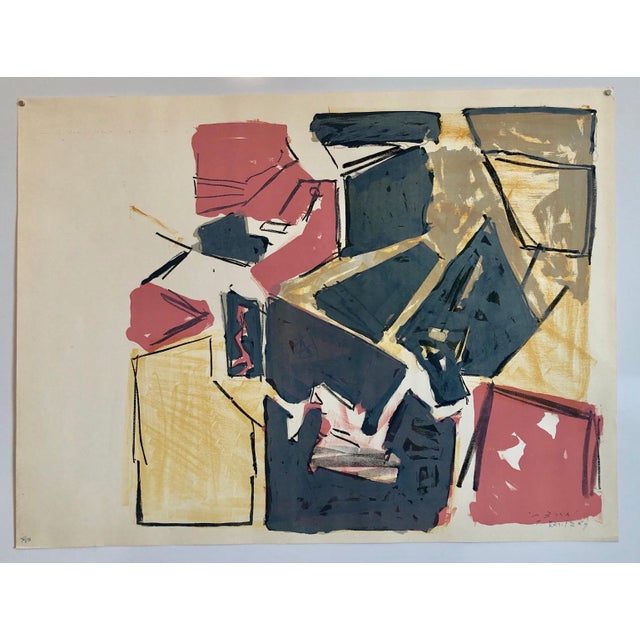
Abstract Composition, 1959 Lithograph
This was from a portfolio which included works by Yosl Bergner, Menashe Kadishman, Yosef Zaritsky, Aharon …
Read more
Abstract Composition, 1959 Lithograph
This was from a portfolio which included works by Yosl Bergner, Menashe Kadishman, Yosef Zaritsky, Aharon Kahana, Moshe Tamir and Michael Gross.
Joseph (Yossef) Zaritsky (Hebrew: יוסף זריצקי; September 1, 1891 – November 30, 1985) was one of Israel's greatest artists and one of the early promoters of modern art in the Land of Israel both during the period of the Yishuv (Palestine, the body of Jewish residents in the Land of Israel before the establishment of the State of Israel) and after the establishment of the State. In 1948 Zaritsky was one of the founders of the "Ofakim Hadashim" group. In his works he created a uniquely Israeli style of abstract art, which he sought to promote by means of the group. For this work he was awarded the Israel Prize for painting in 1959.
Joseph Zaritsky was born in 1891 in Borispol, in the Poltava Oblast (province), in the Southwestern portion of the Russian Empire (today the Kiev Oblast of the Ukraine), to a large, traditional Jewish family. His parents, Golda and Joseph Ben Ya'acov, were farmers with National-Zionist leanings. One of the main expressions of this was their devoting of two rooms in their home to the study of Hebrew and reading. From 1910 to 1914 he studied art at the Academy of Arts in the city of Kiev. Among the artists that influenced Zaritsky was the Russian Symbolist painter Mikhail Vrubel. In 1915, during World War I, Zaritsky was conscripted into the Russian Army, where he served until 1917.
Because of the pogrom of 1919, the family escaped to Kalarash, Bessarabia, leaving behind all his works and art up to that point. In Kalarash he stayed in his father-in-law's home, where he painted small-scale watercolors, of which only five have survived: three portraits of his wife and two rural landscapes. These small works are done in small dark colored dots, and they reflect the influence of Russian modernism. Zaritsky divided the format into a sort of mosaic on small canvases that blur the illusion of perspective.
In 1924 Zaritsky mounted his first solo exhibition in the club "Menorah" in Jerusalem. Another exhibition was opened in the Technion in Haifa. Zaritsky and the sculptor Abraham Melnikov, were the initiators of the first of the exhibitions of Israeli artists in the Tower of David. Also, from 1927 he served as the Chairman of the Israel Painters and Sculptors Association.
In the middle of the 1920s Zaritsky moved to Tel Aviv and continued to paint the series of landscapes that he had started in Jerusalem. The landscapes and portraits of that he painted during these years show his effort to create an artistic language appropriate to description.
In 1927 Zaritsky left his family behind and went to Paris for a stay of several months.
In 1929 Zaritsky participated in the "Egged" group's exhibition, held in an apartment on Allenby Street in Tel Aviv, in which artists such as Sionah Tagger, Arieh Lubin, and Pinchas Litvinovsky, among others, also participated. The works of this group show the influence of late French post-modernism (primarily of the "School of Paris"), which was popular among the artists of the Land of Israel. The exhibition "The Bezalel National Museum" in 1930 placed him firmly in the public consciousness as a modernist artist. “Even the red curtain," Greenberg writes, "which in his paintings reminds us of the abstraction of Kandinsky, even this red is restrained, and its judgment as red becomes just a matter of a wintry sunset."
Between 1932 and 1933, Zaritsky opened an art "studia" adjoining the basement of the home where he lived on 18 Mapu Street. Among the artists who came to his studio were Yehiel Krize, Arie Aroch. Zaritsky’s watercolor paintings – a unique interpretation of Cézanne and of the Russian symbolist painting (Vrubel) – received recognition from the moment of his aliyah in 1923. Joseph Zaritsky's still lifes and portraits from the end of the 1920s and the 1930s, show the influence of French intimiste painting and sometimes of Matisse. From the middle of the 1930s to the middle of the 1940s Zaritsky concentrated on describing one urban landscape – the view of Tel Aviv roofs from the window of his studio or from the roof of his house. These works of Zaritsky’s are a milestone in the history of Israeli art both because of their high quality and because they represent an important stage in Zaritsky’s movement toward abstraction. They represent the influence of French art in the 1930s. They also relate to the modernist, contemporary aspect of the modern architecture of Tel Aviv, and to painting for its own sake and not to a figurative theme. The level of sophistication and the depth with which he dealt with the principles of painting are milestones in themselves. Artists such as Pinchas Abramovich, Yehiel Krize, Arie Aroch, and Shimshon Holzman were all pupils of Zaritsky during those years. And in addition to them, he had a great influence on many other artists. Zaritsky turned his gaze away from the view of the beach which occupied his contemporaries, like Nahum Gutman, Reuven Rubin, etc., to views of the new, modern city spread out to his north and east. In 1941 he mounted a solo exhibition in the Habima building in honor of his 50th birthday. In 1942 Zaritsky won the Dizengoff Prize for Painting.
The motive behind the founding of an alternative to the general art association came into being in 1948, with an invitation to mount an exhibition of Israeli artists at the Italian pavilion of the Venice Biennale. On November 9, 1948 the new group mounted an exhibition of 18 member artists in the Tel Aviv Museum of Art, under the name "New Horizons." While artists such as Yohanan Simon, Moshe Castel, and Marcel Janco dealt with Zionist and Jewish symbolism, Zaritsky chose for the exhibition an abstract still life influenced by the cubist painter Georges Braque.
In 1957 the government of Israel decided to put on a large national display in honor of the tenth anniversary of the founding of the State of Israel. Among the outstanding works were a large steel sculpture by Yechiel Shemi, "Sculpture of the Decade" by Itzhak Danziger , a frieze by Yaakov Wechsler, etc. Another notable work was Zaritsky's painting "Otsma" (Power), which had been commissioned by Avraham Yaski, a designer in the "Department of Economic Achievements."
In the 1980s Zaritsky would take up residence every summer in the studio he had received on Kibbutz Tzuba. At Tzuba he would paint watercolors, among them abstract nature paintings, from direct contemplation of nature. In the summer of 1983, Zaritsky painted a number of paintings in the studio in which he returned to the motif of the window, which he had used in the past. In addition, in the 1980s Zaritsky created a number of paintings, some of them monumental in size, constructed along the lines of painters like Goya, Pablo Picasso, Marc Chagall, etc.
In 1980 one of Zaritsky's watercolors from 1924 was sold at a public auction in the Gordon Gallery for $79,000. In 1979 he was interviewed on television for the first time on Gideon Ofrat's show "Taste and Smell." In 1981 the Israeli Postal Authority issued a stamp depicting Zaritsky’s “Jerusalem: The View from Jaffa Gate” (1927). In 1981 Marc Scheps, Director of the Tel Aviv Museum of Art, named Zaritsky recipient of the Yakir Ha'ir (Esteemed of the City) award; In January 1982 there was a festive screening of the film "Portrait of an Artist: Joseph Zaritsky” (1981; 32 min.), directed by Jachin Hirsch, under the auspices of the Ministry of Education and the Israel Film Service. In 1985 the Tel Aviv Museum Art hosted a retrospective exhibition of Zaritsky’s art that included 340 of his works.
See less
- Dimensions
- 27ʺW × 2ʺD × 20ʺH
- Styles
- Modern
- Art Subjects
- Abstract
- Frame Type
- Unframed
- Period
- 1950s
- Item Type
- Vintage, Antique or Pre-owned
- Materials
- Lithograph
- Condition
- Good Condition, Unknown, Some Imperfections
- Color
- Yellow
- Condition Notes
- Good minor wear, please see photos. Good minor wear, please see photos. less
Questions about the item?
Returns & Cancellations
Return Policy - All sales are final 48 hours after delivery, unless otherwise specified in the description of the product.
Cancellation Policy - Prior to shipping or local pickup, buyers may cancel an order for up to 48 hours, unless otherwise specified.
Related Collections
- George Barbier Original Prints
- Frank Stella Original Prints
- Byzantine Original Prints
- Toledo Original Prints
- Abraham Rattner Original Prints
- Silver Finish Original Prints
- Louis XIII Original Prints
- Gustave Baumann Original Prints
- Shaun Ellison Original Prints
- Pedro Friedeberg Original Prints
- Fornasetti Original Prints
- Rosenthal Original Prints
- Botanical Prints
- Framed Prints
- Japanese Woodblock Prints
- Screen Prints
- Woodblock Prints
- Bird Prints
- Thomas McKnight Original Prints
- Teak Original Prints
- Spray Paint Original Prints
- Paul Wunderlich Original Prints
- Chaim Gross Original Prints