






Details
Description
Oil on canvas. Second half of the 16th century. The painting comes from the historical family collection of Count Castracane, …
Read more
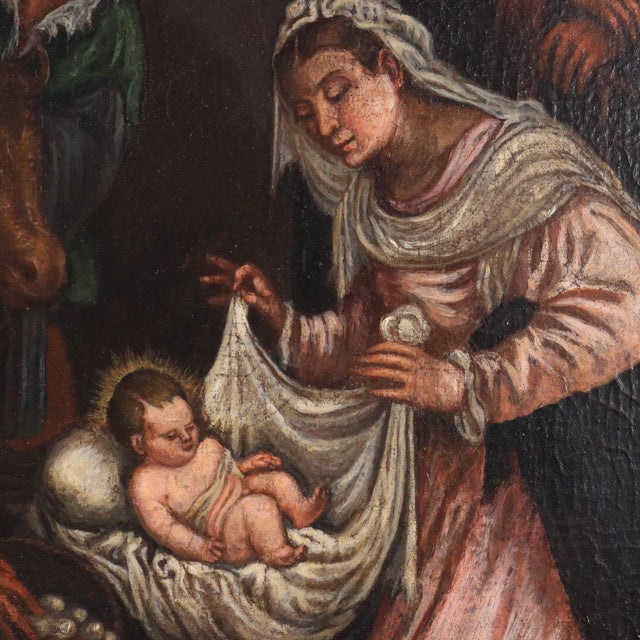
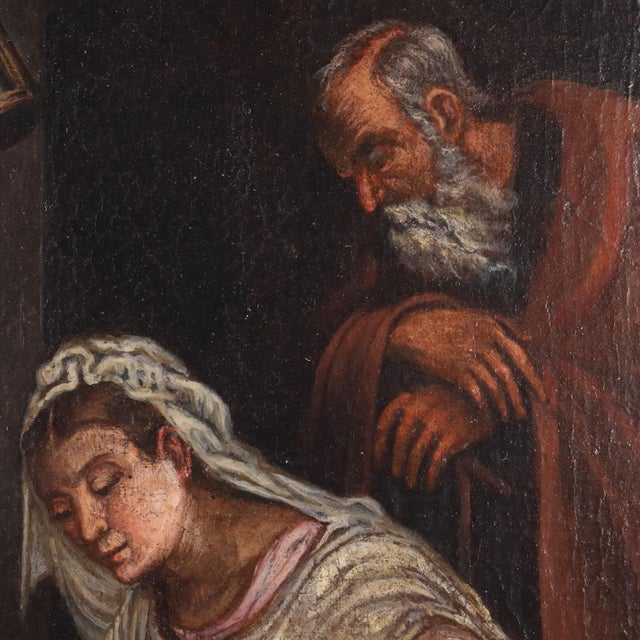
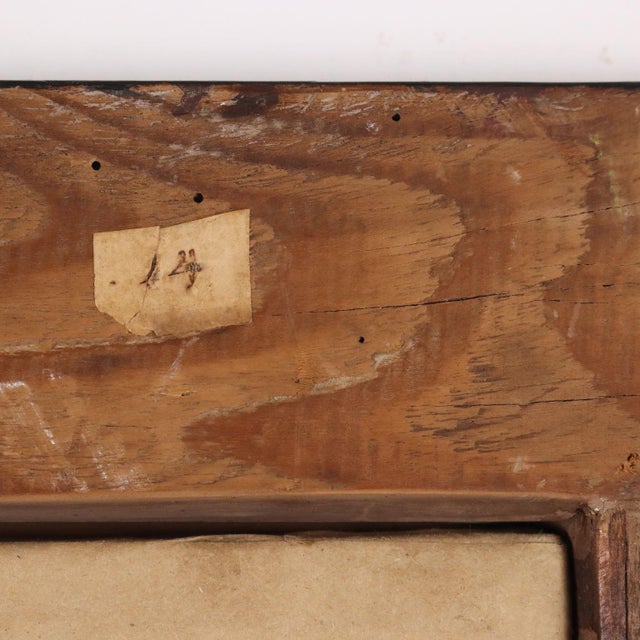
Oil on canvas. Second half of the 16th century. The painting comes from the historical family collection of Count Castracane, as documented by the original autograph paper receipt by Francesco Bassano (attached to the work) which cites: 'V. Most Holy Count Castracane. I received your sum of five hundred ducats for the painting by my hand of Nativitas Domini Nostri as you had ordered. Most Devout Observant Your Servant Franciscus from Ponte de Bassano. On 12 December 1589'. On the back of the frame there is also an inventory cartouche at the top and the writing 'Castracane property' at the bottom. The aforementioned Count Castracane belongs to the noble Castracani family of the Altelminelli di Fano, of Lucca origin. Francesco Dal Ponte da Bassano, known as Il Giovane, worked for many years in the important workshop of his father Jacopo, known as Bassano the Elder, and then moved to Venice in 1578 where he opened his own personal atelier, while continuing to collaborate with the Bassano workshop, managed in the meantime by his brother Leandro after the death of their father; towards the end of the 1980s, however, a crisis manifested itself in Francesco which was also reflected in his allegorical production: in a progressive approach to the taste of his brother Leandro, the color lightened and lost its strength, the forms expanded and became simpler, the composition became fragmented. The production of the Bassanesca family stood out above all for the sacred subjects, however inserted in rural scenarios, which lead them to be defined as biblical-pastoral. Also in this painting the Holy Family it does not characterize the centrality of the scene, but is one of the two groups of very human figures that occupies the right part of the scene, while on the left stands the group of shepherds with the animals of the countryside and the simple objects of daily life. The rural context is also well defined by the surrounding objects, despite the birth hut being replaced by an architectural structure with marble columns, but of a color that blends in with the other surrounding structures. The only spiritual elements are the angel - solitary! - who appears to the shepherds for the announcement, relegated at the top, small and barely visible; and the halo that surrounds the head of the Child Jesus, who is also depicted placidly asleep, unaware of what is happening around him and what awaits him. Characteristic in the production of his father's Bassano workshop were the chromatic richness and liveliness and the luminous contrasts, which however were toned down in Francesco, translating into softer chromatic choices and simplified forms, partially losing their strength. This can also be seen in this work, placed in recent years of the artist's life, especially in the clothes of the characters; note in particular how Mary's dress is no longer red as per tradition, a highly symbolic color of human pain, but is of the same pink shade as the tunic of the central shepherd, as if to underline the Madonna's belonging to humble and simple humanity. Furthermore, Francesco Bassano in the last period, due to his state of health compromised by a serious hypochondria (he died by suicide in 1592), had commissions for works which were only partly carried out by him, but delegated at least partially to his assistants. This he testifies for a work commissioned to him and coming from his workshop, as his autograph declaration states, but probably not created directly by the master, but rather by one of his collaborators. The painting has been restored and relined. It is presented in an ancient wooden frame from the late 18th - early 19th century. This piece is attributed to the mentioned designer/maker. It has no attribution mark and no
official proof of authenticity,
however it is well documented in design history. I take full responsibility for any authenticity
issues arising from misattribution
See less
- Dimensions
- 36.61ʺW × 1.57ʺD × 35.83ʺH
- Art Subjects
- Figure
- Item Type
- Vintage, Antique or Pre-owned
- Materials
- Canvas
- Condition
- Unknown, Some Imperfections
- Color
- Blue
- Condition Notes
- Good — This vintage item remains fully functional, but it shows sign of age through scuffs, dings, faded finishes, minimal … moreGood — This vintage item remains fully functional, but it shows sign of age through scuffs, dings, faded finishes, minimal upholstery defects, or visible repairs\. Restored, Relined less
Returns & Cancellations
Return Policy - All sales are final 48 hours after delivery, unless otherwise specified in the description of the product.
Cancellation Policy - Prior to shipping or local pickup, buyers may cancel an order for up to 48 hours, unless otherwise specified.
Related Collections
- Photorealism Canvas Paintings
- Ed Ruscha Paintings
- Photorealism Paintings in New York
- Richard Serra Paintings
- Herman Miller Paintings
- Jo Baskerville Paintings
- Louise Nevelson Paintings
- Karen Offutt Paintings
- Nicola Simbari Paintings
- BDDW Paintings
- James McCray Paintings
- Leroy Neiman Paintings
- Jaanika Peerna Paintings
- Black Photorealism Paintings
- Johannes Andersen Paintings
- Pedro Friedeberg Paintings
- Peter Behrens Paintings
- Piet Hein Eek Paintings
- Raphael Paintings
- Vienna Secession Paintings
- Jeff Slemmons Paintings
- Gold-filled Paintings
- Photorealism Paintings in Los Angeles
- Carl-Axel Acking Paintings
- Karl-Erik Ekselius Paintings