

Details
Description
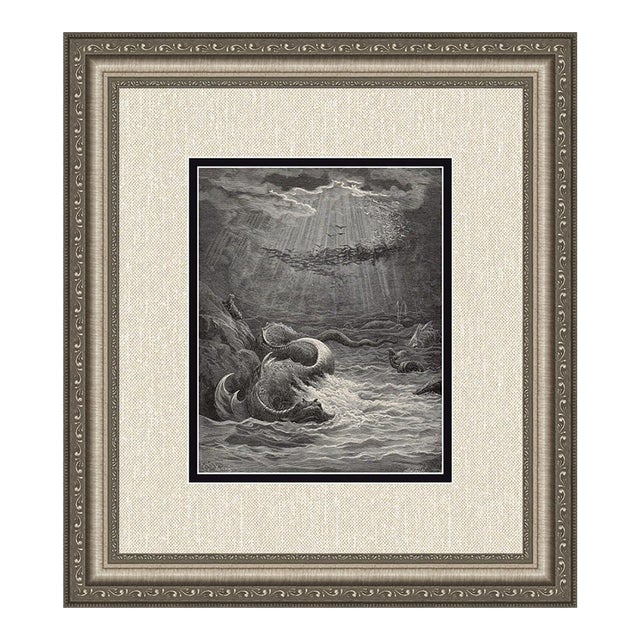
Artist: Gustave Doré (Paul Gustave Louis Christophe Dore) (French, 1832-1883)
Title: Leviathan, waters of Chaos
Medium: Antique woodcut wove paper …
Read more
Artist: Gustave Doré (Paul Gustave Louis Christophe Dore) (French, 1832-1883)
Title: Leviathan, waters of Chaos
Medium: Antique woodcut wove paper after the original by master wood engraver Henri Théophile Hildibrand (French, 1824 - 1897).
Year: c. 1880
Signature: Signed in the plate, lower left.
Condition: Excellent
Dimensions: Image size 7 3/4 x 9 5/8 inches.
Framed dimensions: Approximately 17 x 19 inches.
Framing: This piece has been professionally matted and framed using all new materials.
Accompanied by a Certificate of Authenticity.
Additional notes:
This is not a modern print. This impression is more than 120 years old. The strike is crisp and the lines are sharp
Extra Information:
And seems a moving land; and at his gills Draws in, and at his trunk spouts put, a sea
~John Milton's Paradise Lost
Artist Biography: Paul Gustave Louis Christophe Doré was a French artist, printmaker, illustrator and sculptor. Doré worked primarily with wood engraving. Doré was born in Strasbourg on 6 January 1832. By age five, he was a prodigy troublemaker, playing pranks that were mature beyond his years. Seven years later, he began carving in cement. At the age of fifteen Doré began his career working as a caricaturist for the French paper Le Journal pour rire, and subsequently went on to win commissions to depict scenes from books by Rabelais, Balzac, Milton and Dante. Les Oceanides Les Naiades de la mer, 1860s In 1853, Doré was asked to illustrate the works of Lord Byron. This commission was followed by additional work for British publishers, including a new illustrated Bible. In 1856 he produced twelve folio-size illustrations of The Legend of The Wandering Jew, which propagated long standing anti-semitic views of the time, for a short poem which Pierre-Jean de Ranger had derived from a novel of Eugène Sue of 1845. In the 1860s he illustrated a French edition of Cervantes's Don Quixote, and his depictions of the knight and his squire, Sancho Panza, have become so famous that they have influenced subsequent readers, artists, and stage and film directors' ideas of the physical "look" of the two characters. Doré also illustrated an oversized edition of Edgar Allan Poe's "The Raven", an endeavor that earned him 30,000 francs from publisher Harper & Brothers in 1883. Doré's illustrations for the Bible (1866) were a great success, and in 1867 Doré had a major exhibition of his work in London. This exhibition led to the foundation of the Doré Gallery in Bond Street, London. In 1869, Blanchard Jerrold, the son of Douglas William Jerrold, suggested that they work together to produce a comprehensive portrait of London. Jerrold had obtained the idea from The Microcosm of London produced by Rudolph Ackermann, William Pyne, and Thomas Rowlandson in 1808. Doré signed a five-year contract with the publishers Grant & Co that involved his staying in London for three months a year, and he received the vast sum of £10,000 a year for the project. Doré was mainly celebrated for his paintings in his day. His paintings remain world-renowned, but his woodcuts and engravings, like those he did for Jerrold, are where he really excelled as an artist with an individual vision. The completed book, London: A Pilgrimage, with 180 engravings, was published in 1872. It enjoyed commercial and popular success, but the work was disliked by many contemporary critics. Some of these critics were concerned with the fact that Doré appeared to focus on the poverty that existed in parts of London. Doré was accused by The Art Journal of "inventing rather than copying." The Westminster Review claimed that "Doré gives us sketches in which the commonest, the vulgarest external features are set down." The book was a financial success, however, and Doré received commissions from other British publishers. Doré's later work included illustrations for new editions of Coleridge's Rime of the Ancient Mariner, Milton's Paradise Lost, Tennyson's Idylls of the King, The Works of Thomas Hood, and The Divine Comedy. Doré's work also appeared in the weekly newspaper The Illustrated London News. Doré never married and, following the death of his father in 1849, he continued to live with his mother, illustrating books until his death in Paris following a short illness. The city's Père Lachaise Cemetery contains his grave. The government of France made him a Chevalier de la Legion d'honneur in 1861.
See less
- Dimensions
- 17ʺW × 1ʺD × 19ʺH
- Styles
- Illustration
- Frame Type
- Framed
- Period
- Late 19th Century
- Country of Origin
- United States
- Item Type
- Vintage, Antique or Pre-owned
- Materials
- Woodcut
- Condition
- Good Condition, Original Condition Unaltered, Some Imperfections
- Color
- Onyx
- Condition Notes
- EXCELLENT EXCELLENT less
Questions about the item?
Returns & Cancellations
Return Policy - All sales are final 48 hours after delivery, unless otherwise specified in the description of the product.
Cancellation Policy - Prior to shipping or local pickup, buyers may cancel an order for up to 48 hours, unless otherwise specified.
Related Collections
- Byzantine Original Prints
- Frank Stella Original Prints
- George Barbier Original Prints
- Greg Copeland Original Prints
- Teak Original Prints
- Balmain Original Prints
- Damien Hirst Original Prints
- Shaun Ellison Original Prints
- Abraham Rattner Original Prints
- Silver Finish Original Prints
- Tatiana Alida Original Prints
- Robert Kipniss Original Prints
- Botanical Prints
- Japanese Woodblock Prints
- Framed Prints
- Screen Prints
- Woodblock Prints
- Thomas McKnight Original Prints
- Bird Prints
- Paul Wunderlich Original Prints
- Spray Paint Original Prints