




Details
Description
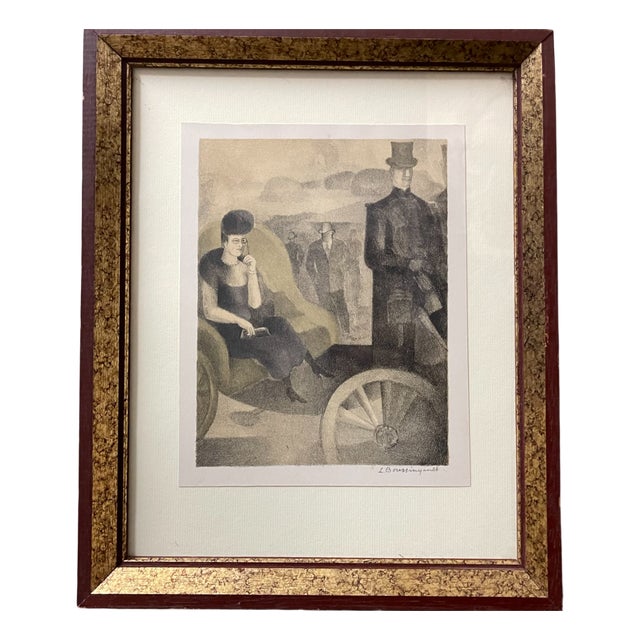
Beautiful and rare engraving by the great Parisian Art Nouveau artist.
It depicts with rare effectiveness the unmatched atmosphere of …
Read more
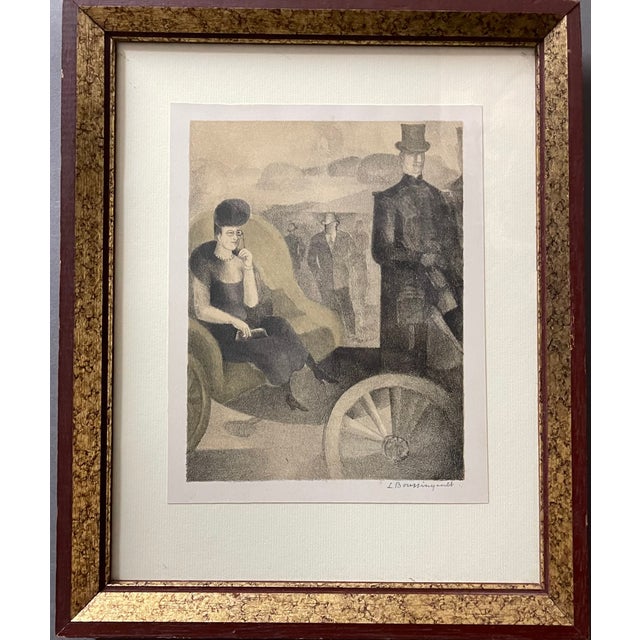
Beautiful and rare engraving by the great Parisian Art Nouveau artist.
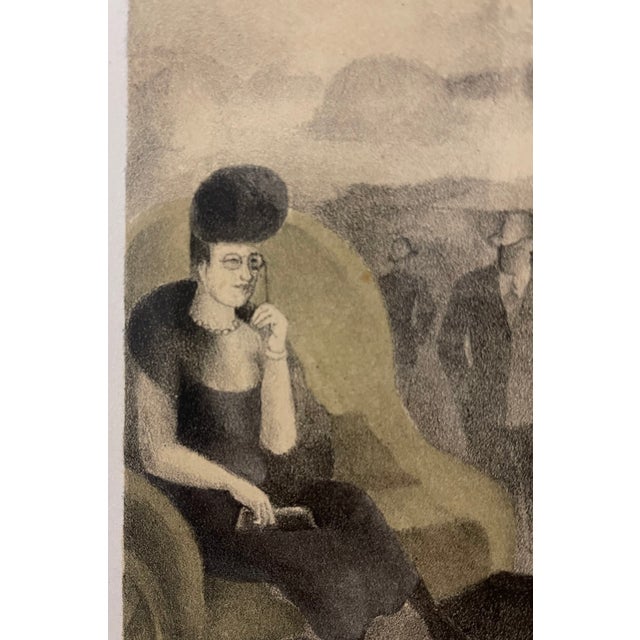
It depicts with rare effectiveness the unmatched atmosphere of the Belle Époque with a snobbish noblewoman sitting in her carriage driven by an impeccable chauffeur.
This artwork, never before on the market, comes from an important private collection and is beautified by an impressive antique frame in laquered wood, in almost perfect condition.
Certificate of authenticity issued by Sabrina Egidi official Expert in Italian furniture for the Chamber of Commerce of Rome and for the Rome Civil Courts.
The artwork is also protected by glass
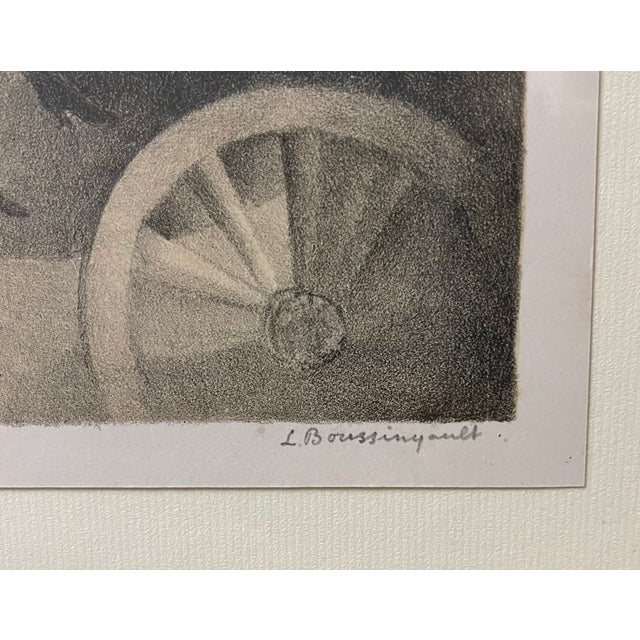
Jean-Louis Boussingault (Paris 1883-1943) est un artiste peintre, graveur et illustrateur français. Il a pratiqué la pointe sèche, l'eau-forte et la lithographie. Born on 8 March 1883 in the 6th arrondissement of Paris, Jean-Louis Boussingault, who belonged to the family of the chemist Jean-Baptiste Boussingault, of whom he was the grandson, frequented the painters André Dunoyer de Segonzac, Luc-Albert Moreau, Valdo Barbey and André Villeboeuf in the 1900s: they were all students at the Académie Julian and then at the Académie de la Palette, where his teachers included Charles Guérin, Georges Desvallières and Pierre Laprade.
During the summer of 1908, this group of friends went on holiday to Saint-Tropez and painted together.
For a time, Dunoyer and Boussingault shared a studio in Paris.
He exhibited for the first time in 1909 at the Salon des Indépendants.
In May 1910, with André Dunoyer de Segonzac and Luc-Albert Moreau, he inaugurated the new Barbazanges gallery with an exhibition of drawings.
In 1914, Bernard Boutet de Monvel painted his portrait, and in June, he contributed to the Gazette du Bon Ton, depicting a dress by Paul Poiret, who commissioned him to create a major decorative ensemble for his shops. He called it the ‘new Constantin Guys’.
He also contributed to the weekly illustrated magazine Le Témoin, founded by Paul Iribe.
In 1919, he joined the Compagnie des arts français founded by Louis Süe and André Mare, where he met Dunoyer and Moreau: they belonged to the figurative movement of decorative art and worked on commission.
In September-October 1923, he exhibited at the van Deene gallery in Amsterdam with eleven other artists.
His death on 17 May 1943 at the Clinique Oudinot in the 7th arrondissement, in the middle of the war, did not go unnoticed, as a tribute exhibition was held from 10 March to 23 April 1944 at the Musée des Arts Décoratifs. He is buried in the Père-Lachaise cemetery.
Dimensions are frame included
This piece has an attribution mark,
I am sure that it is completely authentic and take full responsibility for any authenticity
issues arising from misattribution
See less
Returns & Cancellations
Return Policy - All sales are final 48 hours after delivery, unless otherwise specified in the description of the product.
Cancellation Policy - Prior to shipping or local pickup, buyers may cancel an order for up to 48 hours, unless otherwise specified.
Related Collections
- Patrick Nagel Reproduction Prints
- Hable Reproduction Prints
- Reproduction Prints in Panama City, FL
- William Hogarth Reproduction Prints
- Sister Parish Reproduction Prints
- Jonathan Adler Reproduction Prints
- Lauren Ralph Lauren Reproduction Prints
- Dorothy Draper Reproduction Prints
- Gold-Plate Reproduction Prints
- Leather Reproduction Prints
- Edward S. Curtis Reproduction Prints
- Mark D. Sikes Reproduction Prints
- Jute Reproduction Prints
- Sam Francis Reproduction Prints
- William Gropper Reproduction Prints
- Daylight Dream Editions Reproduction Prints
- Restoration Hardware Reproduction Prints
- Reproduction Prints in Mobile
- Alvar Aalto Reproduction Prints
- Polychrome Reproduction Prints
- Utagawa Kunisada (Toyokuni Iii) Reproduction Prints
- Serena and Lily Reproduction Prints
- Joshua Reynolds Reproduction Prints
- Port 68 Reproduction Prints
- Bunny Williams Home Reproduction Prints