





Details
Description
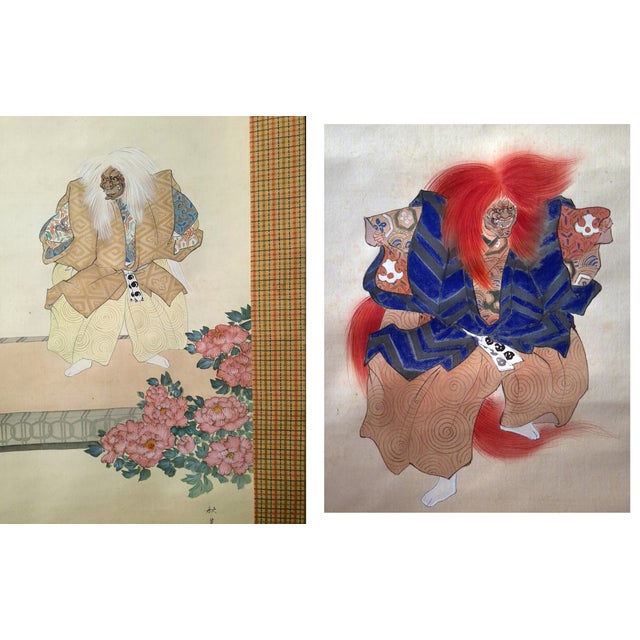
Japanese Noh play Shakkyo Lion Dance scrolls, a pair of finely drawn and detailed, Lion Dance scrolls in colored inks …
Read more
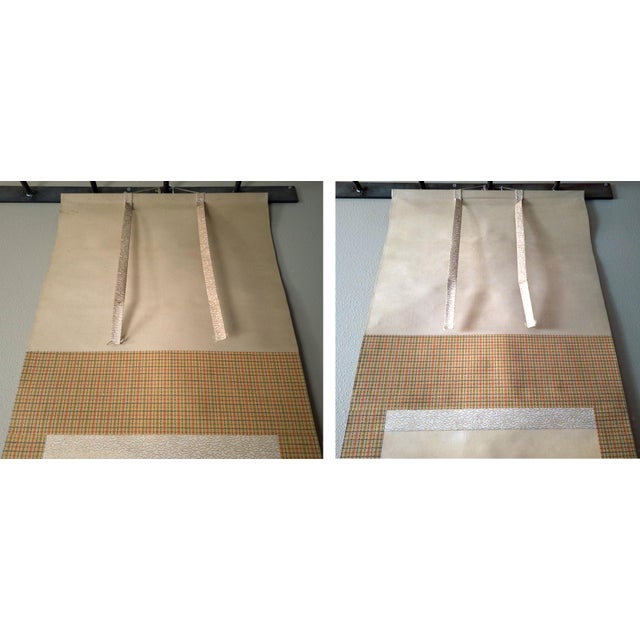
Japanese Noh play Shakkyo Lion Dance scrolls, a pair of finely drawn and detailed, Lion Dance scrolls in colored inks on silk mounted on a red, green, black and orange, silk brocade nakamawashi in a square lattice pattern, with a raw, tan, silk ten and ji, a shimmering, silver and ecru, silk brocade ichimonji and futai in cloud pattern, black and gold, lacquer jikusaki and a black and white, flat braided, silk makio and kakeo at the top. The exterior scroll cover is raw silk in a light green color. Signed in black kaisho script with one, red, seal mark at the lower right and left of the images by Yoshida Shuko. The scrolls come with kiriwood presentation boxes with black xingshu script, "signed and sealed SHUKO", and signed again by Yoshida Shuko on the interior of the covers as well. Circa Taisho era.
Toshida Shuko: (1887-1946) Born in Kanazawa, Yoshida Shuko (whose real name was Seiji), was a Japanese-style painter. He graduated from the Tokyo School of Fine Arts and studied under Terazaki Kogyo (1866-1919). He exhibited his works at the Bunten and the Teiten, and was a member of the Nihonga-in (Institute of Japanese Style Painting) and the Tomoe Kai.
Shakkyo: Monk Jakushō (also known as Ōe no Sadamoto before he renounced the world) is traveling around China and India visiting the places associated with Buddha. One day he arrives at a stone bridge in Mount Shōryōzen in China (located in the present Shanxi Province). A woodcutter boy appears. The boy exchanges words with Jakushō and tells him that the land beyond the bridge is the Pure Land belonging to Monju Bosatsu (Manjusri Bodhisattva) and that crossing this long, narrow bridge arching over a deep gorge is not easy for humans (indicating the difficulty of Buddhist ascetic training). The boy predicts that the monk will see a miracle if he stays at the bridge, and then he disappears.
From the other side of the bridge there comes to the waiting Jakushō, two lions, messengers of Manjusri Bodhisattva. The lions play with gorgeous, fragrant peony flowers. After dancing a lion dance, the lions return to their designated positions, which are the carriers of Manjusri Bodhisattva.
Image is 14.75" wide x 48.75" high. 1" depth is the diameter of the jikusaki.
each presentation box: 21.75" long by 3" wide x 2.75" high
See less
- Dimensions
- 40ʺW × 1ʺD × 80ʺH
- Styles
- Japanese
- Frame Type
- Unframed
- Period
- 1910s
- Country of Origin
- Japan
- Item Type
- Vintage, Antique or Pre-owned
- Materials
- Paper
- Silk
- Wood
- Condition
- Good Condition, Original Condition Unaltered, Some Imperfections
- Color
- Tan
- Condition Notes
- A few creases are seen, mostly in the ji, that will flatten with continued hanging, otherwise excellent vintage condition. A few creases are seen, mostly in the ji, that will flatten with continued hanging, otherwise excellent vintage condition. less
Questions about the item?
Returns & Cancellations
Return Policy - All sales are final 48 hours after delivery, unless otherwise specified in the description of the product.
Cancellation Policy - Prior to shipping or local pickup, buyers may cancel an order for up to 48 hours, unless otherwise specified.
Related Collections
- Photorealism Canvas Paintings
- Ed Ruscha Paintings
- Photorealism Paintings in New York
- Richard Serra Paintings
- Herman Miller Paintings
- BDDW Paintings
- Louise Nevelson Paintings
- Karen Offutt Paintings
- Jo Baskerville Paintings
- Karl-Erik Ekselius Paintings
- Carl-Axel Acking Paintings
- Joseph Stella Paintings
- James McCray Paintings
- Milton Avery Paintings
- Photorealism Paintings in Los Angeles
- Leroy Neiman Paintings
- Jaanika Peerna Paintings
- Vienna Secession Paintings
- Nicola Simbari Paintings
- Soicher Marin Paintings
- Cassina Paintings
- Black Photorealism Paintings
- Lawson-Fenning Paintings
- Jean-Paul Barray Paintings
- Hans Andersen Paintings