



Details
Description
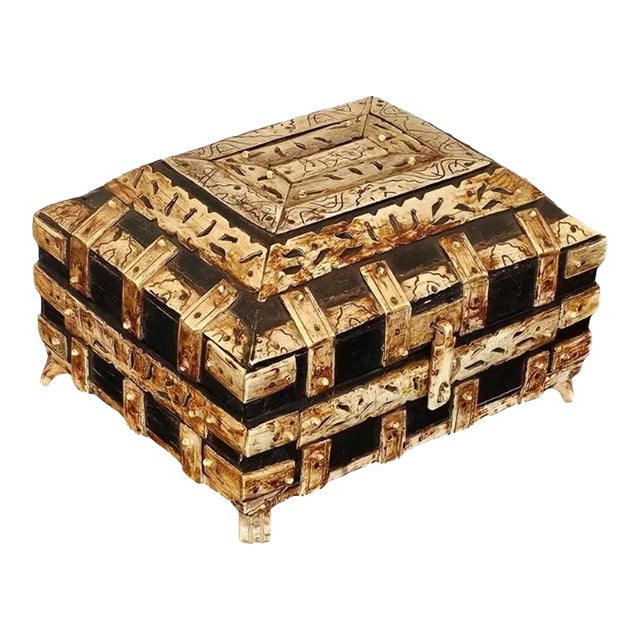
Vizagapatam box, India, 19th century.
This highly decorative and unusual Anglo-Indian table box features rustic workmanship that adds to the …
Read more
Vizagapatam box, India, 19th century.
This highly decorative and unusual Anglo-Indian table box features rustic workmanship that adds to the character and charm of this unique South Asian antique.
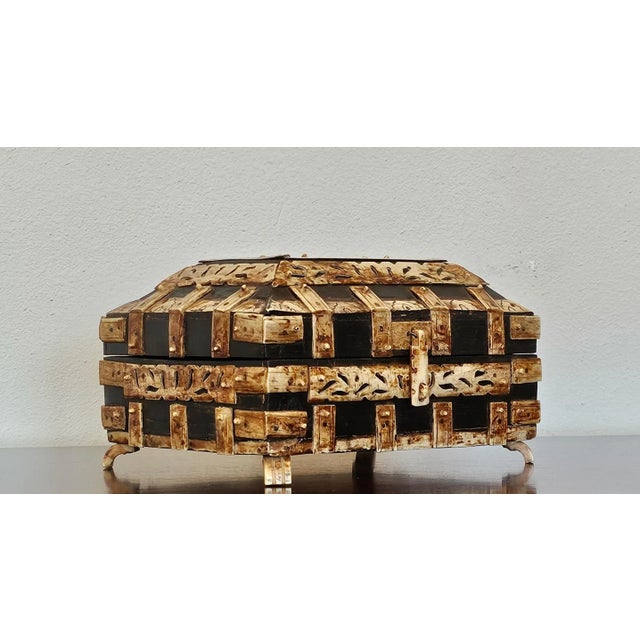
Hand-crafted in Vizagapatam, on the south east coast of India, circa 1875, primitive construction, having an ebonized solid wood footed domed casket form, elaborately mounted with hand carved ox bone panels and straps, pierced and etched with geometric designs and stupas, rising on four carved bone paw feet.
PROVENANCE / ACQUISITION:
From a fine Houston Texas private estate
Acquired from the highly reputable auction house, Austin Auction Gallery, est.1983, Austin, Texas. 2024 Mid-Century Modern, Antiques & Asian catalog
DIMENSIONS: (approx)
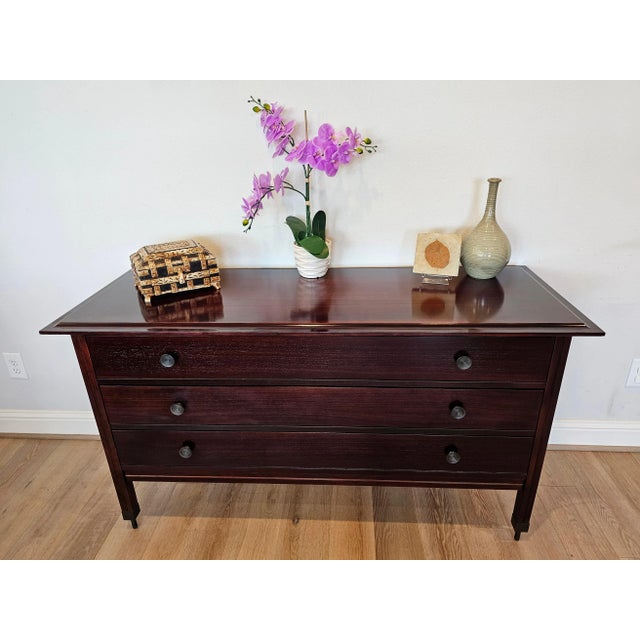
5.75" High, 9.25" Wide, 7.25" Deep;
HISTORY OF THE ANGLO-INDIAN BOXES:
Beginning in the early part of the 18th century, Indian artisans made what came to be known as Anglo-Indian boxes for the English residents living in India, who eventually brought or sent them back to England. At the beginning of the 19th century, India began exporting these boxes commercially, although not in any significant numbers until the 1850s. People valued them so highly that manufacturers of tins copied the designs on them in the late 19th and early 20th century.
Anglo-Indian boxes fall into four groups: Rosewood or ebony boxes inlaid;
sandalwood boxes veneered; sandalwood boxes covered with Sadeli mosaic; and carved boxes often combined with Sadeli mosaic. The first two categories came from Vizagapatam in East India while the last two came from Bombay in West India.
English traders discovered the rich woods and intricate workmanship of Indian artisans, so colonial government officials began to recognize the work of the Indian artists and craftsmen as a source for satisfying the need for furniture and boxes, which would both serve to enhance English households in India. This gave rise to the cabinetmaking workshops in Vizagapatam between Calcutta and Madras.
Craftsmen made the first boxes to be decorated with Sadeli mosaic of rosewood or ebony, incised to give further definition to the decoration, directly inlaid into the wood. The shape of the early boxes was either sloping at the front with a flatter section at the back, reminiscent of English writing slopes, or rectangular. Artisans inlaid the borders with stylized floral scrolls and the centers with a single floral motif following a circular or oval symmetrical or asymmetrical pattern. The edging was ornamental and protective, both helped protect the end grain against the weather.
Made in Vizagapatam, situated on the south east coast of India, near Madras, these exotic boxes were crafted and retailed in Madras and Calcutta by the English and Dutch East India Companies.
CONDITION REPORT:
Great original antique condition with nicely aged warm rustic patina. Wear consistent with age, use, handling and exposure. Overall a remarkable example
Please note, if the box is empty and the top opened all the way back with no assistance or support, it does not have enough weight to hold the chest down and tips backwards. This can easily be avoided if there is weight in the chest compartment or to simply hold on to the top when opening.
Highly collectible objet d'art, perfect for antique collectors, history enthusiasts, artifact hunters, or anyone looking to elevate their home decor, Vizagapatam box, India, 19th century.
This highly decorative and unusual Anglo-Indian table box features rustic workmanship that adds to the character and charm of this unique South Asian antique.
Hand-crafted in Vizagapatam, on the south east coast of India, circa 1875, primitive construction, having an ebonized solid wood footed domed casket form, elaborately mounted with hand carved ox bone panels and straps, pierced and etched with geometric designs and stupas, rising on four carved bone paw feet.
PROVENANCE / ACQUISITION:
From a fine Houston Texas private estate
Acquired from the highly reputable auction house, Austin Auction Gallery, est.1983, Austin, Texas. 2024 Mid-Century Modern, Antiques & Asian catalog
DIMENSIONS: (approx)
5.75" High, 9.25" Wide, 7.25" Deep;
HISTORY OF THE ANGLO-INDIAN BOXES:
Beginning in the early part of the 18th century, Indian artisans made what came to be known as Anglo-Indian boxes for the English residents living in India, who eventually brought or sent them back to England. At the beginning of the 19th century, India began exporting these boxes commercially, although not in any significant numbers until the 1850s. People valued them so highly that manufacturers of tins copied the designs on them in the late 19th and early 20th century.
Anglo-Indian boxes fall into four groups: Rosewood or ebony boxes inlaid;
sandalwood boxes veneered; sandalwood boxes covered with Sadeli mosaic; and carved boxes often combined with Sadeli mosaic. The first two categories came from Vizagapatam in East India while the last two came from Bombay in West India.
English traders discovered the rich woods and intricate workmanship of Indian artisans, so colonial government officials began to recognize the work of the Indian artists and craftsmen as a source for satisfying the need for furniture and boxes, which would both serve to enhance English households in India. This gave rise to the cabinetmaking workshops in Vizagapatam between Calcutta and Madras.
Craftsmen made the first boxes to be decorated with Sadeli mosaic of rosewood or ebony, incised to give further definition to the decoration, directly inlaid into the wood. The shape of the early boxes was either sloping at the front with a flatter section at the back, reminiscent of English writing slopes, or rectangular. Artisans inlaid the borders with stylized floral scrolls and the centers with a single floral motif following a circular or oval symmetrical or asymmetrical pattern. The edging was ornamental and protective, both helped protect the end grain against the weather.
Made in Vizagapatam, situated on the south east coast of India, near Madras, these exotic boxes were crafted and retailed in Madras and Calcutta by the English and Dutch East India Companies.
CONDITION REPORT:
Great original antique condition with nicely aged warm rustic patina. Wear consistent with age, use, handling and exposure. Overall a remarkable example
Please note, if the box is empty and the top opened all the way back with no assistance or support, it does not have enough weight to hold the chest down and tips backwards. This can easily be avoided if there is weight in the chest compartment or to simply hold on to the top when opening.
Highly collectible objet d'art, perfect for antique collectors, history enthusiasts, artifact hunters, or anyone looking to elevate their home decor, jewelry casket, desk organizer, or simply add a touch of rich cultural interest, sophistication and unique historical intrigue!
See less
- Dimensions
- 9.25ʺW × 7.25ʺD × 5.75ʺH
- Styles
- Anglo-Indian
- Indian
- Period
- 19th Century
- Country of Origin
- India
- Item Type
- Vintage, Antique or Pre-owned
- Materials
- Bone
- Wood
- Condition
- Good Condition, Original Condition Unaltered, Some Imperfections
- Color
- Ebony
- Condition Notes
- Great original antique condition with nicely aged warm rustic patina. Wear consistent with age, use, handling and exposure. Overall a … moreGreat original antique condition with nicely aged warm rustic patina. Wear consistent with age, use, handling and exposure. Overall a remarkable example less
Questions about the item?
Returns & Cancellations
Return Policy - All sales are final 48 hours after delivery, unless otherwise specified in the description of the product.
Cancellation Policy - Prior to shipping or local pickup, buyers may cancel an order for up to 48 hours, unless otherwise specified.
Related Collections
- Polyester Boxes
- Alessandro Albrizzi Boxes
- Enzo Mari Boxes
- Abaca Boxes
- Tony Duquette Boxes
- Anthony Redmile Boxes
- Silk Velvet Boxes
- Violet Boxes
- Acacia Wood Boxes
- Bright Green Boxes
- Ettore Sottsass Boxes
- Port 68 Boxes
- Zitan Boxes
- Jewelry Boxes
- Burlwood Boxes
- Hat Boxes
- Silver Boxes
- Japanese Boxes
- Pill Boxes
- Maitland - Smith Boxes
- Tool Boxes
- Cigar Boxes
- Alabaster Boxes
- Porcupine Quill Boxes
- Porcelain Boxes