

Details
Description
English Botanical Watercolor of Seven Tulips, Flamed and Feathered Florists' Varieties
English, Early 19th Century
This early nineteenth-century English watercolor …
Read more
English Botanical Watercolor of Seven Tulips, Flamed and Feathered Florists' Varieties
English, Early 19th Century
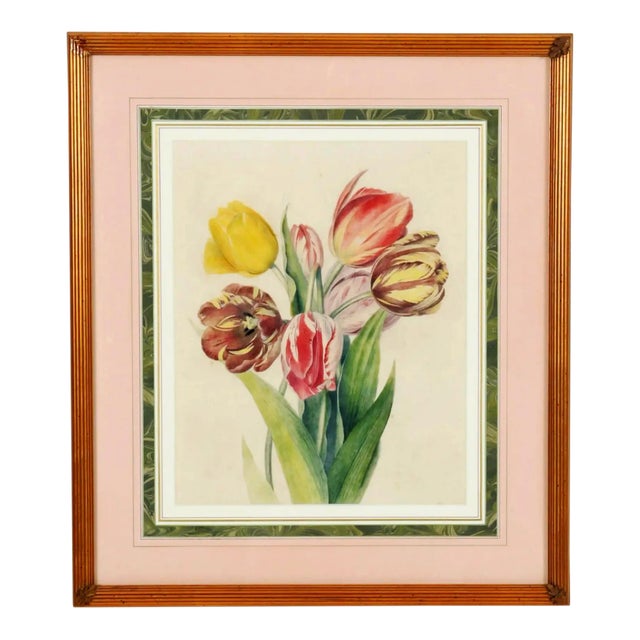
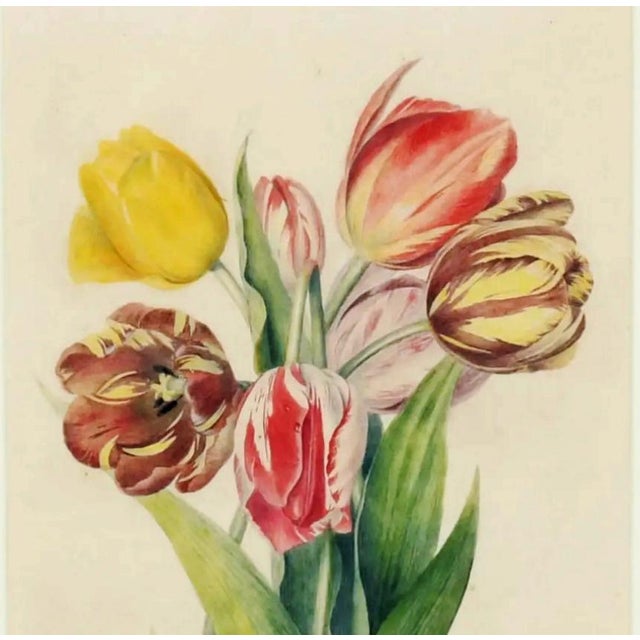
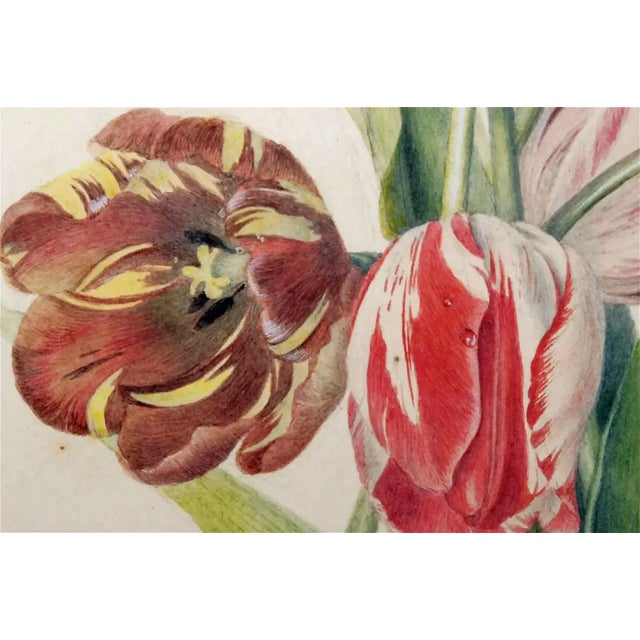
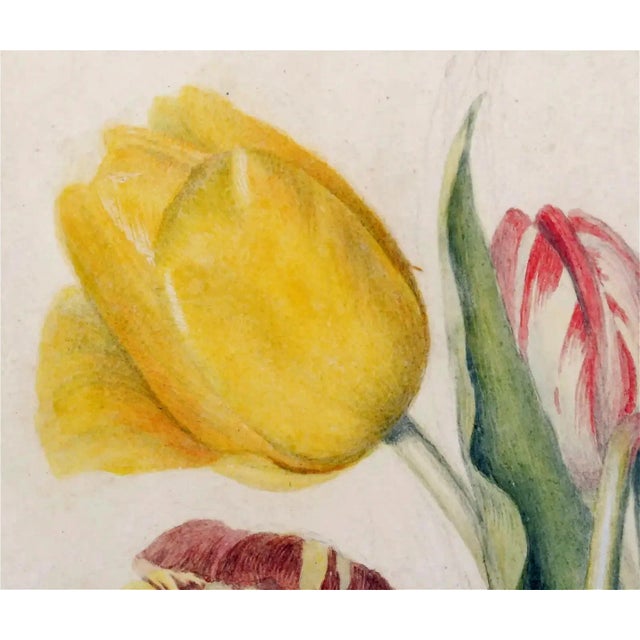
This early nineteenth-century English watercolor depicts a loose bunch of seven tulips, each a different variety and each shown from a different angle, their long strap leaves and bare stems gathered together and set against the plain paper without a vase, ground line or cast shadow, in the manner of the florists' flower portraits of the period. A self-colored yellow tulip, still closed, stands at the upper left. Below it a fully open flower, its cup deep mahogany-red flamed with yellow, turns toward the viewer to show its dark base, yellow anthers and stigma. At the center a closed bloom is striped scarlet on a white ground and carries two painted drops of water on its petals. To the right a large scarlet tulip is feathered with white along the petal edges, a slender yellow tulip is broken with red-brown flames, and behind them a pale pink and white flower and a small pink-flamed bud complete the group.
The petals are modeled with fine parallel hatching over transparent washes, while the leaves are laid in broader washes of blue-green and yellow-green with the veins drawn in. Faint graphite underdrawing survives at the top of the sheet, where a further leaf was sketched but never painted, confirming the work as an original drawing rather than a hand-colored print. The sheet is unsigned and the artist has not been identified; the hatched modeling of the petals belongs to the tradition of the flower painters on vellum of the seventeenth and eighteenth centuries, a manner kept up by trained miniaturists long after broader washes had become the rule among botanical illustrators.
All but the yellow tulip show the “broken” coloring prized by the English florists' societies, whose classes were codified by James Maddock, the Walworth nurseryman, in The Florist's Directory of 1792: bizarres, with red, brown or purple markings on a yellow ground; bybloemens, with purple markings on a white ground; and roses, with pink or scarlet markings on a white ground. In each class the flower was either feathered, with the color confined to a fine edging on the petals, or flamed, with a central beam of color as well. The flowers here are bizarres and roses, and the self-colored yellow tulip is a breeder, an unbroken flower of the kind from which the florists hoped a broken form would one day appear.
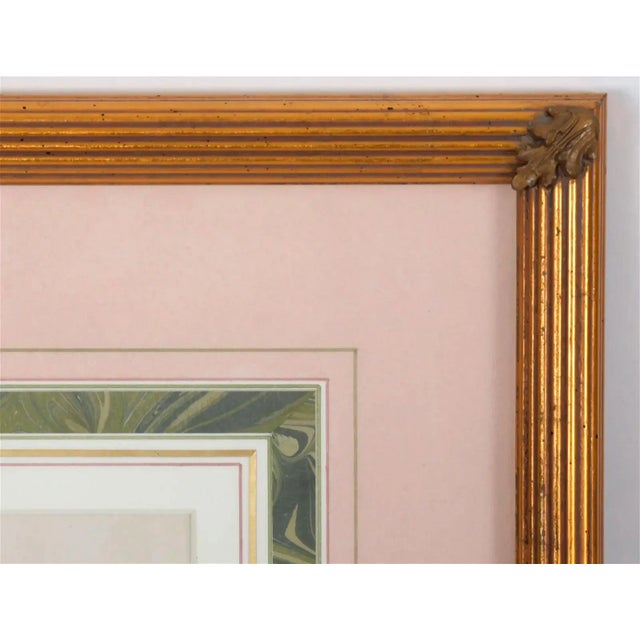
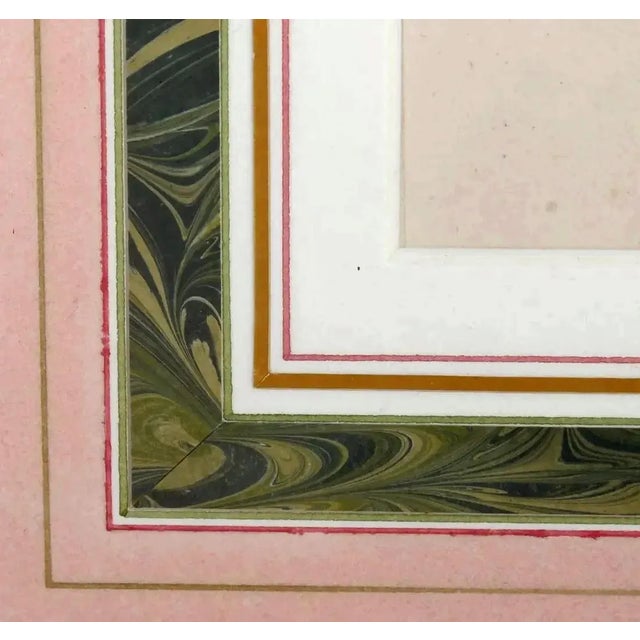
The watercolor is presented in a French mat with an inner cream mat ruled in gold and red, a band of green marbled paper and an outer pink mat with a further ruled border, within a gilt reeded frame with foliate corner blocks. A companion watercolor of four tulips from the same source is also available (NY10551-xicl).
Hung alone above a console or paired with its companion sheet, the watercolor suits a hall, dining room, bedroom or garden room, and the pink and green French mat sits comfortably with both traditional and painted interiors.
Dimensions (frame)
Height: 19 3/4 inches (50.2 cm)
Width: 17 inches (43.2 cm)
Depth: 1 inch (2.5 cm)
Marks
Unsigned. Gallery label of W. Graham Arader III on the reverse.
Provenance
W. Graham Arader III (gallery label)
Private Collection, Pennsylvania
Earle D. Vandekar of Knightsbridge
Condition
Good.
References
Maddock, James. The Florist's Directory; or a Treatise on the Culture of Flowers. London, 1792; later editions revised by Samuel Curtis, London, 1810 and 1822.
Thornton, Robert John. The Temple of Flora. London, 1799–1807, the plate of Tulips painted by Philip Reinagle and engraved by Richard Earlom, 1798.
Pavord, Anna. The Tulip. London: Bloomsbury, 1999.
Blunt, Wilfrid, and William T. Stearn. The Art of Botanical Illustration. London, 1950; revised edition, Woodbridge: Antique Collectors' Club, 1994.
Cayley, D. M. “‘Breaking’ in Tulips.” Annals of Applied Biology 15 (1928), pp. 529–539.
Historical Context
Tulips reached Western Europe from the Ottoman court in the mid-sixteenth century, and the speculative frenzy of Dutch tulipmania in 1636–1637 was driven above all by broken flowers, whose flames and feathers could not be produced to order. In eighteenth- and early nineteenth-century England the tulip passed from the aristocratic garden to the florists' societies of artisans and tradesmen, who raised, exhibited and judged the flowers to strict standards of form and marking and paid high prices for a fine broken bloom; watercolors such as this served the same audience as portraits of prized varieties. The cause of breaking was not understood until 1928, when Dorothy Cayley of the John Innes Horticultural Institution proved by grafting experiments that it was a virus spread by aphids. The English florists' tulip survives today in the Wakefield and North of England Tulip Society, founded in 1836.
See less
- Dimensions
- 17ʺW × 1ʺD × 19.75ʺH
- Styles
- English Traditional
- Art Subjects
- Botanic
- Frame Type
- Framed
- Period
- Early 19th Century
- Country of Origin
- United Kingdom
- Item Type
- Vintage, Antique or Pre-owned
- Materials
- Watercolor
- Condition
- Good Condition, Original Condition Unaltered, Some Imperfections
- Color
- Cream
- Condition Notes
- Good Good less
Questions about the item?
Returns & Cancellations
Return Policy - All sales are final 48 hours after delivery, unless otherwise specified in the description of the product.
Cancellation Policy - Prior to shipping or local pickup, buyers may cancel an order for up to 48 hours, unless otherwise specified.
Related Collections
- Photorealism Canvas Paintings
- Ed Ruscha Paintings
- Richard Serra Paintings
- Photorealism Paintings in New York
- Herman Miller Paintings
- Louise Nevelson Paintings
- Karen Offutt Paintings
- Jo Baskerville Paintings
- Nicola Simbari Paintings
- BDDW Paintings
- James McCray Paintings
- Leroy Neiman Paintings
- Jaanika Peerna Paintings
- Vienna Secession Paintings
- Black Photorealism Paintings
- Johannes Andersen Paintings
- Pedro Friedeberg Paintings
- Peter Behrens Paintings
- Piet Hein Eek Paintings
- Raphael Paintings
- Jeff Slemmons Paintings
- Photorealism Paintings in Los Angeles
- Milton Avery Paintings
- Karl-Erik Ekselius Paintings
- Joseph Stella Paintings