

Details
Description
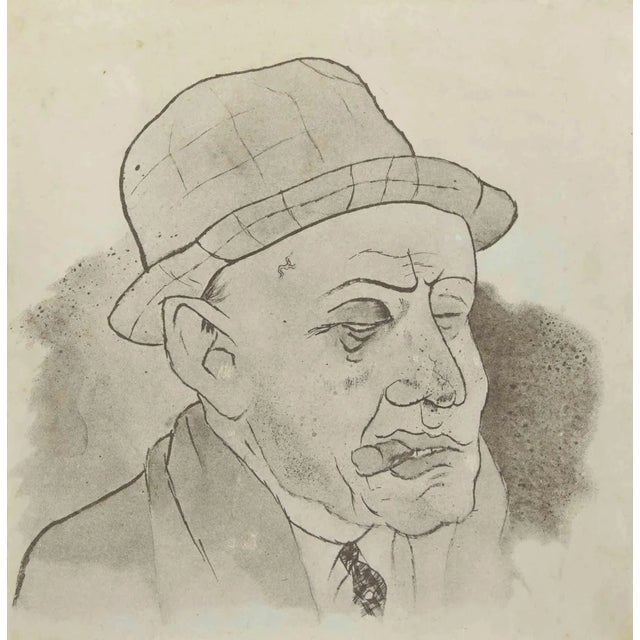
Cover for Ecce Homo is an artwork realized by George Grosz in 1923. Cover for the Suite "Ecce Homo". Lithograph …
Read more
Cover for Ecce Homo is an artwork realized by George Grosz in 1923. Cover for the Suite "Ecce Homo". Lithograph and offset. 26 x 26 cm, no frame. Good conditions. Reference: Wieland Herzfelde (introduction), Der Malik-Verlag, 1916-1947, exhib. cat. German Academy of Arts Berlin, Berlin (East) 1966, cat. no. 59; Lothar Lang, George Grosz bibliography, in: Marginalia, magazine for book art and bibliophilia, 30th issue, July 1968, p. 1ff, no. 38; Rosamunde Neugebauer, Georges Grosz, power and powerlessness of satirical art. The graphic series "God with us", Ecce Homo and Background, Berlin 1993, p. 81 ff. George Grosz; Between 1909 and 1911 he studied at the Dresden Academy with the aim of deepening his knowledge of the great classics. He then made copies of works by the old masters, in particular by Rubens, exhibited in the Dresden art gallery; In this period he also made drawings for newspapers and satirical magazines, using the tool of caricature. In 1913 he stayed in Paris, where he came into contact with the avant-gardes of Cubism and Futurism and where he was able to closely admire the works of Francisco Goya, Honoré Daumier and Henri de Toulouse-Lautrec. It was in these years that his style underwent a process of progressive simplification of forms, under the influence of expressionism, cubism and futurism, widespread among the young artists of the time. Between 1915 and 1917 the graphic reduction of the sign was radicalized to express the moral collapse following the Prussian defeat: on this style Grosz based the production of the following years, characterized by adherence to the Berlin Dada movement and by revolutionary political positions. In 1919 he was arrested for participating in the Spartacist uprising; in the same year he joined the Communist Party of Germany. The artistic production of those years was based on a cubist and futurist language that started from courtly artistic sources of the past to arrive at popular iconographic models. Thus he passed from caricatured drawings to apocalyptic and violent urban views to programmatically political graphics, finally arriving at the New Objectivity movement, in which Grosz participated in the 1925 Mannheim exhibition. In his paintings, but above all in the drawings and lithographs of this period, the immense tragedy of post-war Germany is reflected. Streets, hovels, living rooms, barracks are as if vivisected by Grosz's corrosive pencil, which without irony mercilessly reveals their hypocrisy and violence. His hard and angular style, sometimes childish and violently explicit, is ideal for illustrating poor people, prostitutes, drunks, murderers, wounded soldiers, with a violent component of social criticism against the ruthless greed of the ruling classes and vulgar men of business, hidden under the guise of respectability. In 1933, with the advent of Nazism, George Grosz was considered a degenerate artist and for this reason he left Germany to teach in New York; In 1938 he obtained United States citizenship. In 1958 he returned to live in Germany. George Grosz died in Berlin on July 6, 1959 at the age of 65. This piece is attributed to the mentioned designer/maker. It has no attribution mark and no
official proof of authenticity,
however it is well documented in design history. I take full responsibility for any authenticity
issues arising from misattribution
See less
- Dimensions
- 10.24ʺW × 10.24ʺH
- Styles
- Modern
- Art Subjects
- Figure
- Period
- 1920s
- Country of Origin
- Germany
- Item Type
- Vintage, Antique or Pre-owned
- Condition
- Good Condition, Unknown, Some Imperfections
- Color
- Black
- Condition Notes
- Very Good — This vintage item has no defects, but it may show slight traces of use\. Please note that … moreVery Good — This vintage item has no defects, but it may show slight traces of use\. Please note that an additional handling period of up to 4 weeks may apply to this item less
Returns & Cancellations
Return Policy - All sales are final 48 hours after delivery, unless otherwise specified in the description of the product.
Cancellation Policy - Prior to shipping or local pickup, buyers may cancel an order for up to 48 hours, unless otherwise specified.
Related Collections
- Patrick Nagel Reproduction Prints
- Qing Reproduction Prints
- Reproduction Prints in Panama City, FL
- Sol LeWitt Reproduction Prints
- Utagawa Kunisada (Toyokuni Iii) Reproduction Prints
- Monotype Reproduction Prints
- Daylight Dream Editions Reproduction Prints
- William Gropper Reproduction Prints
- Reproduction Prints in Mobile
- William Hogarth Reproduction Prints
- Classical Greek Reproduction Prints
- Polychrome Reproduction Prints
- Gold-Plate Reproduction Prints
- Ethan Allen Reproduction Prints
- Paule Marrot Reproduction Prints