




Details
Description
A Japanese stoneware tsubo (storage jar) circa 19th century (Meiji period), likely made in one of the Shigaraki or Echizen …
Read more
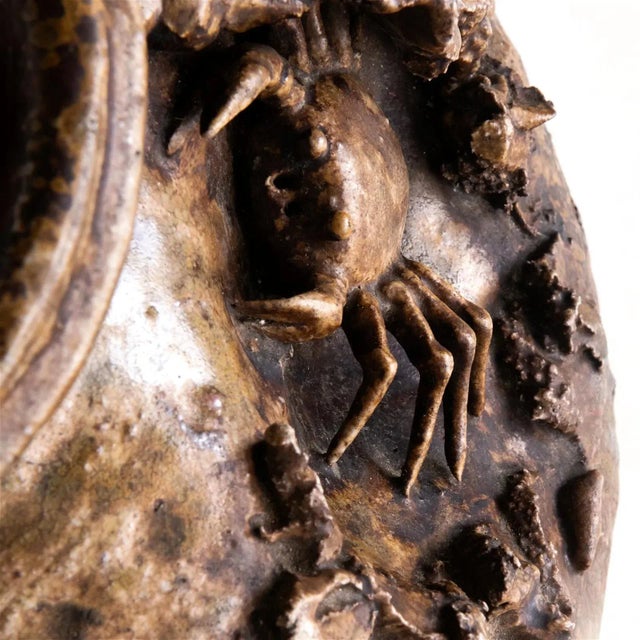
A Japanese stoneware tsubo (storage jar) circa 19th century (Meiji period), likely made in one of the Shigaraki or Echizen kilns. The jar has a thick robust body, and a short-neck rimmed mouth with deep groove. It was hand-coil built from a coarse clay, fired to an iron-rich deep earthy color. The surface is partially covered with a thick ash glaze that is splashed and pooled on one side of the upper part of the body and drips down in streaks/ The lower body and the base shows unglazed reddish clay. A highly unusual feature of this jar is that on its shoulder, quite unexpectedly, there is a high-relief sculpture of a sand crab, beautifully rendered in a realistic fashion. With the meticulous molding, sculpturing and glazing, the little creature appears visually embedded in its surrounding that was made to resemble sandy dirt as if it was just crawling out of its hidden place. The decoration was creative and genuinely smart, giving the sense of an accidental encounter when one views the jar.
The high-relief decoration technique itself is not unusual in Japanese ceramic-making. For instance, applied high relief ornaments is the main feature found on the heavily glazed Sumida ware. However, it is rare to see such method applied in unglazed stoneware such as Shigaraki or Echizen. The realistic rendition of the sand crab indicates that the work was likely made in the second half of the 19th century during Meiji instead of Edo period. Artist Makuzu Kozan (1842-1916), for instance, in his early career, developed a stunning output of high-relief sculptural work (1876-1881) known as Takauki ware. Although this tsubo was unlikely from his studio, it shares a similar spirit in its artistic method and aspiration.
Tsubos were used as storage jar for tea leaves or various types of liquor. Although unitarian by nature, the tea masters in Edo period highly appreciated their earthy wabi-sabi spirit thus elevated them to cherished collectibles.
See less
- Dimensions
- 10.5ʺW × 10.5ʺD × 14ʺH
- Styles
- Japanese
- Period
- 19th Century
- Country of Origin
- Japan
- Item Type
- Vintage, Antique or Pre-owned
- Materials
- Ceramic
- Condition
- Good Condition, Unknown, Some Imperfections
- Color
- Brown
- Condition Notes
- Good Wear consistent with age and use. Fine antique condition.8000Natural surface with irregular ash deposits and irregularity from the firing … moreGood Wear consistent with age and use. Fine antique condition.8000Natural surface with irregular ash deposits and irregularity from the firing process, as made. less
Questions about the item?
Returns & Cancellations
Return Policy - All sales are final 48 hours after delivery, unless otherwise specified in the description of the product.
Cancellation Policy - Prior to shipping or local pickup, buyers may cancel an order for up to 48 hours, unless otherwise specified.
Related Collections
- Bottles and Jars and Jugs in Lexington, KY
- Khaki Bottles and Jars and Jugs
- Port 68 Bottles and Jars and Jugs
- Acrylic Bottles and Jars and Jugs
- Roger Capron Bottles and Jars and Jugs
- Ralph Lauren Bottles and Jars and Jugs
- Gold-Plate Bottles and Jars and Jugs
- Medieval Bottles and Jars and Jugs
- Borosilicate Glass Bottles and Jars and Jugs
- Cherry Wood Bottles and Jars and Jugs
- Crocks
- Wicker Bottles and Jars and Jugs
- Apothecary Jars
- Cookie Jars
- Japanese Bottles and Jars and Jugs
- 1800s Perfume Bottles
- Candy Jars
- Antique Water Jugs
- Murano Glass Bottles and Jars and Jugs
- 1950s Perfume Bottles
- Apothecary Bottles
- Deruta Bottles and Jars and Jugs
- Portieux Vallerysthal Bottles and Jars and Jugs
- Lead Bottles and Jars and Jugs
- Mottahedeh Bottles and Jars and Jugs