






Details
Description
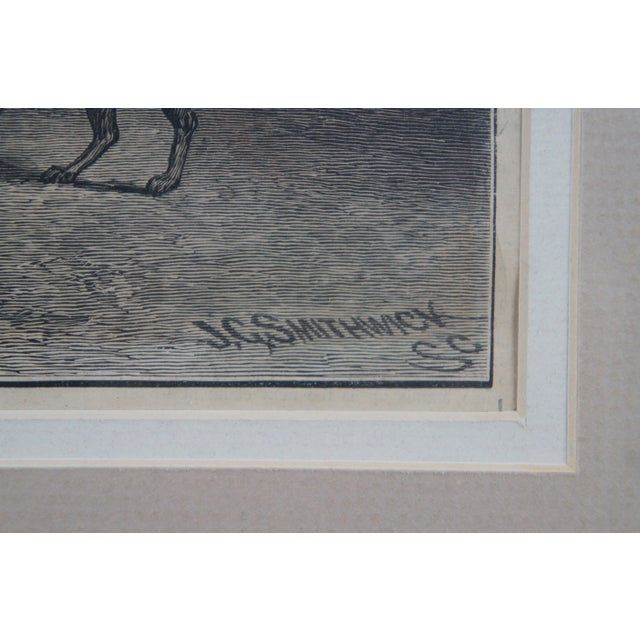
Framed antique hand colored engraving from a series titled "Southern Sketches," depicting "A Gentleman of Color" by T.W. Wood 1874, …
Read more
Framed antique hand colored engraving from a series titled "Southern Sketches," depicting "A Gentleman of Color" by T.W. Wood 1874, showing a finely dressed black man walking down a street with a small dog. Engraved by J.C. Smithwick SC. Framed in a gilded frame with beaded and foliate details and a white painted bevel.
"Thomas Waterman Wood (1823 - 1903) was active/lived in New York, Kentucky. The son of a Montpelier, Vermont cabinetmaker, Thomas Waterman Wood determined his life's course at an early age. He first pursued studies in portraiture with Chester Harding in Boston and then established a New York portrait studio in 1853. Beginning in 1855, Wood worked as an itinerant in Quebec, Washington, D.C. and Baltimore until 1858, when he and his wife departed for a year long sojourn in Paris. While abroad, the artist copied Old Masters and refined his technique before returning to America in 1859.
Executed from his new home in Nashville, Tennessee, Wood's best known painting—an 1861 depiction of field slaves titled Southern Cornfield—heralded the start of his career as an artist of "sensitive portrayals of southern blacks, free blacks in the North, and black soldiers from the Civil War." With Nashville under increasing threat from Union forces, Wood relocated to Louisville in 1863, where, for a time, he specialized in highly detailed portraits of children set against lush backgrounds. It was an encounter in Louisville—the sight of an African American Civil War veteran struggling to cross the street on one leg—that inspired an important series of works (collectively called "War Episodes" and now in the collection of the Metropolitan Museum of Art) documenting the transition from slavery to freedom. Created at a time of flux in the role of American genre painting, Wood's images of emancipated African Americans have powerful allegorical undercurrents and document the quest of outsiders to establish identity in a shifting world. Like many of these latter works, The Apple Vendor depicts a black man, well dressed and affable, trying to make a living through honest trade.
Wood returned to New York in 1866 and focused almost exclusively on genre scenes with African American themes. Named an associate of the National Academy of Design in 1869 and elevated to full academician in 1871, Wood was later elected president of the academy in 1891. From 1878 to 1887, he served as president of the American Watercolor Society."
Dimensions:
17.5" x 1" x 21.5" / Sans Frame - 9.5" x 13" (Width x Depth x Height)
See less
- Dimensions
- 17.5ʺW × 1ʺD × 21.5ʺH
- Styles
- Early American
- Frame Type
- Framed
- Art Subjects
- Portrait
- Still Life
- Period
- Late 19th Century
- Country of Origin
- United States
- Item Type
- Vintage, Antique or Pre-owned
- Materials
- Engraving
- Condition
- Good Condition, Original Condition Unaltered, Some Imperfections
- Color
- Gray
- Condition Notes
- Good Overall - Light wear to frame; discoloration to print Good Overall - Light wear to frame; discoloration to print less
Questions about the item?
Returns & Cancellations
Return Policy - All sales are final 48 hours after delivery, unless otherwise specified in the description of the product.
Cancellation Policy - Prior to shipping or local pickup, buyers may cancel an order for up to 48 hours, unless otherwise specified.
Related Collections
- Rattan Original Prints
- Soicher Marin Original Prints
- Medium-Density Fibreboard Original Prints
- Silver Finish Original Prints
- Sam Francis Original Prints
- Dye Transfer Original Prints
- Original Prints in Lexington, KY
- John Kiraly Original Prints
- Donald Sultan Original Prints
- Original Prints in Panama City, FL
- Johannes Kip Original Prints
- Damien Hirst Original Prints
- Ralph Lauren Original Prints
- Original Prints in Salt Lake City
- Framed Prints
- Botanical Prints
- Bird Prints
- Woodblock Prints
- Screen Prints
- Japanese Woodblock Prints
- George Barbier Original Prints
- Thomas McKnight Original Prints
- Frank Stella Original Prints
- Gustave Baumann Original Prints
- Teak Original Prints