




Details
Description
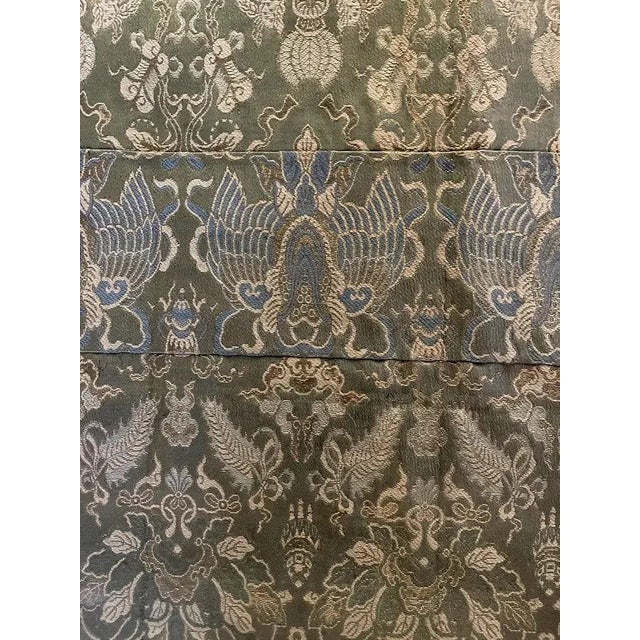
A Japanese Kesa (Monk's Vestment) made from thirteen columns of patchworks of shimmering woven brocades. The elaborate motifs feature repetitive …
Read more
A Japanese Kesa (Monk's Vestment) made from thirteen columns of patchworks of shimmering woven brocades. The elaborate motifs feature repetitive elaborate floral designs with variations. Six silk square in contrasting bright orange color with subtle embroidered patterns were sewn to the four corners and along one longitude side of the Kesa, completing the symbolism of the robe. The four squares in the corners represent the Four Heavenly Kings (Shi Tenno); while the two slightly larger squares in the middle section represent two compassionate bodhisattvas. The back of the Kesa was lined with a turquoise-color silk with loops for hanging, obviously a more recent lining replacement.
Kesa is derived from the Sanskrit word kasaya, meaning “dark colored,” a reference to the saffron colored robes worn by early Indian Buddhist monks. It is essentially a rectangular cloth originally sewn from patches of rags, being formless, it serves as a symbolism of the ascetic life of one's choosing. In Japan, since at least the Heian period (794–1185), the kesa has been worn by Buddhist priests as their outermost robe, draped over the left shoulder and attached under the right armpit. While it served some function of protection, it was more a signal of the wearer’s faith, and became increasingly elaborate over the centuries. During the Edo period (1600–1868), many kesa worn were patched together from exquisite silk brocade fabrics that were donated to the temples by members of the aristocracy, ruling military class, or wealthy merchants. By stitching the fabric into a patchwork robe, the monks concentrated their attention on the creation of a devotional work of art, every stitch part of an act of meditation on the teachings of the Buddha. The number of stripes (from 5 to up to 25) indicates the wearer’s rank and the occasion for which it was worn, the highest number of stripes usually only being worn by an abbot during festival ceremonies. The normal daily kesa generally have seven columns. The kesa on offer is more likely a ceremonial robe for special occasion.
See less
- Dimensions
- 77.5ʺW × 0.1ʺD × 46ʺH
- Styles
- Japanese
- Period
- Late 19th Century
- Country of Origin
- Japan
- Item Type
- Vintage, Antique or Pre-owned
- Materials
- Silk
- Condition
- Good Condition, Unknown, Some Imperfections
- Color
- Taupe
- Condition Notes
- Good Wear consistent with age and use. Minor fading. Fine antique textile condition. Color is a but uneven with the … moreGood Wear consistent with age and use. Minor fading. Fine antique textile condition. Color is a but uneven with the center slightly darker, maybe due to the folded exposure. loss threads on one seam hard to notice. Backing silk is of a more recent time. less
Questions about the item?
Returns & Cancellations
Return Policy - All sales are final 48 hours after delivery, unless otherwise specified in the description of the product.
Cancellation Policy - Prior to shipping or local pickup, buyers may cancel an order for up to 48 hours, unless otherwise specified.
Related Collections
- Cashmere Textile Art
- Rug and Kilim Textile Art
- Textile Art in Santa Fe
- Workaday Handmade Textile Art
- Louis XIII Textile Art
- Hair on Hide Textile Art
- Cork Textile Art
- Old New House Textile Art
- Chanel Textile Art
- Antique Gold Finish Textile Art
- Edwardian Textile Art
- Mid-Century Modern Textile Art
- Framed Scarves
- Tapestry
- Chinese Textile Art
- Japanese Textile Art
- Scandinavian Textile Art
- Aubusson Tapestry
- Brutalist Textile Art
- Märta Måås-Fjetterström Textile Art
- Space Age Textile Art
- Cardboard Textile Art
- Surrealism Textile Art
- Asian Style Textile Art