





Details
Description
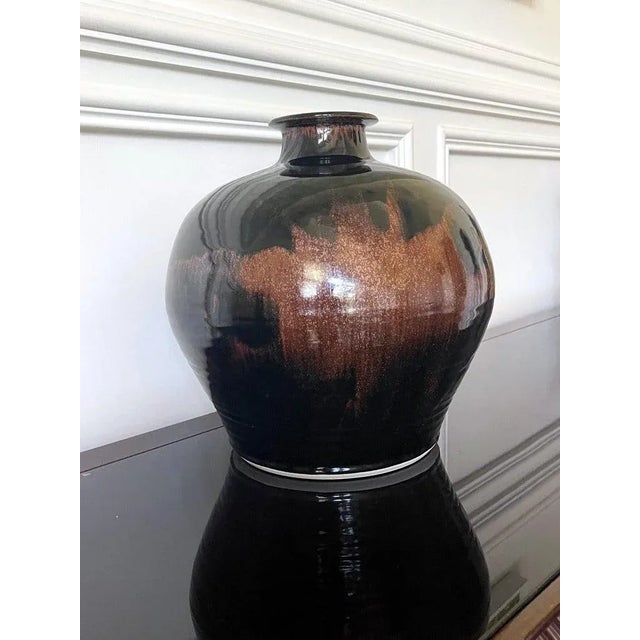
An early ceramic jar with a distinct Tenmoku glaze by Brother Thomas Bezanson (1929-2007) by Benedictine monk potter Brother Thomas …
Read more
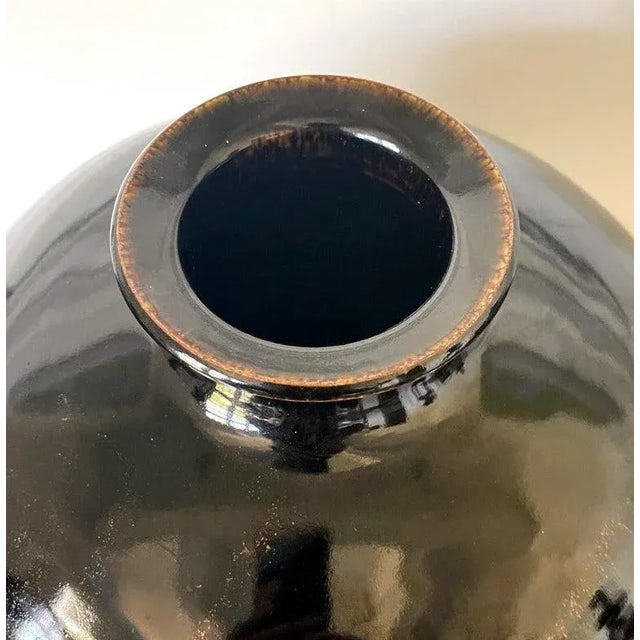
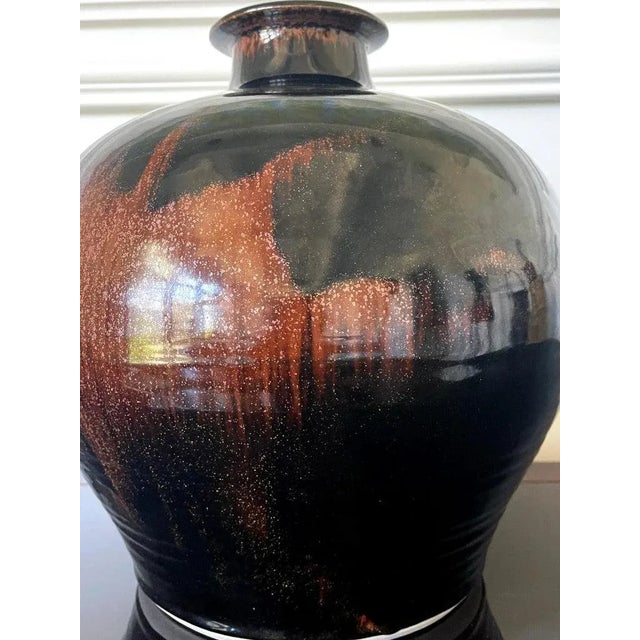
An early ceramic jar with a distinct Tenmoku glaze by Brother Thomas Bezanson (1929-2007) by Benedictine monk potter Brother Thomas Bezanson (1929-2007). The minimalistic robust form with a bulbous body and a short-necked mouth was unmistakably informed by the Classic Chinese form found in Song Dynasty. What is extraordinary about this piece is the so-called "Honan Tenmoku" glaze Bezanson achieved on the surface. The term Tenmoku is Japanese, but it came from Chinese Tianmu Mountain in Zhejiang Province of Eastern China. The teacups used in the temples there featured such a dark glaze that it became widely popular in Song Dynasty. Jian ware, located in Fujian Provence in China focused its prided production on tea bowls with such delicate glaze effects and intimately their popularity spread to Japan and stimulated local imitation and became highly priced chado pieces. The dark glaze displays random effects with historical named such as the "hare's fur", "oil-spot" and "partridge feather" patterns, caused by excess iron in the glaze during firing. Such effect is evident as the highlight on this spectacular jar.
The base is marked ''Benedictine Monks, Weston Vermont'' and artist decipher, dating the piece to circa 1965-1970.
Brother Thomas Bezanson (1929-2007) was a Canadian born artist and Benedictine monk primarily known for his porcelain pottery and mastery of complex glazes. Strongly influenced by Asian pottery, often adapting traditional Chinese and Japanese pottery methods and materials to his work. He is renowned for his original glaze recipes and perfect forms and always sought to create something new and beautiful. His exacting standards made for the shattering of over 80% of each firing. One "rescued" piece however is now in the collection of the Museum of fine Arts, Boston. His estate is represented by Pucker Gallery in Boston.
See three examples with the Honan Tenmoku glaze, see illustration 13, 24 and 34 in "The porcelain of Brother Thomas The path to the Beautiful" by Godine/Pucker Safrai.
See less
- Dimensions
- 13ʺW × 13ʺD × 13.25ʺH
- Styles
- Modern
- Period
- 1960s
- Country of Origin
- United States
- Item Type
- Vintage, Antique or Pre-owned
- Materials
- Ceramic
- Condition
- Good Condition, Unknown, Some Imperfections
- Color
- Brown
- Condition Notes
- Good Wear consistent with age and use. Fine condition. Base show minor shelf wear. Good Wear consistent with age and use. Fine condition. Base show minor shelf wear. less
Questions about the item?
Returns & Cancellations
Return Policy - All sales are final 48 hours after delivery, unless otherwise specified in the description of the product.
Cancellation Policy - Prior to shipping or local pickup, buyers may cancel an order for up to 48 hours, unless otherwise specified.
Related Collections
- Port 68 Bottles and Jars and Jugs
- Roger Capron Bottles and Jars and Jugs
- Ralph Lauren Bottles and Jars and Jugs
- Gold-Plate Bottles and Jars and Jugs
- Medieval Bottles and Jars and Jugs
- Borosilicate Glass Bottles and Jars and Jugs
- Cherry Wood Bottles and Jars and Jugs
- Acrylic Bottles and Jars and Jugs
- Bottles and Jars and Jugs in Lexington, KY
- Khaki Bottles and Jars and Jugs
- Crocks
- Wicker Bottles and Jars and Jugs
- Apothecary Jars
- Cookie Jars
- Japanese Bottles and Jars and Jugs
- 1800s Perfume Bottles
- Candy Jars
- Antique Water Jugs
- Murano Glass Bottles and Jars and Jugs
- Apothecary Bottles
- 1950s Perfume Bottles
- Portieux Vallerysthal Bottles and Jars and Jugs
- Deruta Bottles and Jars and Jugs
- Mottahedeh Bottles and Jars and Jugs
- Lead Bottles and Jars and Jugs