



Details
Description
A rare Japanese copper serving tray with cloisonne enamel design. The central part of the tray depicts a wireless cloisonne …
Read more
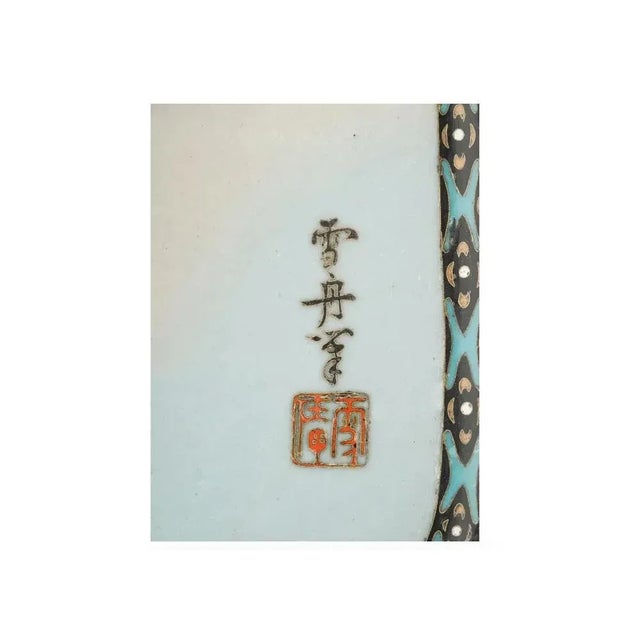
A rare Japanese copper serving tray with cloisonne enamel design. The central part of the tray depicts a wireless cloisonne picture, a coastal landscape view with a full moon. The hieroglyphical signature of the artist is in the lower right. The rims and the backside are decorated with floral ornaments. Blue and black color palette. Collectible Oriental Decor And Applied Arts For Interior Design.
Namikawa Sōsuke (1847–1910) was a Japanese cloisonné artist,[1] known for innovations that developed cloisonné enamel into an artistic medium sharing many features with paintings.[2][3] He and Namikawa Yasuyuki (no relation)[notes 1] were the most famous cloisonné artists of the 1890 to 1910 period, known as the "golden age" of Japanese enamels.[1] Around 1880 he set up and ran the Tokyo branch of the Nagoya Cloisonné Company.[1] He exhibited his artworks at national and international expositions, where he took an organising role.[2] He was recognised as an Imperial Household Artist and created art works for imperial residences. He sometimes signed his works with the character sakigake (pioneer)
the art work is based off a art work done by Sesshū Tōyō
Sesshū Tōyō (雪舟 等楊, c. 1420 – August 26, 1506), also known simply as Sesshū (雪舟), was a Japanese Zen monk and painter who is considered a great master of Japanese ink painting. Initially inspired by Chinese landscapes, Sesshū's work holds a distinctively Japanese style that reflects Zen Buddhist aesthetics.[1] His prominent work captured images of landscapes, portraits, and birds and flowers paintings, infused with Zen Buddhist beliefs, flattened perspective, and emphatic lines.[2]
Sesshū was born into the samurai Oda family (小田家) and trained at Shōkoku-ji temple in Kyoto, Japan, as a Zen monk.[1] From his early childhood, Sesshū showed a talent for painting and eventually became widely revered throughout Japan as a wise, reputable Zen scholar, and the greatest painter priest of Zen-Shu.[3]
Sesshū worked in a painting atelier whilst training under Tenshō Shūbun (c. 1418–1463). But upon visiting China, his work betook a distinctive Chinese influence, merging Japanese and Chinese styles to develop his individualistic style of Zen paintings.[3] Sesshū's influence on painting was so wide that many schools of art appointed him their founder.[4] Sesshū's most acclaimed works are Winter Landscape (c. 1470s), Birds and Flowers (1420–1506) and Four Landscape Scrolls of the Seasons (1420–1506).
Dimensions: 10 3/4 x 7 in. All measurements are approximate.
Condition
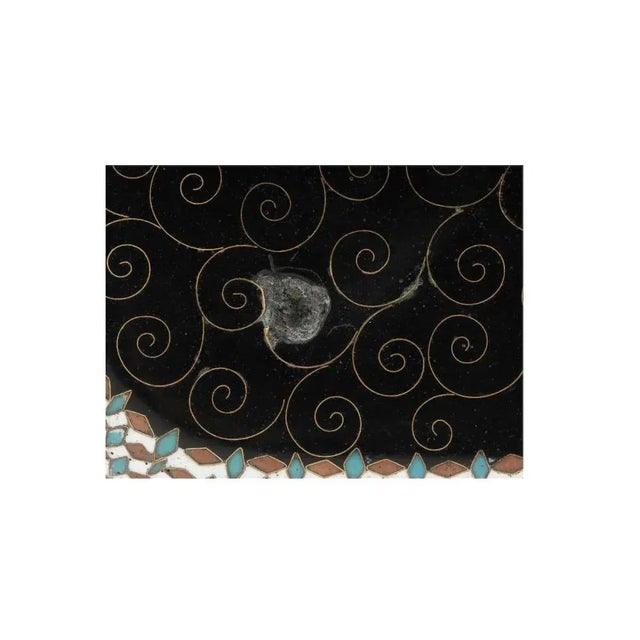
Good antique condition. Signs of age and wear. Refer to photos.
See less
- Dimensions
- 7ʺW × 10.75ʺD × 1ʺH
- Styles
- Japanese
- Period
- Late 19th Century
- Country of Origin
- Japan
- Item Type
- Vintage, Antique or Pre-owned
- Materials
- Cloisonné
- Copper
- Condition
- Good Condition, Original Condition Unaltered, Some Imperfections
- Color
- Baby Blue
- Condition Notes
- Good antique condition. Signs of age and wear. Refer to photos. Good antique condition. Signs of age and wear. Refer to photos. less
Questions about the item?
Returns & Cancellations
Return Policy - All sales are final 48 hours after delivery, unless otherwise specified in the description of the product.
Cancellation Policy - Prior to shipping or local pickup, buyers may cancel an order for up to 48 hours, unless otherwise specified.
Related Collections
- Los Castillo Trays
- Gustavsberg Trays
- Virginia Metalcrafters Trays
- Chrome Finish Trays
- Venini Trays
- Chase Brass and Copper Company Trays
- Barovier and Toso Trays
- Terra Cotta Trays
- Emilia Castillo Trays
- Willy Rizzo Trays
- Bone China Trays
- James Dixon and Sons Trays
- Seagrass Trays
- Maison Baguès Trays
- Coral Trays
- Copper Trays
- Silver Trays
- Brass Trays
- Persian Trays
- Silverplate Trays
- Georges Briard Trays
- Mid-Century Modern Trays
- Metal Trays
- Aluminum Trays
- Japanese Trays