




Details
Description
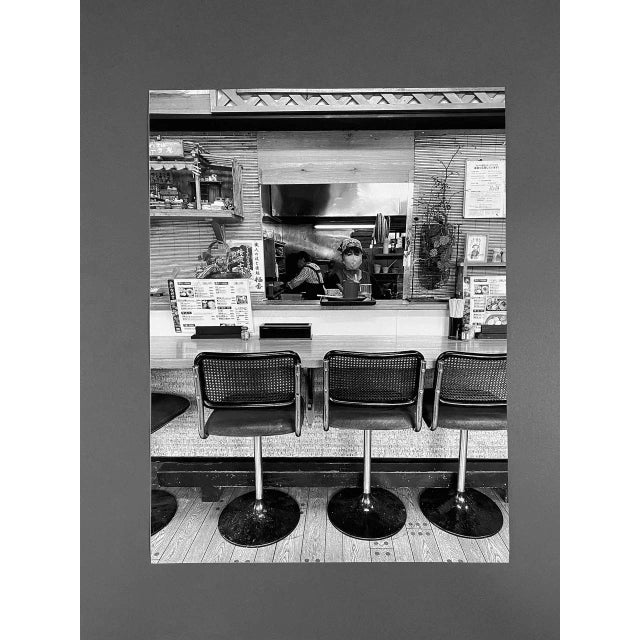
Limited Edition #01/10 Black & White portrait of a road house Chef in Nikko Japan October 2022 by Taco Joustra.
…
Read more
Limited Edition #01/10 Black & White portrait of a road house Chef in Nikko Japan October 2022 by Taco Joustra.
This portrait is part of a series titled "Faces of Japan".
The museum quality fine art B&W print measures Height : 22.062 x Width : 15.944 inches. The photograph will be signed and numbered .
Monochrome photography is photography where each position on an image can record and show a different amount of light, but not a different hue. It includes all forms of black-and-white photography, which produce images containing shades of neutral grey ranging from black to white. Other hues besides grey, such as sepia, cyan, blue, or brown can also be used in monochrome photography. In the contemporary world, monochrome photography is mostly used for artistic purposes and certain technical imaging applications, rather than for visually accurate reproduction of scenes.
Although methods for photographing in color emerged slowly starting in the 1850s, monochrome imagery dominated photography until the mid–twentieth century. from the start, photographic recording processes such as the daguerreotype, the paper negative and the glass collodion negative did not render the color of light (although they were sensitive to some colors more than others). The result was a monochrome image.
Until the 1880s, photographic processes used to print negatives — such as calotype, ambro type, tintype, salt print and the albumen print — generally produced images with a variety of brown or sepia tones. Later processes moved toward a black-and-white image, although photographers have used toning solutions to convert silver in the image to silver sulphide, imparting a brown or sepia tone. Similarly, selenium toner produces a blue-black or purple image by converting silver into more stable silver selenide. Cyanotypes use iron salts rather than silver salts, producing blue images.
Most modern black-and-white films, called panchromatic films, record the entire visible spectrum. : 157 Some films are orthochromatic, recording visible light wavelengths shorter than 590 nanometers, : 158 in the blue to green range of the spectrum and are less sensitive to the longer wavelength range (i.e. orange-red) of the visible spectrum. This piece has an attribution mark,
I am sure that it is completely authentic and take full responsibility for any authenticity
issues arising from misattribution
See less
- Dimensions
- 15.75ʺW × 20.87ʺH
- Styles
- Contemporary
- Period
- 2020s
- Country of Origin
- Japan
- Item Type
- Vintage, Antique or Pre-owned
- Condition
- Good Condition, Original Condition Unaltered, Some Imperfections
- Color
- Black
Returns & Cancellations
Return Policy - All sales are final 48 hours after delivery, unless otherwise specified in the description of the product.
Cancellation Policy - Prior to shipping or local pickup, buyers may cancel an order for up to 48 hours, unless otherwise specified.
Related Collections
- Photography in Salt Lake City
- Color Pencil Photography
- Edward S. Curtis Photography
- Raymond Loewy Photography
- Soicher Marin Photography
- Scarlet Photography
- Renaissance Photography
- Cubism Photography
- Nick Mele Photography
- Black and White Photos
- Edwardian Photography
- Gustavian (Swedish) Photography
- Photography in Cleveland
- Photography in Minneapolis