






Details
Description
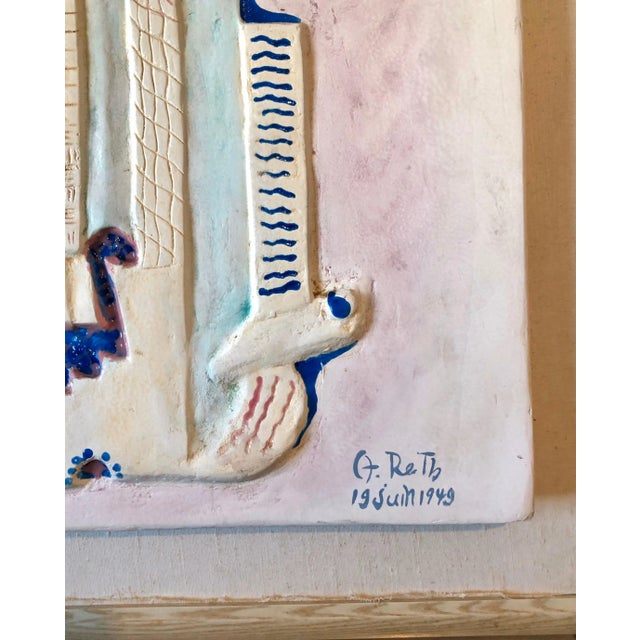
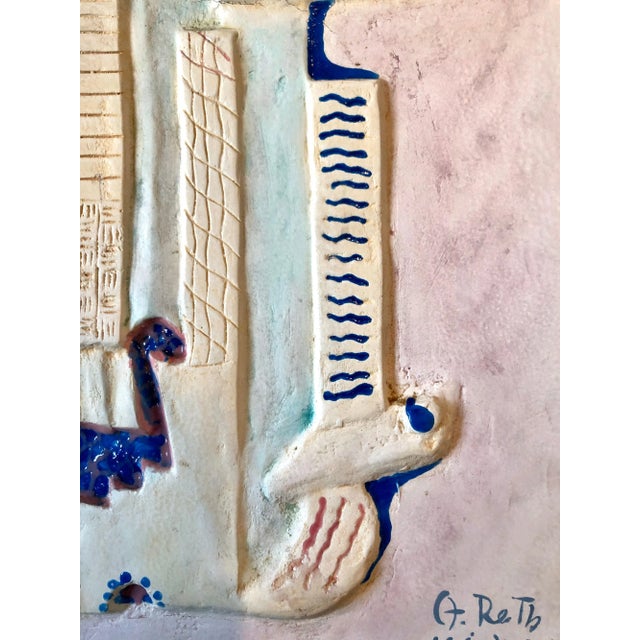
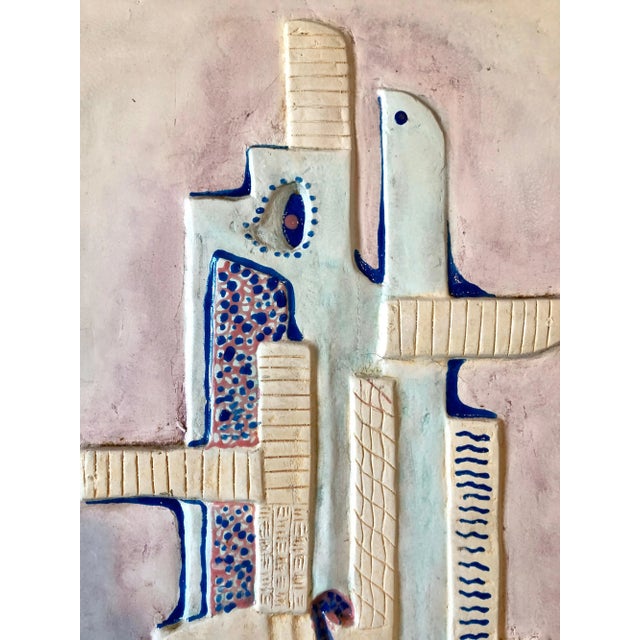
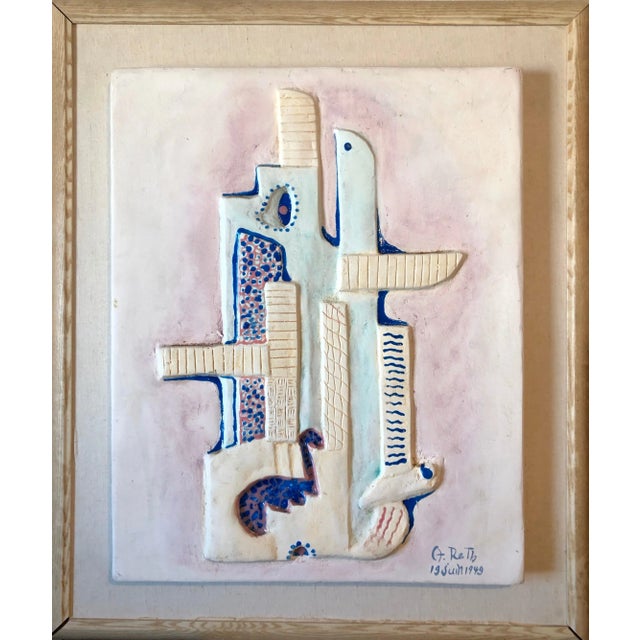
This is a plaster or ceramic relief sculpture with extensive hand painting in an enamel paint.
hand signed and dated …
Read more
This is a plaster or ceramic relief sculpture with extensive hand painting in an enamel paint.
hand signed and dated 1949. It is an abstract piece.
Framed it is 39.5 X 33.5 without frame it is about 29.5 X 24 inches.
Alfréd Réth (1884–1966) was a Hungarian painter and sculptor. Born Alfred Roth, the son of a doctor, a disciple of Karoly Ferenczy in Nagybánya. At the age of 19 he left to study in Italy with painter Istvan Farkas, in 1905 he moved to Paris. Here he discovered the art of Paul Cezanne and Hindu and Khmer art at the Musée Guime. Living in Montparnasse, he attended the academy of Jacques Emile Blanche where he studying drawing. During a second trip to Italy, Alfred Reth studied a few months to the Beaux-Arts in Florence. He became a highly regarded member of the early cubist movement known for his innovative textural approach to abstraction. He showed at the Salon d’Automne and the Salon des Indépendants of 1910, 1911 and 1912. A first rate Hungarian artist along with Victor vasarely, Karel Molnar, Bela Kadar, Hugo Scheiber and Otakar Nejdely. His work bears the influence of Albert Gleizes, Juan Gris and Alexander Archipenko.
A very important exhibition was devoted to him to the Gallery Der Sturm in Berlin in 1913. He was a founding member of the Abstraction-CreationFair and the Salon des Réalités Nouvelles. Many Parisian galleries exhibited his work including Denise Rene Gallery and Galerie Berthe Weill.
In 1920, Reth renewed with the most daring of his artistic past, then leading to solutions that were similar to Sonia Delaunay chromatic circles.
He showed at the Gallery Der Sturm in Berlin and also with fellow avant-garde artists Fernand Leger, Jean Metzinger, Wassilyn Kandinsky, and Robert Delaunay. He then volunteered for military service in the first World War, and it seems that with the distress and instability of this period Reth reverted to a more directly representational manner. This decision was echoed in the work of many other avant-garde artists including Pablo Picasso. In 1932 he became a member of Abstraction Création. This large association of artists quickly became an influential rallying point for the “abstract contingent” of the European avant-garde, and counted among its members Kandinsky, Rene Mondrian, Naum Gabo, Jean Hans Arp.
Reth exhibited his work at the Salon des Réalités Nouvelles, which he helped launch as an important new platform to the post-war avant-garde. A sure sign of the growing public recognition of Reth’s role in the avant-garde were the numerous international exhibitions, among others Sao Paulo (1949), Copenhagen (1950), Stockholm (1951, 1952), Chicago (1966), London (1969). Michel Seuphor wrote of the artist at this time: Reth has for a long time devoted himself to the study of materials, No one has investigated the possibilities of new techniques more thoroughly. After the war and up to the early 1960s he continued to make compositions of circles and arcs, but materials interested him more than forms. He began using sand, wood, gravel and charcoal and called these works “Harmony of Materials.” The figurative works made during the five last years of his life sum-up the entire experience he accumulated during several decades. His works were exhibited at the Abstract Art Exhibition, and as part of the first generations (1910-1939) of the Saint-Etienne Art and Industry Museum in 1957, but the most complete exhibition of his work took place in 1984 in Albi at the Toulouse-Lautrec Museum, celebrating his 100th birthday. A retrospective exhibitions at the Hungarian Institute in Paris and of the Budapest Gallery both organized and curated by Kalman Maklary led to a rediscovery of his work. Major Museum shows included “Le Cubism 1907-1914” Musée d’Art Moderne Paris, 1953, and more recently “Alfred Reth, Retrospective” Musée d’Albi, 1984; L’Ecole de Paris 1909-1929, Musée d’Art Moderne Paris, 2000; Paris Capital of the Arts, Royal Academy, London, 2002. The importance of Reth’s oeuvre is not only in it’s contribution to the development of Modern Art, but also as Julia Cserba writes in the recently published Catalogue Raisonné on Alfred Reth, in the work’s inherent lyricism and discreetly concealed spirituality.
The artist is represented in many major museums including the Musée National d’Art Moderne, Centre Georges Pompidou, Paris; Musée de Peinture, Grenoble; National Gallery, Hungary.
See less
- Dimensions
- 33.5ʺW × 1ʺD × 39.5ʺH
- Styles
- Cubism
- Period
- 1940s
- Item Type
- Vintage, Antique or Pre-owned
- Materials
- Enamel
- Mixed-Media
- Condition
- Good Condition, Unknown, Some Imperfections
- Color
- Off-white
- Condition Notes
- Good good. has minor wear commensurate with age but in generally sound condition. wear at joints to frame mounting. Good good. has minor wear commensurate with age but in generally sound condition. wear at joints to frame mounting. less
Questions about the item?
Returns & Cancellations
Return Policy - All sales are final 48 hours after delivery, unless otherwise specified in the description of the product.
Cancellation Policy - Prior to shipping or local pickup, buyers may cancel an order for up to 48 hours, unless otherwise specified.
Related Collections
- Wenge Sculptural Wall Objects
- Helmut Friedrich Schäffenacker Sculptural Wall Objects
- Egyptian Sculptural Wall Objects
- Stainless Steel Sculptural Wall Objects
- Byzantine Sculptural Wall Objects
- Antique Copper Finish Sculptural Wall Objects
- Ralph Lauren Sculptural Wall Objects
- Medium-Density Fibreboard Sculptural Wall Objects
- Mid-Century Modern Sculptural Wall Objects
- Plaster Sculptural Wall Objects
- Curtis Jere Sculptural Wall Objects
- Brutalist Sculptural Wall Objects
- Asian Sculptural Wall Objects
- Japanese Sculptural Wall Objects
- Greg Copeland Sculptural Wall Objects
- Sarreid Ltd. Sculptural Wall Objects
- Arteriors Home Sculptural Wall Objects