


Details
Description
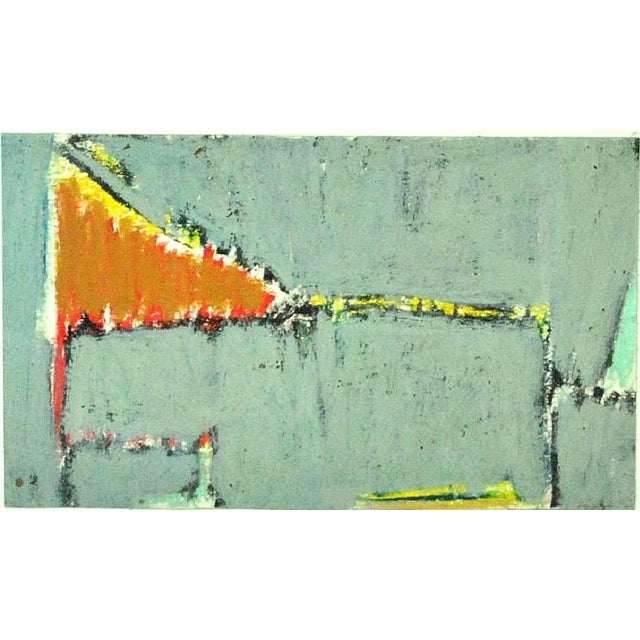
10 X 17 without frame.
Seymour Boardman (1921–2005) was a New York abstract expressionist. Since his first solo exhibition in …
Read more
10 X 17 without frame.
Seymour Boardman (1921–2005) was a New York abstract expressionist. Since his first solo exhibition in Paris in 1951, Boardman developed a personal vision and style of his own, following his own path of abstraction. As a painter he sought to reduce the image to its bare essence. Initially working in the freely brushed manner of Abstract Expressionism, Boardman gradually eliminated the arbitrary aspects of his work until only straight lines and two or three areas of flat, sometimes somber, tones remained. He could hardly have achieved more with less.
In a career that was steady and determined, Seymour Boardman created paintings that are unique, while avoiding fashion and trends. His work stands alone because it derives from the Romantic landscape previously articulated by Milton Avery and early Mark Rothko (who was a friend) and later developed into almost hard edged painting.
Seymour Boardman majored in art at City College of New York in 1938-1942. He served in the United States Air Force from 1942–1946, during which he was hospitalized for over a year due to a wound to his left shoulder, which resulted in partial paralysis of the arm and hand.
After a full medical discharge from the service in 1946, he left for Paris to continue his art education at the École des Beaux-Arts, Académie de la Grande Chaumière, and Atelier Fernand Léger. Boardman's work became more abstract but still based on figure and landscape. He returned to New York in 1949 and went to the Art Students League. Boardman continued to paint dark, moody paintings using a limited palette of black, white, grey, and an occasional additional color. Departed Le Havre France on the Liberte, arriving with his wife in New York on Jan. 22, 1952. In 1955, he had his first one-man show in New York at the Martha Jackson Gallery. It was favorably reviewed by Hilton Kramer, Emily Genauer, Fairfield Porter, and others. "…inscrutable, dark, mostly in blacks stained here and there with calm whitish shapes, they yet manage to suggest something inhuman and romantic…" (N.Y.Times, March 26, 1955). He began to acquire recognition in the 1950s with his paintings of griddled facets seen as if through a frosted glass, without any crisp lines, and in bright colors favoring reds. Boardman's friends included Lawrence Calcagno, Perez Celis, John Hultberg, Burt Hasen, Frank Lobdell, Richards Ruben, Robert Ryman and Nassos Daphnis.
Throughout the 1960s, Boardman showed at both the Stephen Radich Gallery and the A.M. Sachs Gallery; in 1967, The Whitney Museum of American Art and the Guggenheim Museum acquired a painting each. In the early 1970s Boardman had a large exhibition of paintings at the Andrew Dickson White Museum of Art, (currently Herbert F. Johnson Museum of Art), Cornell University, Albany, NY. Thomas Levitt, the Director, wrote in the catalogue, "…Seymour Boardman has gradually eliminated the arbitrary aspects of his work until only straight lines and two or three areas of flat, usually somber, tones remain…" This accurately describes the paintings of that period. He continued to work that way during the 1970s.
Since the mid-1980s, Boardman has exhibited his work at the Anita Shapolsky Gallery in several one-person and group shows. The paintings have changed, no longer using acrylic, and returning to oil paint and a more painterly surface. In 1992, Boardman had an important one-person show at the Anderson Gallery in Buffalo, N.Y., and in 1999, a two-person show at the Shapolsky Gallery with the late Richards Ruben. Seymour Boardman died on October 3, 2005 at the age of age 84. Interest in his work continues grow.
Selected Collections
Seymour Boardman is represented in many private
and public collections, including the Whitney Museum, Solomon R. Guggenheim Museum, Newark Museum, Herbert Johnson Museum of Art of Cornell University, Museo Rufino Tamayo, Mexico; Rose Art Museum, Brandeis University; Gallery Beyeler, Switzerland; New York University, NY; Santa Barbara Museum of Art, California; Walker Art Center, Minneapolis, MN; Stichting Yellow Fellow Museum, Woudrichem, Netherlands, etc.
Awards
He was recipient of Pollock-Krasner Foundation Award, Adolph and Esther Gottlieb Foundation Award, and the John Simon Guggenheim Memorial Award.
Solo exhibitions
Anita Shapolsky Gallery, NYC,
De Toren van de Martinuskerk, Woudrichem, the Netherlands, 2004
Anderson Gallery Buffalo, NY, 1994,1993
Aaron Berman Gallery, NYC, 1978
Dorsky Gallery, NYC, 1974, 1972
Andrew Dickson White Museum of Art, Cornell University, Ithaca, NY, 1971
A.M. Sachs Gallery, NYC, 1968, 1967, 1966
Esther Robles Gallery, Los Angeles, CA, 1965
Stephen Radish Gallery, NY, 1962, 1961, 1960
Dwan Gallery, Los Angeles, CA, 1959
Martha Jackson Gallery, NY, 1955–60
Galerie Mai, Paris, France, 1951
See less
- Dimensions
- 26ʺW × 1ʺD × 19ʺH
- Styles
- Abstract Expressionism
- Art Subjects
- Abstract
- Frame Type
- Framed
- Period
- 1980s
- Item Type
- Vintage, Antique or Pre-owned
- Materials
- Oil Pastel
- Condition
- Good Condition, Unknown, Some Imperfections
- Color
- Red
- Condition Notes
- Good Good less
Questions about the item?
Returns & Cancellations
Return Policy - All sales are final 48 hours after delivery, unless otherwise specified in the description of the product.
Cancellation Policy - Prior to shipping or local pickup, buyers may cancel an order for up to 48 hours, unless otherwise specified.
Related Collections
- Ralph Lauren Paintings
- Ed Ruscha Paintings
- Photorealism Canvas Paintings
- Photorealism Paintings in New York
- Karen Offutt Paintings
- Richard Serra Paintings
- Jo Baskerville Paintings
- Silk Velvet Paintings
- Jeff Slemmons Paintings
- Black Photorealism Paintings
- BDDW Paintings
- Photorealism Paintings in Los Angeles
- Herman Miller Paintings
- Cassina Paintings
- Louise Nevelson Paintings
- Mark Lewis Paintings
- Mark Lewis Art Paintings
- Vienna Secession Paintings
- Lee Reynolds Paintings
- Mid-Century Modern Paintings
- Abstract Paintings
- Nautical Paintings
- Velvet Paintings
- Landscape Paintings
- 19th Century Oil Paintings