






Details
Description
Richard Allen (1933 – 1999) was a British Minimalist, Abstract, Systems, Fundamental, and Geometric painter and printmaker. During the winter …
Read more
Richard Allen (1933 – 1999) was a British Minimalist, Abstract, Systems, Fundamental, and Geometric painter and printmaker. During the winter of 2016/2017 Tate Britain exhibited its Richard Allen work, Six Panel Systems Painting (1972), in a BP Spotlight display.
1957 - 1960 Attended Bath Academy of Art aged 24. Enthusiastically embraced the unconventional teaching at Bath at that time. He quickly established a strong disposition towards abstraction as a form of painting. Taught by Adrian Heath, Martin Froy, Anthony Fry, Howard Hodgkin, Malcolm Hughes, Philip Sutton, Gillian Ayres, William Scott, Jack Smith, John Earnest and Robyn Denny. In his last year at Bath he was commissioned to make a 15 x 9 foot abstract mosaic for a college in Wiltshire. The first signs of grids and blocks of colour within a grid construction began to appear in his work at this time.
1960s Pop art, Op art and Kinetic Art
In the early 1960s he became involved In the Op art and Kinetic art movements, exhibiting with Bridget Riley, Jeffrey Steele, Michael Kidner and Peter Sedgely. A fascination with interferometry influenced his work at this time and enabled him to develop the linear element in the collage works into a form of optical painting. This work was done using fast acid dye on canvas and an acrylic resist line for the structure of the paintings.
During this period Allen was also working on a series of black and white OP paintings in PVA and oil on board and graphic Op art works.
In the early 1970s Allen was involved with [Bridget Riley] and Peter Sedgely's artist cooperative at the Match Shed in London. In 1970 his large two colour stripe acrylic Op art paintings on canvas were installed at the Match Shed in London and he had a one-man show at Angela Flowers in 1971. Insert exhibition wall “Match Shed 1970” here.
In 1971 Allen became a member of the Matrix Group, organised by Malcolm Hughes. The group were involved in the idea of a systemic form of painting, that is, a recoverable system underlying its construction. Allen's work was included in the Matrix Exhibition at the Arnolfini Gallery, Bristol in 1971. The group then evolved into the Systems group whose interests could be traced back to European Constructivism. In 1972 Allen was represented in the Arts Council's major exhibition of Systems Art, curated by Nicholas Serota, opening at the Whitechapel Gallery, London in 1972 and moving on to tour the UK.
Allen's work became increasingly Minimalist and Fundamental. He stopped using colour (apart from in his graphic and geometric work) and began a period of 20 years working primarily with charcoal and cellulose acetate on canvas. Using iconic images; the cross and the grid. Allen described his work as being: concerned with evolving and manifesting simple and direct images of a concrete nature. The process through which these images develop involves a rational approach to creativity with the use of systemic procedures where there is a relationship between the creative imagination and systems of order Statement: Richard Allen 1976
By 1974 Allen had gained an international reputation with solo exhibitions in Italy, the Netherlands, Belgium, Switzerland, France, Japan and the USA. As well as being included in “British painting ‘74” at the Hayward Gallery in London, “British Painting 1952-1977” at the Royal Academy, London he was celebrated with a one-man show at The Institute of Contemporary Art (ICA, London) in 1975.
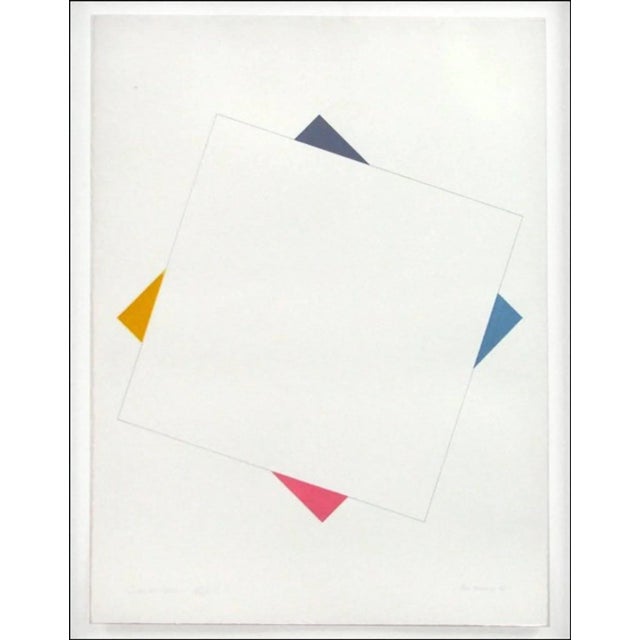
Allen was also a talented printmaker. He consistently made graphics alongside his painting and drawing. These works included Silk Screen Op art graphics back in the 60s, the “Ikonocross” series of black cross derived prints, brightly coloured silk screens and Geometric abstraction, and a small edition of "White Painting" Lithographs.
Offer Waterman is the gallery representing the estate of Richard Allen.
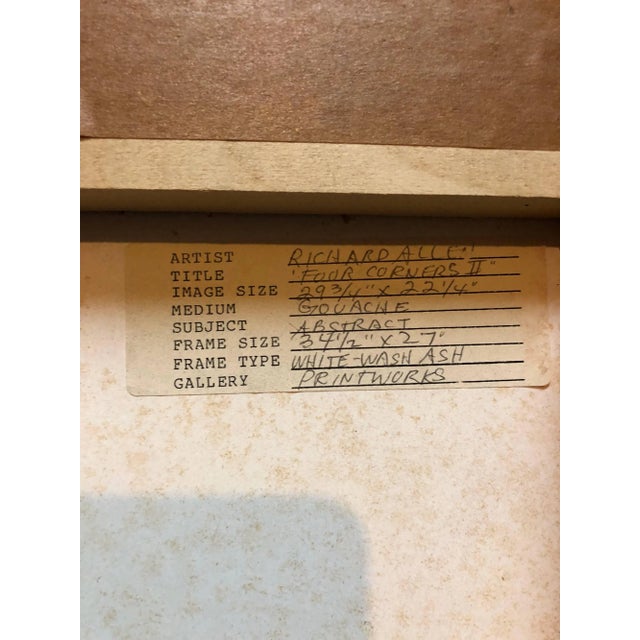
In all he held 21 solo exhibitions, including shows at the Institute of Contemporary Art, London (1975), Gallery Takagi Nogoya, in Japan (1982), Exeter University (1985) and the Printworks Gallery, Chicago (1998). His work has been widely exhibited and examples can be found in many leading collections, among them those of the Arts Council, of the British Council, the National Academy of Art, New Delhi and the Museums of Modern Art of Lodz, Skopje and Florida; and the universities of Hull and Aberystwyth.
See less
- Dimensions
- 27ʺW × 1ʺD × 34.5ʺH
- Styles
- Minimalist
- Frame Type
- Framed
- Art Subjects
- Patterns
- Period
- 1980s
- Item Type
- Vintage, Antique or Pre-owned
- Materials
- Gouache
- Paper
- Condition
- Good Condition, Unknown, Some Imperfections
- Color
- White
- Condition Notes
- Good frame has wear. Good frame has wear. less
Questions about the item?
Returns & Cancellations
Return Policy - All sales are final 48 hours after delivery, unless otherwise specified in the description of the product.
Cancellation Policy - Prior to shipping or local pickup, buyers may cancel an order for up to 48 hours, unless otherwise specified.
Related Collections
- Photorealism Paintings in New York
- Photorealism Canvas Paintings
- George Coggeshall Paintings
- Karen Offutt Paintings
- Richard Serra Paintings
- Donald Judd Paintings
- Ralph Lauren Paintings
- Laddie John Dill Paintings
- Joseph Solman Paintings
- René Magritte Paintings
- Jeff Slemmons Paintings
- BandB Italia Paintings
- Camille Pissarro Paintings
- Etruscan Revival Paintings
- Black Photorealism Paintings
- Keith Haring Paintings
- Photorealism Paintings in Los Angeles
- Ed Ruscha Paintings
- William IV Paintings
- FM Mobler Paintings
- Vienna Secession Paintings
- Paintings in Panama City, FL
- Lowell Nesbitt Paintings
- Louis Wolchonok Paintings
- Jean Calogero Paintings