



Details
Description
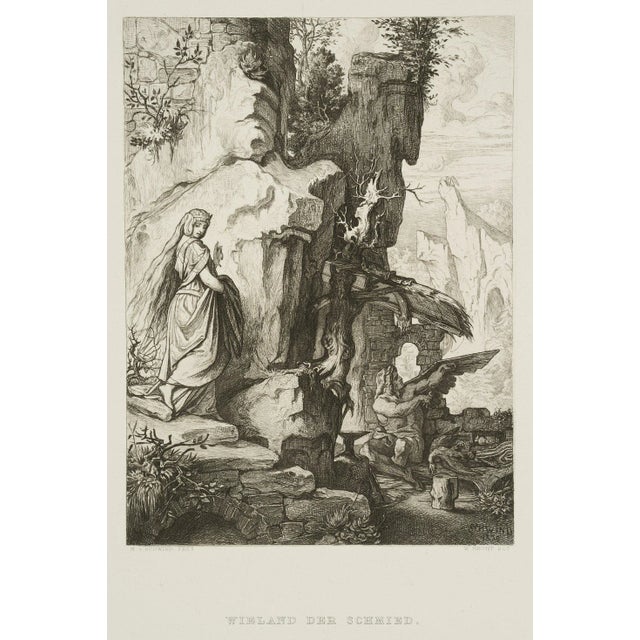
Wilhelm hecht (1843 ansbach - 1920 linz/danube) after moritz von schwind (1804 vienna - 1871 munich): wieland the smith, 1850, … Read more Wilhelm hecht (1843 ansbach - 1920 linz/danube) after moritz von schwind (1804 vienna - 1871 munich): wieland the smith, 1850, etchingtechnique: etching and copper engraving on china paper, rolled-on on paperinscription: at the lower part signed in the printing plate: "m. V. Schwind fect / w. Hecht sct.". inscribed in the plate at lower left: "m. V. Schwind fect.", signed in the plate at lower right: "w. Hecht sct.", inscribed at lower right: "wieland der schmied.".date: 1850description: few artists of the 19th century indulged in bizarre fabrications as devotedly as moritz von schwind. His pictorial worlds populated by fairy-tale creatures indulge in grotesquely heightened embellishment that stops at neither the staff nor the surroundings. His rbezahl is an apt example: the cranky hermit with his lance-beard and huge hercules club roams in his clogs through an enchanted forest in which every tree has as much character as rbezahl himself. The gnarlier and more intricate, the better. this absorption in the jumble of lines, which condense into ever more complex structures, can also be found in the other two prints shown here, and it is to wilhelm hecht's great credit that he has understood precisely this way of narrating with each individual line. In wieland der schmied (wieland the blacksmith) we find it in the rocks, and in sankt wolfgangs kirchenbau (st. Wolfgang's church) it is the lush foliage and the individual branches that, in their dynamism, become independent personalities. but it is precisely such a sheet that shows schwind's great talent for trenchant depiction. The devil struggling and panting, sticking his tongue out at the viewer, is congenially contrasted with the saint, who, at peace, holds the trowel at the ready and has almost become a building decoration himself. The same applies to rbezahl, who in his quirky wanderings reveals so much carefree abandon, which schwind illustrates with small details such as the socks that have slipped down or the bones in his trouser pocket. all three of schwind's paintings, after which wilhelm hecht created the present prints, were acquired by adolf friedrich graf von schack for his collection. Rbezahl and st. Wolfgang belonged to a group of 25 paintings that he was able to buy directly from the artist in 1869. Schwind called them travel pictures and created them without a commissioner for a private occasion. This may also explain the unconventional appearance of these pictures. Here he was able to abandon himself entirely to his lust for the fantastic and indulge in whimsical forms and pictorial worlds.keywords: 19th century, romanticism, mythology, germany, size: 32,2 cm x 26,1 cm (12,7 x 10,3 in), plate: 27,5 cm x 19,8 cm (10,8 x 7,8 in), depiction: 18,6 cm x 13,7 cm (7,3 x 5,4 in)condition: very good condition. Age-appropriate. See less
- Dimensions
- 10.24ʺD × 12.6ʺH
- Art Subjects
- Figure
- Period
- 19th Century
- Item Type
- Vintage, Antique or Pre-owned
- Materials
- Copper
- Paper
- Condition
- Good Condition, Unknown, Some Imperfections
- Color
- Condition Notes
- Very Good — This vintage item has no defects, but it may show slight traces of use. Very Good — This vintage item has no defects, but it may show slight traces of use. less
Returns & Cancellations
Return Policy - All sales are final 48 hours after delivery, unless otherwise specified in the description of the product.
Cancellation Policy - Prior to shipping or local pickup, buyers may cancel an order for up to 48 hours, unless otherwise specified.
Related Collections
- Patrick Nagel Reproduction Prints
- Reproduction Prints in Panama City, FL
- William Hogarth Reproduction Prints
- Hable Reproduction Prints
- Jute Reproduction Prints
- Reproduction Prints in Mobile
- Sam Francis Reproduction Prints
- Leather Reproduction Prints
- Reproduction Prints in Boise
- Alvar Aalto Reproduction Prints
- Daylight Dream Editions Reproduction Prints
- Port 68 Reproduction Prints
- Polychrome Reproduction Prints
- Dorothy Draper Reproduction Prints
- Restoration Hardware Reproduction Prints
- Lauren Ralph Lauren Reproduction Prints
- Ralph Lauren Home Reproduction Prints
- Serena and Lily Reproduction Prints
- Tuscan Reproduction Prints
- Bunny Williams Home Reproduction Prints
- Ralph Lauren Reproduction Prints
- Sister Parish Reproduction Prints
- Jonathan Adler Reproduction Prints
- Utagawa Kunisada (Toyokuni Iii) Reproduction Prints
- Gold-Plate Reproduction Prints