

Details
Description
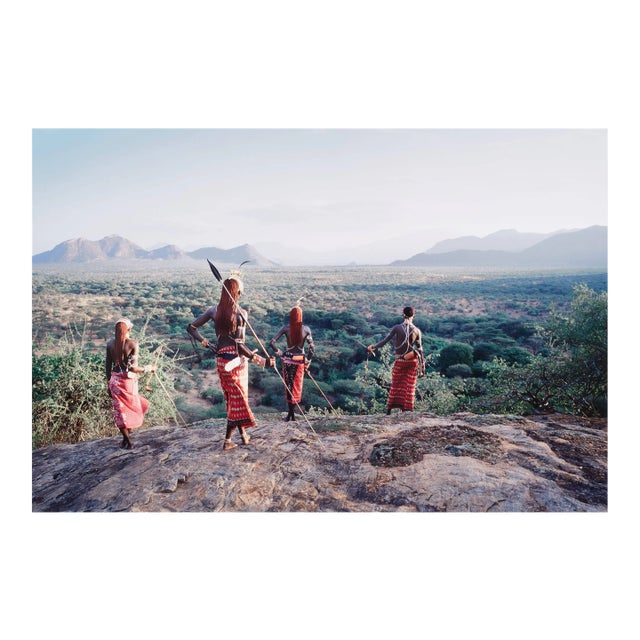
Jimmy Nelson Nyerere, Loingo, Lewangum & Lepokodou Kaisut Desert, Kenya Chromogenic print on dibond. 80 x 120 cm (107.5 x … Read more Jimmy Nelson Nyerere, Loingo, Lewangum & Lepokodou Kaisut Desert, Kenya Chromogenic print on dibond. 80 x 120 cm (107.5 x 147 cm). Signed in felt tip pen as well as detailed notes on the subject and on the edition on an artist's label affixed to the reverse of the mount. Edition 3/6 Framed. Accompanied by photographer's certificate, dated 18.09.2015 Literature: Jimmy Nelson, Before they pass away, Kempen 2013, ill. pp. 218 Jimmy Nelson (Sevenoaks, Kent, 1967) started working as a photographer in 1987. Having spent 10 years at a Jesuit boarding school in the North of England, he set off on his own to traverse the length of Tibet on foot. The journey lasted a year and upon his return his unique visual diary, featuring revealing images of a previously inaccessible Tibet, was published to wide international acclaim. Soon after, he was commissioned to cover a variety of culturally newsworthy themes, ranging from the Russian involvement in Afghanistan and the ongoing strife between India and Pakistan in Kashmir to the beginning of the war in former Yugoslavia. In early 1994 he and his Dutch wife produced Literary Portraits of China, a 30 month project that brought them to all the hidden corners of the newly opening People’s Republic. Upon its completion the images were exhibited in the People’s Palace on Tiananmen Square, Beijing, and then followed by a worldwide tour. From 1997 onwards Jimmy began to successfully undertake commercial advertising assignments for many of the world’s leading brands. At the same time he started accumulating images of remote and unique cultures photographed with a traditional 50-year-old plate camera and awards followed . International exhibitions and acclaim created the subsequent momentum and enthusiasm for the initiation of Before they Pass Away in 2010. Between 2010 & 2013 Jimmy Nelson travelled the world to document some of the most fantastic indigenous cultures left on the planet today. He had come to realize that from a life spent travelling that his camera was the perfect tool for making contact and building intimate and unique friendships. Relationships with hither to unknown and understood communities in some of the farther most reaches of the planet. He wanted to discover how the rest of the world is threatening to change their way of life forever. But most importantly, he wanted to create an ambitious aesthetic photographic document that would stand the test of time. Jimmy’s projects title ‘Before they pass away’ is intended to be a controversial catalyst for further discussion as to the authenticity of these fragile disappearing cultures. Jimmy Nelson s not a studied scientist but rather an self trained and visual anthropologist who through curiosity is trying to find answers. He wants to tell stories that leave room for the recipient’s questions. With the project Jimmy Nelson tried next to creating a photographic document, creating an awareness for the fascinating variety of the cultureand history charged symbols of the people, reflecting their rites, customs and traditions, that had hitherto has not existed. These fragile disappearing cultures. Jimmy Nelson is not a studied scientist but rather an self trained ethnologist and visual anthropologist who through curiosity is trying to find answers. He wants to tell stories that leave room for the recipient’s questions. With the project Jimmy Nelson wanted to create an awareness for the fascinating variety of the culture- and history charged symbols of the people, reflecting their rites, customs and traditions, that had hitherto has not existed. He asks us, will we as a species sever the fragile umbilical cord to our extraordinary primeval past? Thus potentially finding ourselves alone without a cultural purpose. Or will we make a different choice. It is his hope that we can all gather around the digital fireplace of humanity and continue for generations to tell the stories. Of what it means to be alive on a planet that has survived the 21st Century. Margeret Mead a great social anthropologist once said. Having been born into a polychromatic world of cultural diversity. It is her fear that our grandchildren will awake into a monochromatic world not ever having known anything else. See less
- Dimensions
- 57.87ʺW × 0.39ʺD × 42.13ʺH
- Period
- Early 21st Century
- Item Type
- New
- Materials
- Ash
- Felt
- Condition
- Mint Condition, No Imperfections
- Color
- Condition Notes
- New — This is a new (unused) item of contemporary design. New — This is a new (unused) item of contemporary design. less
Returns & Cancellations
Return Policy - All sales are final 48 hours after delivery, unless otherwise specified in the description of the product.
Cancellation Policy - Prior to shipping or local pickup, buyers may cancel an order for up to 48 hours, unless otherwise specified.