

Details
Description
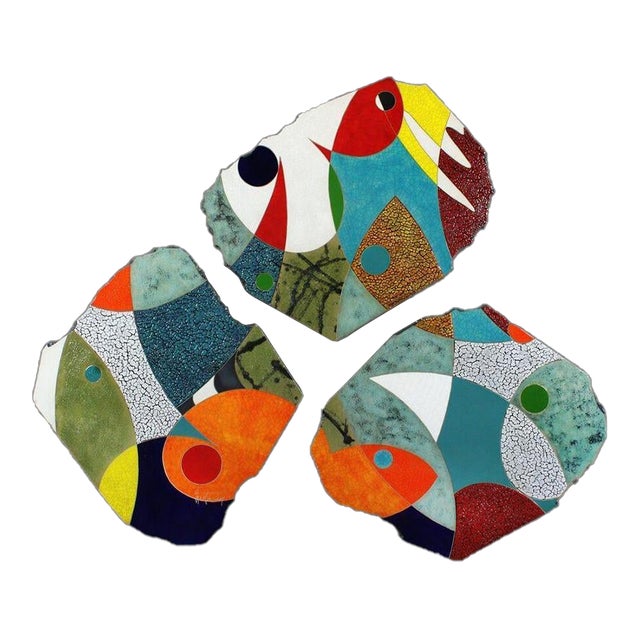
Three rounded, chipped slabs are alive with orange, red, yellow and teal, as if a sunny day had broken into …
Read more
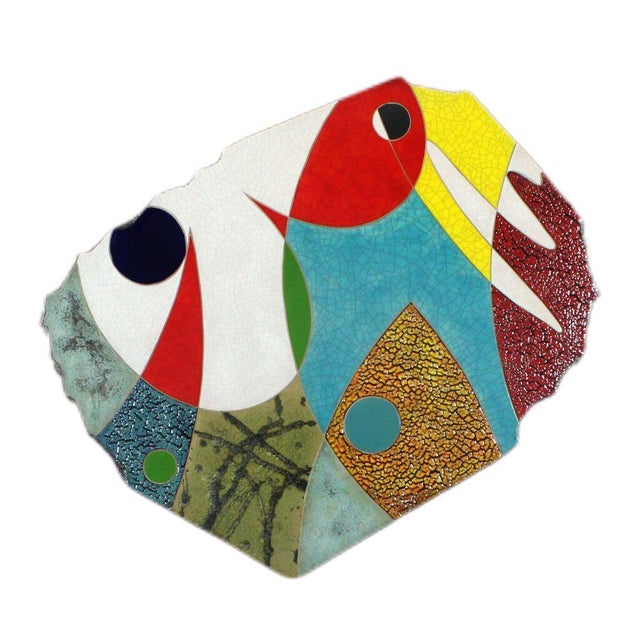
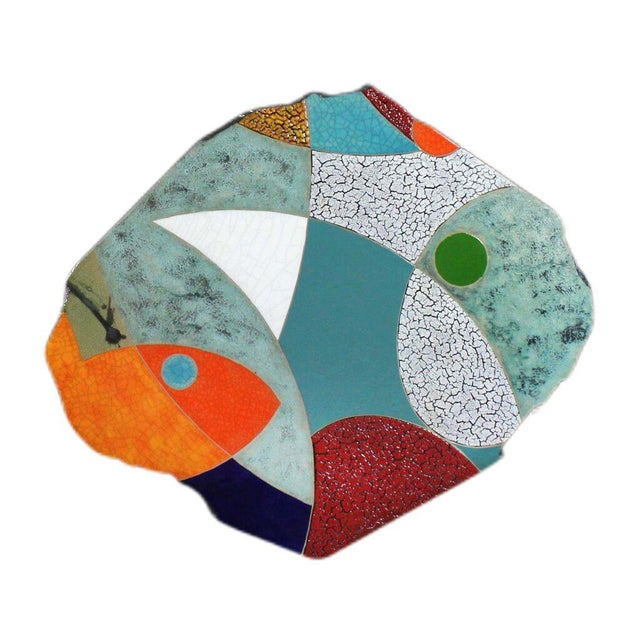
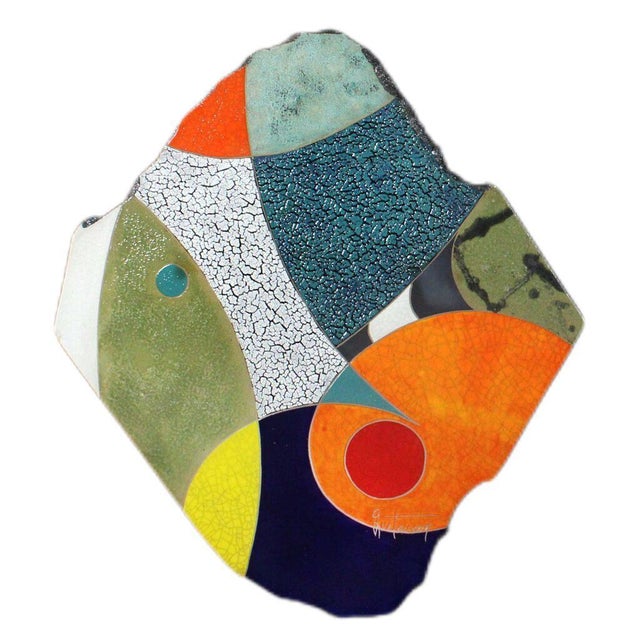
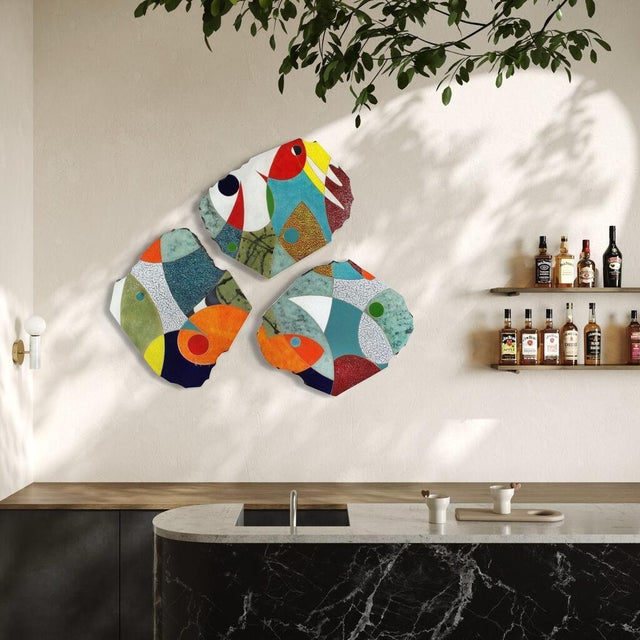
Three rounded, chipped slabs are alive with orange, red, yellow and teal, as if a sunny day had broken into pieces. In the top slab a white and scarlet shape with a black dot and a yellow wedge suggests a bird's head, while below, orange almonds and green circles swim across speckled teal, sage and olive grounds. Thin lines mark each plane, and the fine crackle in some patches glows like sunlit ice. Gustavson's wall pieces play positive shape against negative space, and the open gaps between these three slabs make a pattern of their own. Edges are rough and torn, which adds a handmade, organic character against the bright, hard-edged shapes.
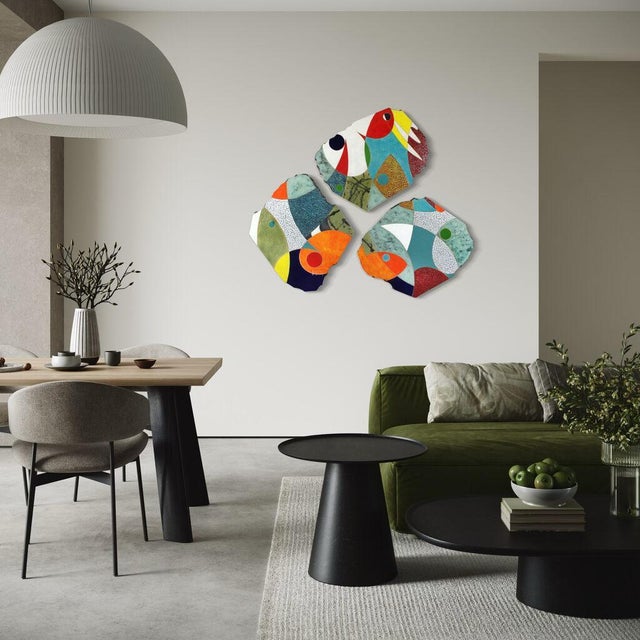
The bright palette lifts a kitchen, a breakfast nook or a dining room, especially beside warm wood, white plaster or a black stone counter. Teal and orange also work in a family room with olive or navy furnishings. Hung above a console or a banquette, the loose cluster has an informal rhythm that suits spaces where people gather.
Raku-fired glazed ceramic, 50 x 58 in (127.0 x 147.3 cm), three separate pieces, overall arrangement.
Gustavson's wall works are composed of fragmented slabs of clay, grouped as diptychs, triptychs or larger sets, so that the negative space between the pieces becomes part of the composition. The slabs are glazed like paintings and raku-fired, using the firing approach he has refined over decades, with pine needles introduced at lower temperatures to create reduction. Crackle, drips and drawn lines add depth to each torn-edged surface.
Michael Gustavson is a ceramic artist based in Murphys, California, who has worked in clay for more than four decades. He earned his MFA from San Jose State University in 1980 and describes himself as a painter-sculptor, treating each form as a three-dimensional canvas and glaze as his paint. His work is held in private and public collections worldwide, including IBM, Kaiser Permanente, Seagate, Cranbrook Museum and Eastman Kodak.
Building on the traditional Japanese process of raku, he developed his own firing approach, leaving large pieces in the kiln and introducing pine needles at lower temperatures to create reduction. The method allows larger scale and unusually vivid color. His wheel-thrown, hand-stretched vessels suggest the figure in motion, his wall reliefs use fragmented slabs and negative space, and recent outdoor sculptures and benches carry his surfaces into tectonic forms, with nods to Miró, Kandinsky, Mondrian and Pollock.
See less
Questions about the item?
Returns & Cancellations
Return Policy - All sales are final 48 hours after delivery, unless otherwise specified in the description of the product.
Cancellation Policy - Prior to shipping or local pickup, buyers may cancel an order for up to 48 hours, unless otherwise specified.
Related Collections
- Fernando Botero Sculpture
- Straw Sculpture
- Roman Bronze Works Sculpture
- Maison Jansen Sculpture
- Constantin Brancusi Sculpture
- Barovier and Toso Sculpture
- Far Pavilions Sculpture
- Georgian Sculpture
- Jute Sculpture
- Blenko Sculpture
- Satinwood Sculpture
- Bakelite Sculpture
- Emmanuel Villanis Sculpture
- Feliciano Béjar Sculpture
- Medium-Density Fibreboard Sculpture
- Sculpture in Panama City, FL
- René Lalique Sculpture
- Gourd Sculpture
- Photography Sculpture
- Gold-Plate Sculpture
- Sculpture in Columbus
- Recycled/Repurposed Sculpture
- Waylande Gregory Sculpture
- Flavio Poli Sculpture
- Antique Iron Finish Sculpture