

Details
Description
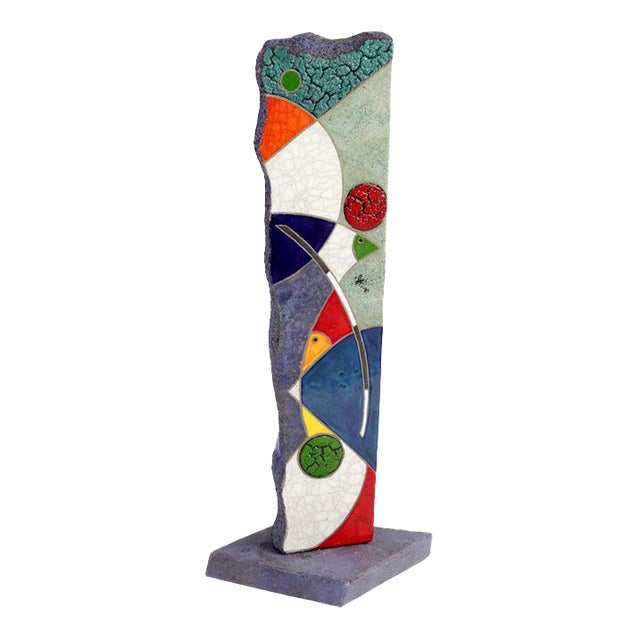
The slab-like form stands on a slate-lilac base, its irregular top edge torn and uneven like a broken stone. The …
Read more
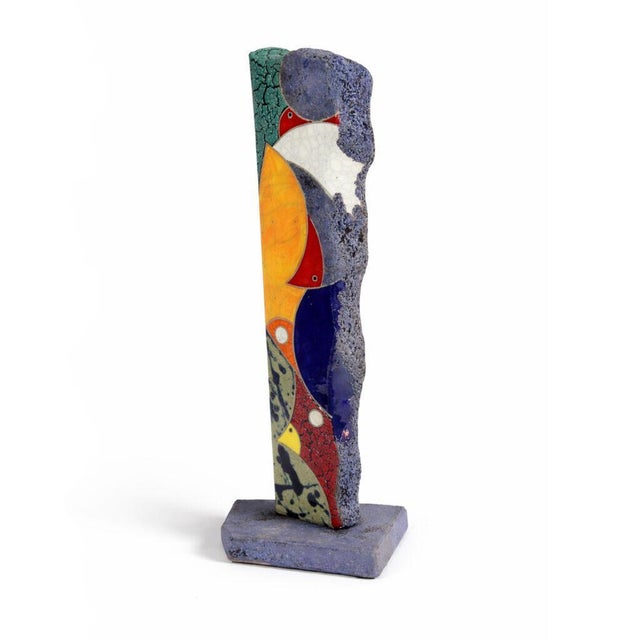
The slab-like form stands on a slate-lilac base, its irregular top edge torn and uneven like a broken stone. The front is a patchwork of white crackle, orange and sunflower yellow, with navy half-circles, a crimson dot and a sage-green cap that is itself finely crazed. A thin line of cream cuts an arc across the middle like a pencil mark. Gustavson looks for surfaces that invite touch, and the contrast of high gloss, matte passages and fine crackle here makes the piece as pleasing to the hand as to the eye. The back carries warmer oranges and deep blue, so the colors change as you circle it.
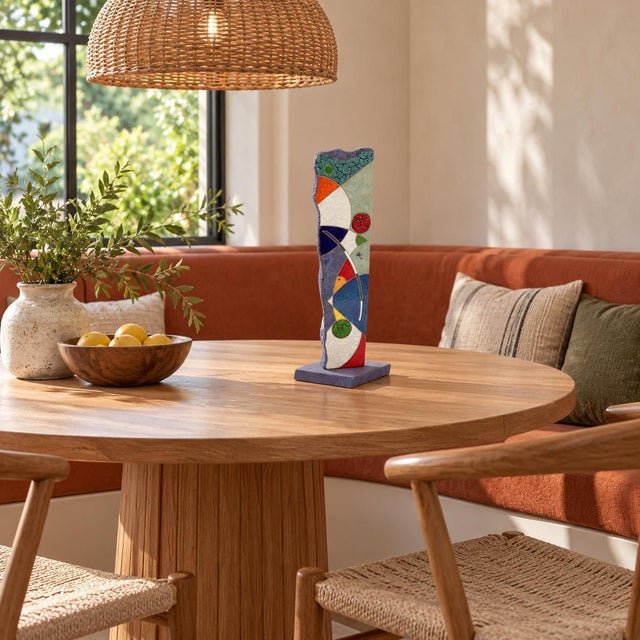
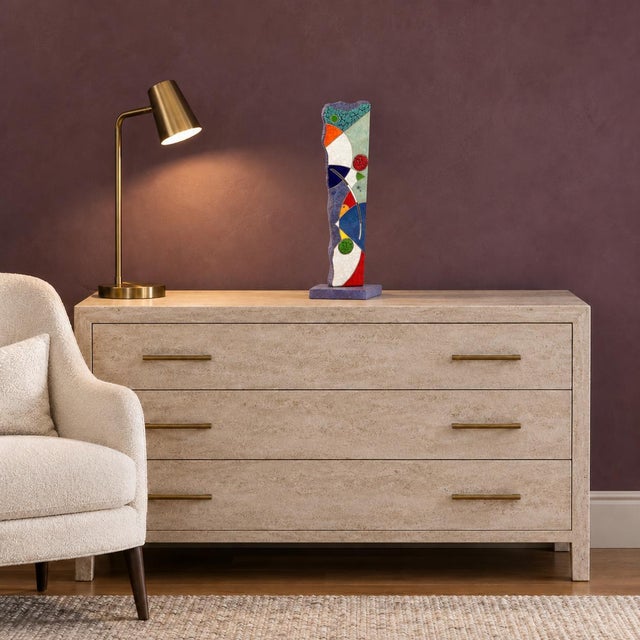
Compact and bold, it suits a shelf, a console or a side table, where its rough crown and bright patchwork catch the eye. Cool lilac and navy go with gray-blue walls and linen, while the orange pairs well with walnut, leather and cream upholstery. It is also a good counterpoint to smooth, simple vases and ceramics in a neutral room.
Glazed ceramic, 8 x 18.5 x 6 in (20.3 x 47.0 x 15.2 cm).
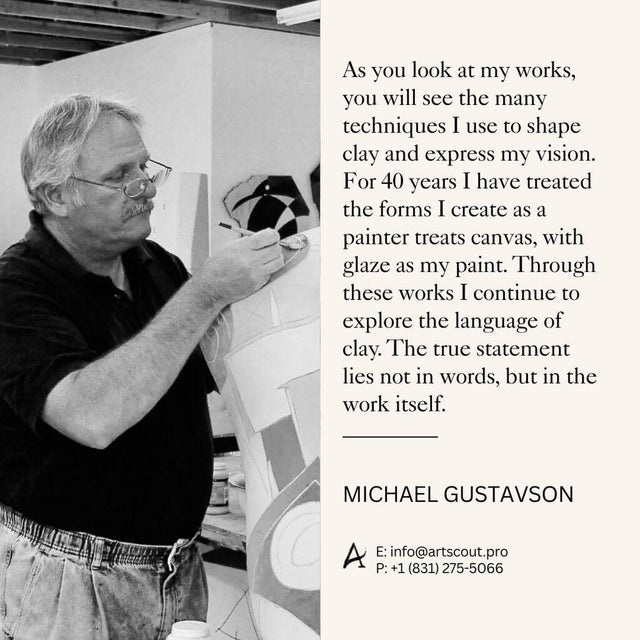
Gustavson approaches clay as a painter-sculptor, using glaze as his paint. Surfaces are built from layers of glaze, texture and color, with crackle, controlled drips and thin drawn lines, then fired to a rich, glossy finish. His firing approach grew out of raku during more than four decades of practice. His vessels are wheel-thrown and stretched by hand, and the same painterly method extends to towers, benches and tall columns.
Michael Gustavson is a ceramic artist based in Murphys, California, who has worked in clay for more than four decades. He earned his MFA from San Jose State University in 1980 and describes himself as a painter-sculptor, treating each form as a three-dimensional canvas and glaze as his paint. His work is held in private and public collections worldwide, including IBM, Kaiser Permanente, Seagate, Cranbrook Museum and Eastman Kodak.
Building on the traditional Japanese process of raku, he developed his own firing approach, leaving large pieces in the kiln and introducing pine needles at lower temperatures to create reduction. The method allows larger scale and unusually vivid color. His wheel-thrown, hand-stretched vessels suggest the figure in motion, his wall reliefs use fragmented slabs and negative space, and recent outdoor sculptures and benches carry his surfaces into tectonic forms, with nods to Miró, Kandinsky, Mondrian and Pollock.
See less
Questions about the item?
Returns & Cancellations
Return Policy - All sales are final 48 hours after delivery, unless otherwise specified in the description of the product.
Cancellation Policy - Prior to shipping or local pickup, buyers may cancel an order for up to 48 hours, unless otherwise specified.
Related Collections
- Fernando Botero Sculpture
- Straw Sculpture
- Roman Bronze Works Sculpture
- Maison Jansen Sculpture
- Constantin Brancusi Sculpture
- Barovier and Toso Sculpture
- Georgian Sculpture
- Far Pavilions Sculpture
- Jute Sculpture
- Blenko Sculpture
- Satinwood Sculpture
- Bakelite Sculpture
- Emmanuel Villanis Sculpture
- Feliciano Béjar Sculpture
- Medium-Density Fibreboard Sculpture
- Sculpture in Panama City, FL
- Gourd Sculpture
- René Lalique Sculpture
- Sculpture in Columbus
- Photography Sculpture
- Gold-Plate Sculpture
- Recycled/Repurposed Sculpture
- Waylande Gregory Sculpture
- Flavio Poli Sculpture
- Polished Brass Finish Sculpture