

Details
Description
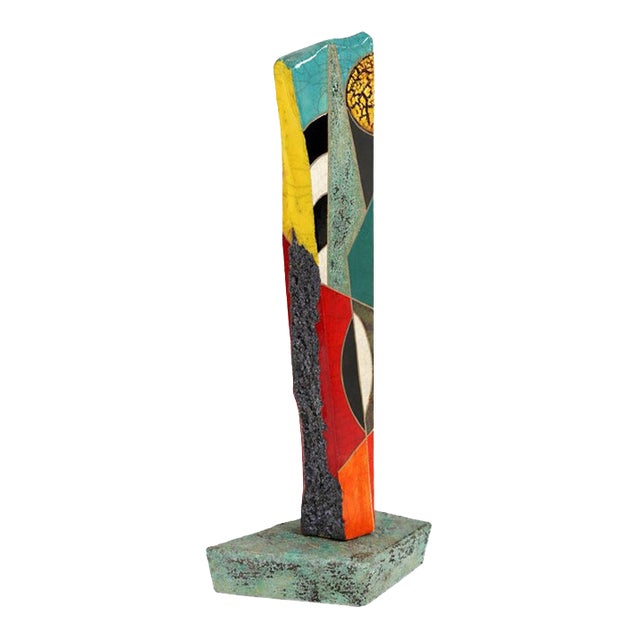
A tall, narrow column of mottled color stands on a rough verdigris-green base, its upper face opening with a gold …
Read more
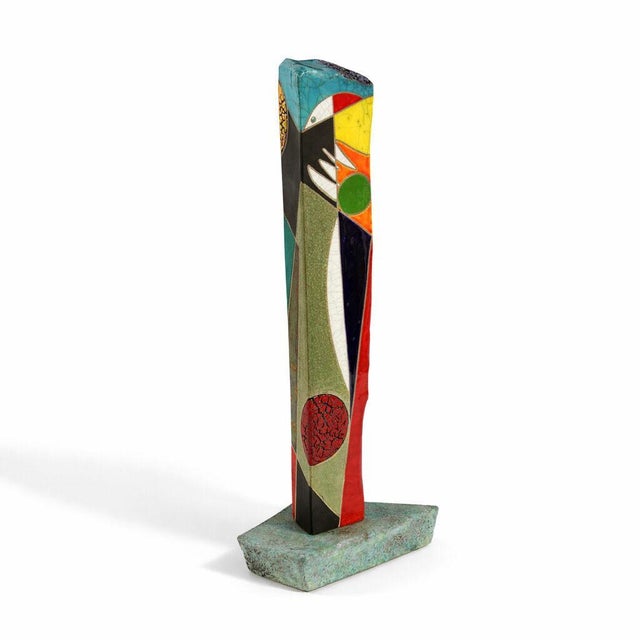
A tall, narrow column of mottled color stands on a rough verdigris-green base, its upper face opening with a gold circle and ribbons of yellow, teal and black. Lower down, orange and red planes meet at hard angles, and a streak of dark crackle runs along one edge. The top is cut unevenly, so the form feels hand-shaped rather than machined. Gustavson works glaze as his paint, and he has cited Mondrian, Kandinsky and Miró among his influences, which shows in the way geometric blocks and loose curves share each side of the form. The reverse softens into teal and green, a quieter counterpart to the busy front.
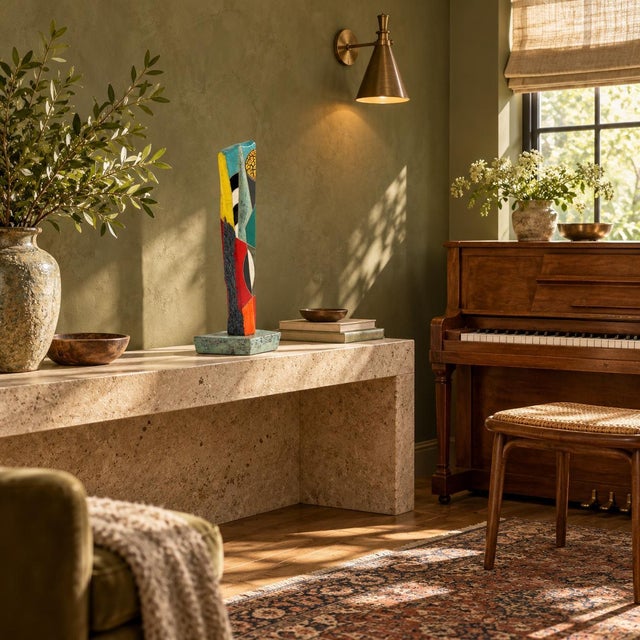
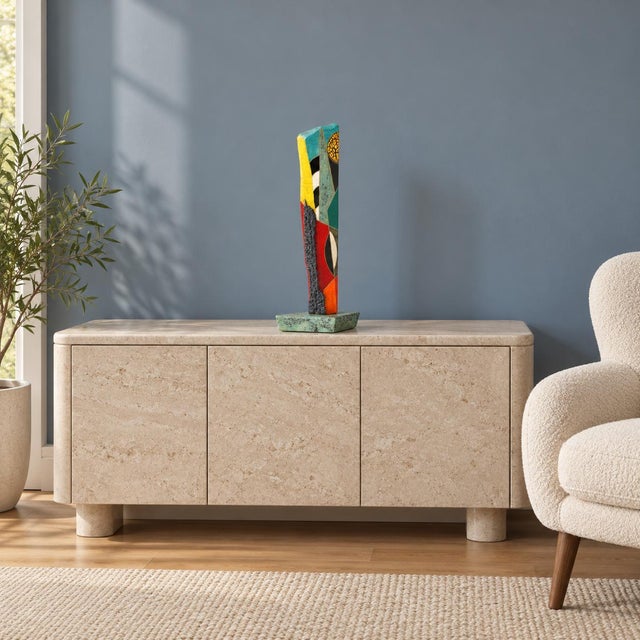
Slim enough for a bookshelf, mantel or windowsill ledge, it adds a vertical note to arrangements of lower objects. The green base and teal accents suit sage walls, natural wood and woven textures, while the orange and red work with warm neutrals and brick. Placed alone on a pedestal or side table, it takes on a quietly sculptural presence.
Glazed ceramic, 8 x 21 x 5 in (20.3 x 53.3 x 12.7 cm).
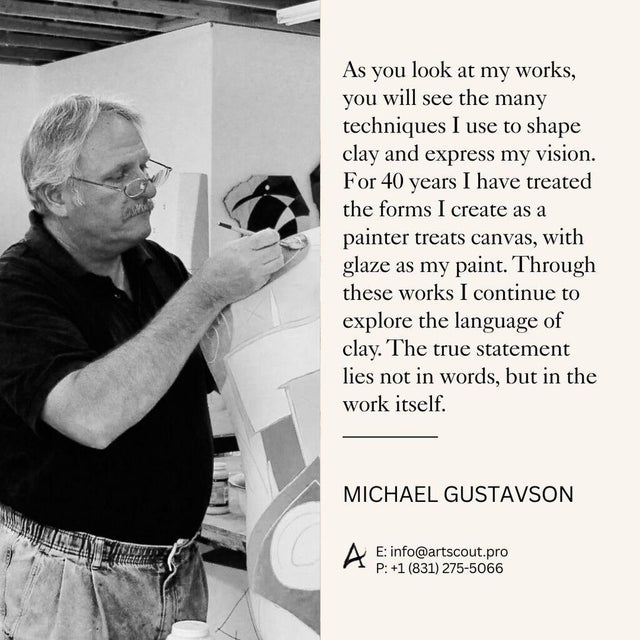
Gustavson approaches clay as a painter-sculptor, using glaze as his paint. Surfaces are built from layers of glaze, texture and color, with crackle, controlled drips and thin drawn lines, then fired to a rich, glossy finish. His firing approach grew out of raku during more than four decades of practice. His vessels are wheel-thrown and stretched by hand, and the same painterly method extends to towers, benches and tall columns.
Michael Gustavson is a ceramic artist based in Murphys, California, who has worked in clay for more than four decades. He earned his MFA from San Jose State University in 1980 and describes himself as a painter-sculptor, treating each form as a three-dimensional canvas and glaze as his paint. His work is held in private and public collections worldwide, including IBM, Kaiser Permanente, Seagate, Cranbrook Museum and Eastman Kodak.
Building on the traditional Japanese process of raku, he developed his own firing approach, leaving large pieces in the kiln and introducing pine needles at lower temperatures to create reduction. The method allows larger scale and unusually vivid color. His wheel-thrown, hand-stretched vessels suggest the figure in motion, his wall reliefs use fragmented slabs and negative space, and recent outdoor sculptures and benches carry his surfaces into tectonic forms, with nods to Miró, Kandinsky, Mondrian and Pollock.
See less
Questions about the item?
Returns & Cancellations
Return Policy - All sales are final 48 hours after delivery, unless otherwise specified in the description of the product.
Cancellation Policy - Prior to shipping or local pickup, buyers may cancel an order for up to 48 hours, unless otherwise specified.
Related Collections
- Fernando Botero Sculpture
- Straw Sculpture
- Maison Jansen Sculpture
- Roman Bronze Works Sculpture
- Constantin Brancusi Sculpture
- Barovier and Toso Sculpture
- Far Pavilions Sculpture
- Georgian Sculpture
- Jute Sculpture
- Blenko Sculpture
- Satinwood Sculpture
- Bakelite Sculpture
- Feliciano Béjar Sculpture
- Medium-Density Fibreboard Sculpture
- Emmanuel Villanis Sculpture
- Sculpture in Panama City, FL
- Gourd Sculpture
- Sculpture in Columbus
- Recycled/Repurposed Sculpture
- Photography Sculpture
- Gold-Plate Sculpture
- René Lalique Sculpture
- Flavio Poli Sculpture
- Polished Brass Finish Sculpture
- Waylande Gregory Sculpture